A collection of links to music, images and videos that relate art and science. Today: Black holes in Circinus; the disintegration of comet LINEAR; a fantastic image of Paranal; music by Adam Castillo; an animation of Pale Blue Dot (subtitled); and photography links to leave you speechless.

Images of the decade
Chandra Examines Black Holes
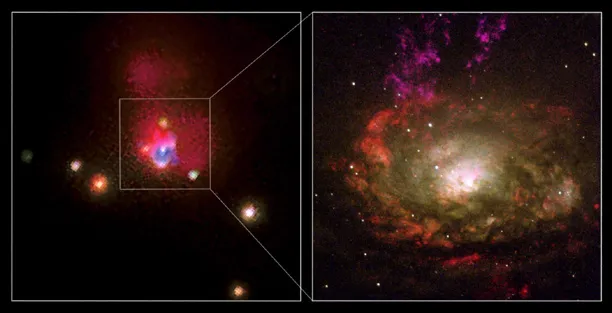
This X-ray image from Chandra shows the inner portion of the Circinus Galaxy or Circinus Galaxy. In X-ray terms, red represents low energies, green, intermediate and blue the highest. A bright and compact source is present at the center of the image. Astronomers from Penn State University used Chandra to discover a variable object within a dozen X-ray emitting sources scattered across the Galaxy. The X-ray intensity of this source changes in cycles of 7.5 hours and was the first time that periodic variability has been detected in X-ray wavelengths in an object outside the Local Group of galaxies. The evidence suggests the system contains a black hole about 50 times more massive than the Sun.
The same object, seen in optical wavelengths.
Credit: NASA/Penn State/F. Bauer et al.; Optical: NASA/A.Wilson et al.
The images were published on May 14, 2001 by the Chandra Observatory.
The missing pieces of a comet
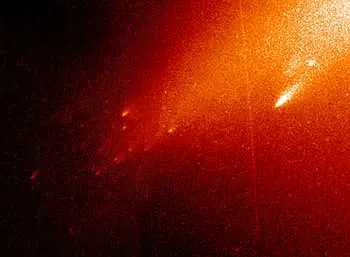
When astronomers analyzed the debris of a comet that had come apart they found pieces as small as smoke particles and as large as football stadiums. But what amazed them were the pieces they did not detect.
The doomed comet, called C/1999 S4 and nicknamed LINEAR (for the Lincoln Near Earth Asteroid Research, the observatory that first detected it), disintegrated into many parts as it approached the Sun in July 2000. The event was followed by Hubble which detected the long tail (100,000 km long) and 16 large fragments. But the estimated mass of the debris did not match the estimates of the object's original mass (about 300 billion kg). The total mass of the measured fragments was 100 times less (3 billion kg).
Where is the missing mass? asked astronomer Hal Weaver of Johns Hopkins University.
Perhaps, the scientist suggested, most of the material is made up of very small pieces, between 2.5 millimeters and 50 meters that cannot be detected by visible light telescopes. The other question about the phenomenon was why the comet disintegrated as it approached the Sun. This disintegration was observed for the first time from Roque de los Muchachos by Mark Kidger and colleagues. At first it was thought that the disintegration was total, but then Hubble discovered an armada of "mini-comets".
The comet was at 114 million kilometers at its closest approach to the Sun, so it is thought that the disintegration was due more to the evaporation of material than to the tidal force produced by our star.
Credit: NASA and Hal Weaver (The Johns Hopkins University)
On HubbleSite on May 17, 2001, but the images were taken on August 5, 2000.
Images of the week
A galactic fountain of youth
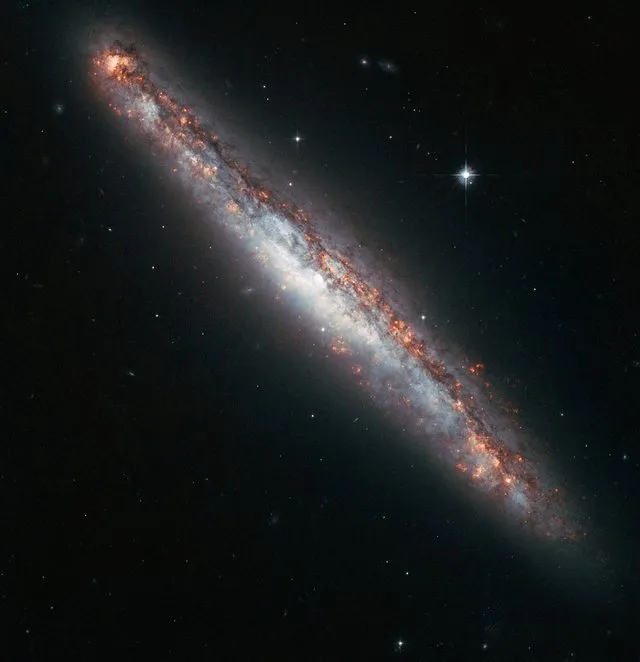
Hubble shows us this inclined galaxy (from our point of view) NGC 5775. This view is advantageous for astronomers. The high inclination of the spiral has allowed the study of the properties of the hot gas halo detectable in X-rays.
The galaxy is in the process of merging with its companion NGC 5774 and both are located in the Virgo Cluster about 85 million light-years away.
The color image was created with images taken with Hubble's Advanced Camera for Surveys. The images with a red filter were colored blue and those taken with a filter that isolates the glow of hydrogen gas (H-alpha) were colored red. The exposure times were 2292 and 6848 seconds, respectively (38 and 114 minutes).
The image was released on May 9, 2011 and a very large file can be accessed on the Hubble site.
Credit: ESA/Hubble & NASA
Eclipsed Moon, stunning night
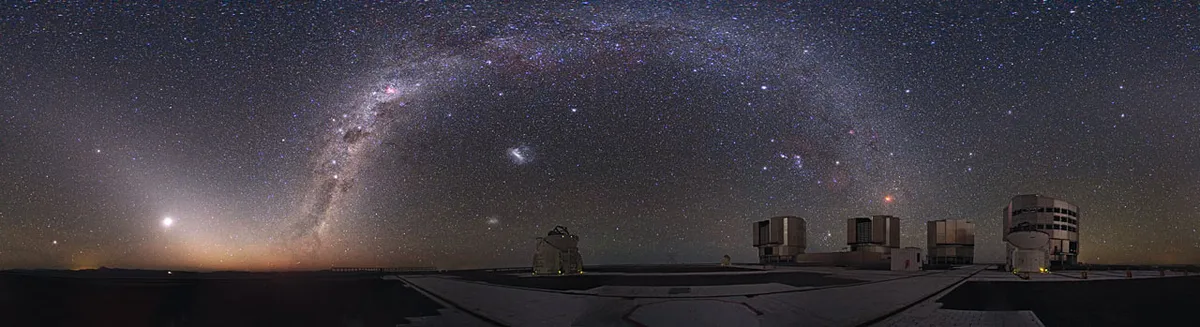
A total lunar eclipse is an impressive spectacle. But it also provides an observation opportunity, with a dark sky. At Cerro Paranal, in the Atacama Desert in Chile, the distance from light pollution sources allows access to an incredible night sky during such an eclipse.
This panoramic photo, taken by ESO Photo Ambassador Yuri Beletsky, shows the view of the starry sky from the VLT on Cerro Paranal during the eclipse of December 21 last year. The reddish lunar disk is seen on the right, while the Milky Way arches across the skies in all its beauty. Another faint glow is seen in the left corner, around Venus. This is the zodiacal light, a phenomenon produced by sunlight reflected off dust in the plane of the planets. It is so faint that it is normally not seen as it is covered by moonlight or light pollution.
During a total lunar eclipse, Earth's shadow hides the Moon, but it can still be visible and reddish because only light rays in the red part of the spectrum are able to reach the Moon after being redirected through Earth's atmosphere, while light rays in the blue and green part are scattered more strongly).
The image was released on May 9, 2011 and a large copy of the image can be obtained on the ESO page.
Credit: ESO/Y. Beletsky
Space Music
Today: The Nabis project, Adam Castillo
This is an album created this year based on a text by Sonia De Braco, idea by Adam Castillo.
The text is more of the fantasy type than science fiction and is available, but in English.
Another album related to space music, by the same artist, is Neptun, which also has a supporting text.
In commemoration of the 40th anniversary of the moon landing, Adam published Search on the Moon in 2009.
In addition to the music, the idea for the text and the cover art, Adam made some videos for his works:
List of videos by Adam Castillo
http://www.youtube.com/playlist?p=PL20B462A288734B2C
Adam Castillo's music is on Jamendo, which means it's free music, for us to download and enjoy, under a CC license.
Also, we can find Adam Castillo on Facebook.
Science in motion
Today: Pale Blue Dot, animation, subtitled
Video: Pale Blue Dot - Animation (Spanish)
http://www.youtube.com/watch?v=ob0HviW4i7Q
Narration: Excerpts from Cosmos, by Carl Sagan
Music: "You're So Cool" by Hans Zimmer
Design and Animation: Adam Winnik
Links of the week
- http://www.luisargerich.com/
A photographer from Buenos Aires, Argentina, whose main interest is landscapes through positive photography of natural scenes. - One of his photos was chosen as the Astronomy Picture of the Day on May 7, 2011: Dawn of the Planets.
- Luis also has a blog: The Amazing light
- To access previous editions of this section, see the Multimedia Selection Series.