A collection of links to music, images and videos relating art and science. Today: a photo of M's; Saturn, Music by Rauf Khalilov and video by Sean Carroll.

Images of the decade
A photo of M's
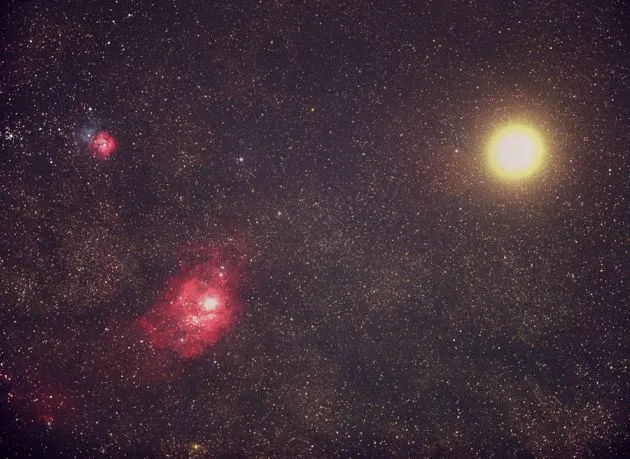
I invite the reader to guess what is shown in the image. Know that it is not an illustration, but a photograph.
The reddish parts look like nebulae. The yellow looks like a star. The Sun, perhaps. Do you think so?
They are M's, from Messier. Entry 20 of the famous catalog belongs to the Trifid Nebula (top left). Just below and a little to the right is the expansive M8, the Lagoon Nebula. Both, M8 and M20 are located about 4000 light-years away (approximately). They can be seen with binoculars from dark sites, pointing towards Sagittarius. There are other nebulae in the region, but these are the largest and brightest.
But further to the right and above what we have is something local, Mars. Passing through Sagittarius and strongly overexposed in this image, it lies about 4 light-minutes away and when the photo was taken it was near a closest approach to Earth.
It was the astronomy picture of the day (APOD) on June 15, 2001, a decade ago. Also on Observatorio.
Credit: Michael Cole
A change of seasons on Saturn
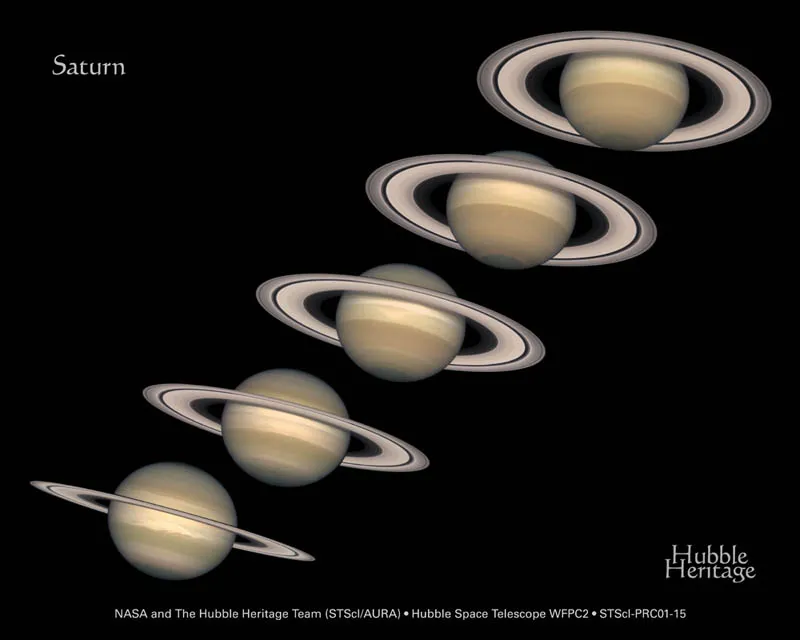
Like a flying saucer in the outer solar system, Saturn and its magnificent ring system orbits the Sun every 29 years. These images captured by Hubble between 1996 and 2000 show the gas giant tilted on its axis (27º), almost like Earth (23º), which is why it also has seasons.
The image combination was released by HubbleSite on June 7, 2001.
Along with the images, a video was released on that occasion, the same as the one now available on YouTube: Saturn, Earth, and Sun Sequence
Credits: NASA and The Hubble Heritage Team (STScI/AURA)
Acknowledgments: R.G. French (Wellesley College), J. Cuzzi (NASA/Ames), L. Dones (SwRI), J. Lissauer (NASA/Ames)
Images of the week
Hubble captures a celestial prologue
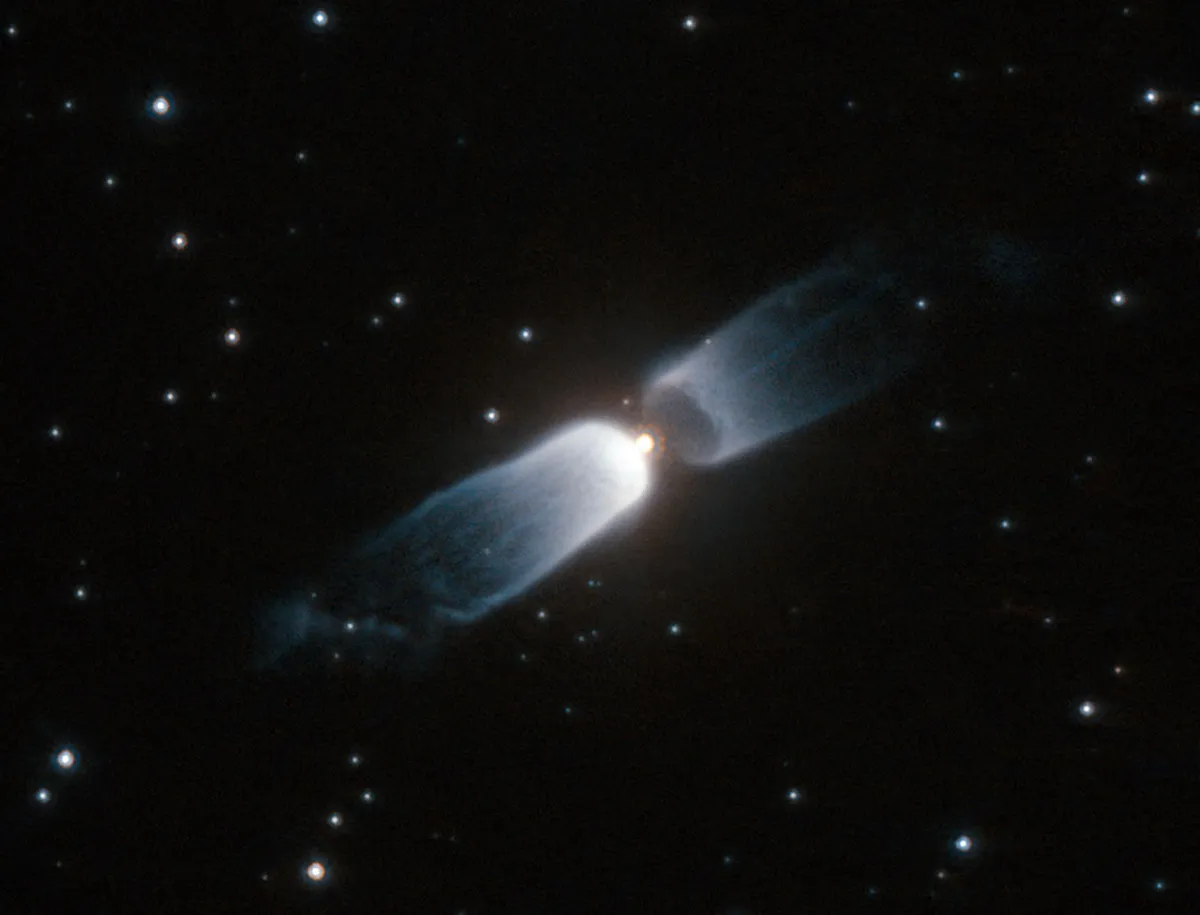
The two wavy structures in this photo from the NASA/ESA Hubble Space Telescope are formed by material scattered by the central star IRAS 13208-6020. It is a short-lived phenomenon that gives astronomers an opportunity to see the early stages of the formation of a planetary nebula. These objects are not related to planets, but they looked similar with the first low-resolution telescopes centuries ago.
Protoplanetary nebulae do not glow, but are illuminated by light from the central star that is reflected to us. But as the star continues its evolution it becomes hot enough to emit very strong ultraviolet radiation that ionizes the surroundings and will make the surrounding gas glow. Meanwhile, stellar winds will shape the gas into intricate patterns.
The image was created with the High Resolution Channel of Hubble's ACS camera. Images taken with an orange filter (in blue) and a near-infrared filter (in red) were combined with exposure times of 1130s and 150s respectively.
It was the Hubble Space Telescope image of the week.
Credit: NASA/ESA
A nearby supernova factory
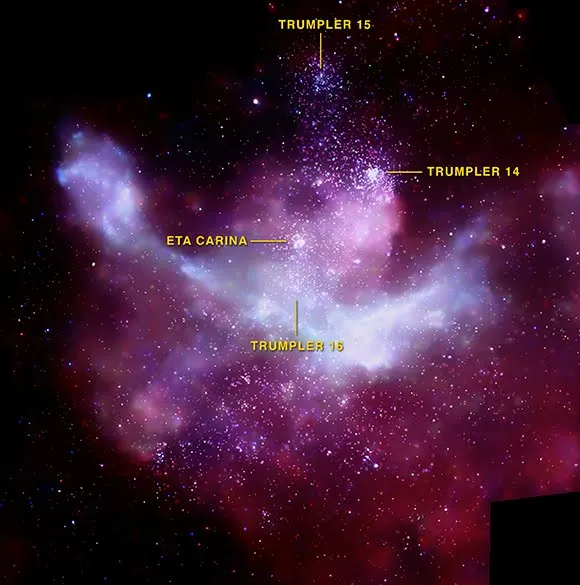
Stars are born in dense clouds of gas. It is a complex process, as the new stars interact strongly with their birth clouds. These regions are heated by the young massive stars, while winds create large bubbles. Finally, some massive stars will end their lives in supernova events, even as other stars continue to be born. The Carina Nebula, a relatively nearby star-forming cloud, provides an opportunity to see this process. The region is located in the Sagittarius-Carina arm of the Milky Way about 7,500 light-years away. The image is a new mosaic of the nebula in X-rays, taken by Chandra. The lower-energy rays in this image are in red, medium in green and the higher-energy in blue.
Astronomers think the supernova show in the region has already begun. An important piece is the deficit of bright X-ray sources in Trumpler 15, one of the ten star clusters in the Carina complex. That lack is thought to be because some of the massive stars in the cluster have been destroyed in supernovae.
The recent Chandra survey also reveals the possible presence of six neutron stars, the dense cores left by supernovae, whereas in previous observations only one such star had been detected in Carina.
The image was made public not this week, but on May 24 by Chandra. Also by HEASARC.
Credits: NASA/CXC/PSU/L.Townsley et al.
This other image was also released:
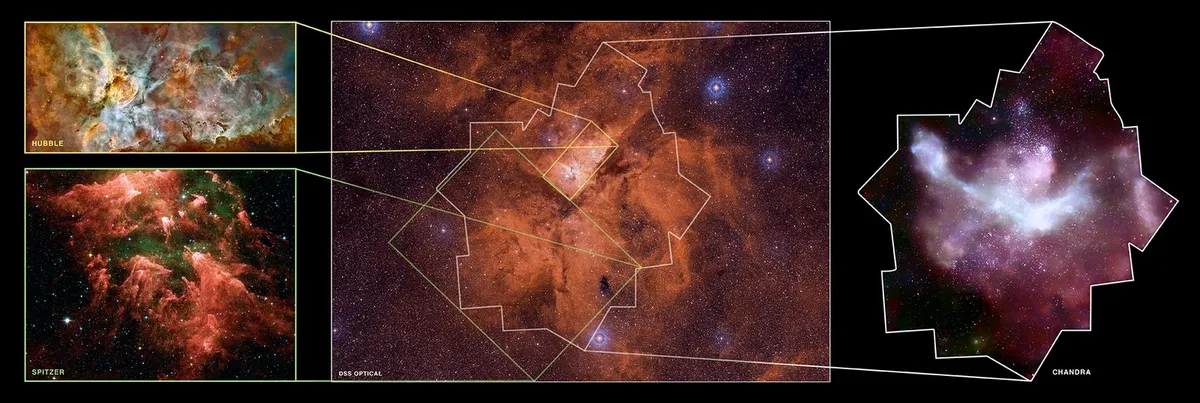
It is an optical image from DSS of the Carina Nebula with details of observations from NASA's three Great Observatories: Chandra, Hubble and Spitzer.
Credits: Optical: DSS/NASA/STScI; IR: NASA/JPL-Caltech; X-ray: NASA/CXC/PSU/L.Townsley et al.
Space Music
Rauf Khalilov
Out of milky way is one of the three compositions that Rauf Khalilov has on Jamendo.
It is a single, like When They Come For Me. Different is Monopolar World, an album of six short tracks, very interesting.
Khalilov was born in Baku, Azerbaijan, in 1981.
Science in motion
Sean Carroll: distant times and hints of a multiverse
At TEDxCaltech, cosmologist Sean Carroll, on a fun and stimulating walk through the nature of time and that of the Universe, tackles a deceptively simple question: why does time exist? The possible answers point towards a surprising view of the Universe and our place in it.
To access previous editions of this section, consult the Multimedia Selection Series.