Astronomical research of celestial bodies could have an impact on the study of the human body, especially in cancer treatments.
Astronomers from Ohio University are working with medical physicists and oncologists to develop a new radiation therapy that is harsher on tumors, but gentler on human tissues.
By studying how chemical elements emit and absorb radiation inside stars and around black holes, astronomers discovered that heavy elements, like iron, emit low-energy electrons when exposed to X-rays of specific energies.
Their finding provides the possibility of creating implants from heavy elements that could allow doctors to eliminate tumors with low-energy electrons, while exposing healthy tissue to the least possible radiation. This could also be used for imaging diagnostics.
At the International Symposium on Molecular Spectroscopy held at Ohio University this Friday the 24th, researcher Sultana Nahar announced her team's simulations of elements like gold and platinum and the design of a prototype device that generates X-rays at key frequencies.
Their simulations suggest that exposing an atom of gold or platinum with a dose of X-rays in a narrow range of frequencies produces a flow of more than 20 low-energy electrons.
"As astronomers we apply basic physics and chemistry to understand what happens in stars. We are excited to apply the same knowledge to a potential cancer treatment," said Nahar.
"We believe that nanoparticles embedded in tumors can efficiently absorb X-rays at particular frequencies, resulting in ejections of electrons that can kill the damaged cells," continued Sultana Nurun Nahar, a doctor in atomic theory originally from Bangladesh (or Bangladés), APS fellow, member of the astronomy department at Ohio University, affiliated with the IAU in commission 14.
Nahar and Anil Pradhan, an astronomy professor at Ohio, discovered that particular frequencies of X-rays cause electrons in atoms of heavy elements to vibrate and break free from their orbits around the nucleus, creating an electrically charged gas, or plasma, around atoms on the nanometric scale. That's why they nicknamed the medical concept Resonant Nano-Plasma Theranostics (RNPT). The last word is a fusion of treatment and diagnosis, something like Resonance Nano-Plasma Theranostics.
Physicists have long known that electrons orbit the nuclei of atoms at different distances, some closer and others farther from the nucleus. When an electron in an orbit close to the nucleus is lost, a more distant electron falls into that empty place, which releases energy. This "Auger effect" was discovered at the beginning of the last century, in the 1920s.
Usually the energy is enough to knock out a second electron, called an Auger electron. The same process could result in the emission of light particles (photons) at specific energies or frequencies, the main ones of which are called K-alpha X-rays.
Astronomers think that the frequencies of these X-rays remove electrons close to the nucleus of heavy elements like platinum, causing many more distant electrons to fall and many more to be ejected. These free Auger electrons are low-energy, but in large numbers, and could bombard damaged cells and break their DNA.
It could also be used in imaging diagnostics like computed tomography, which usually generates X-rays, but with the RNPT technique would reduce the patient's exposure to radiation.
The function of the created prototype device, which will need further development, is to test in these first experiments that the Auger effect can be used to deliver X-ray radiation of specific frequencies to nanoparticles of heavy elements embedded in dead tissue for diagnosis and therapy.
Gold and platinum are the first two elements the team is studying in detail to apply this methodology. Both metals are safe to use in the body, they assure, and platinum is already used in chemotherapy.
The astrophysical-medical application was made possible thanks to the collaboration of medical physicist Yan Yu from Thomas Jefferson University.
At the same time, Nahar and Pradhan hope to help astronomers determine with greater precision what our Sun and other stars are made of by studying stellar chemical abundance. They use the Ohio Supercomputer Center for this purpose to perform computational simulations. Back in 2006 I reproduced a news item about it here: Supercomputers to study atoms related to black holes.
They have also performed simulations of radiation absorption by atoms of heavy elements, like iron. This element plays a key role in controlling the flow of radiation in stars, but is also observed in some black hole environments, where K-alpha X-rays can be detected from Earth. Perhaps that's why Nahar is called "the Iron Lady" (1).
"That's when we realized the implications went beyond atomic astrophysics," commented Pradhan.
The usefulness of astrophysics
In this blog we began a while ago to pose an irritating question: What is astrophysics USEFUL for? To those who enjoy science in general and astronomy and physics in particular, the question may seem annoying, but it must be answerable with solid arguments. Otherwise we have a problem.
There are several ways to answer that question, but many times weak arguments or abstract approaches are used. Part of those arguments, the most general and perhaps the fundamental ones, linked to basic sciences, I have not presented here yet.
On the contrary, my intention is first to give an account of concrete examples of knowledge and technology transfer. It is an argument often wielded, but not so often exemplified.
In this case we have physicists who study, for example, the chemical abundances of stars for astronomical purposes linked, fundamentally, with the thirst for knowledge.
For that, there is necessarily an economic expenditure in the use of instruments and computing resources. That does NOT have a direct effect on people's quality of life.
However, with some serendipity involved, there are many examples, like this one, where a finding in one scientific discipline has implications in another that does have more direct contact with civic life.
Nevertheless, it must be considered that what is narrated here is something in development that surely will not have an immediate practical application.
If the reader can think of other examples of knowledge/technology transfer related to astronomy/astrophysics, please let me know.
Sources and related links
- Astronomers reach for the stars to discover new cancer therapy
- Monte Carlo Simulations and Atomic Calculations for Auger Processes in Biomedical Nanotheranostics
Maximiliano Montenegro, Sultana N. Nahar, Anil K. Pradhan, Ke Huang & Yan Yu
J. Phys. Chem. A, 2009, 113 (45), pp 12364–12369
DOI: 10.1021/jp905323y - Resonant X-ray Enhancement of the Auger Effect in High-Z Atoms, Molecules, and Nanoparticles: Potential Biomedical Applications
Nahar, Sultana N.; Luo, Yi; Le, Linh; Pradhan, A. K.; Chowdhury, E.; Pitzer, R.; Montenegro, M.
J. Phys. Chem. A, 2009, 113 (45), pp 12356–12363
DOI: 10.1021/jp904977z - Note 1: Dr. Sultana Nurun Nahar has been nicknamed "The Iron Lady", according to the 2004 issue of the magazine of the astronomy department of Ohio University (page 19). She is also nicknamed that way in the highlights of OSC 2009 (Ohio Supercomputer Center).
About the images
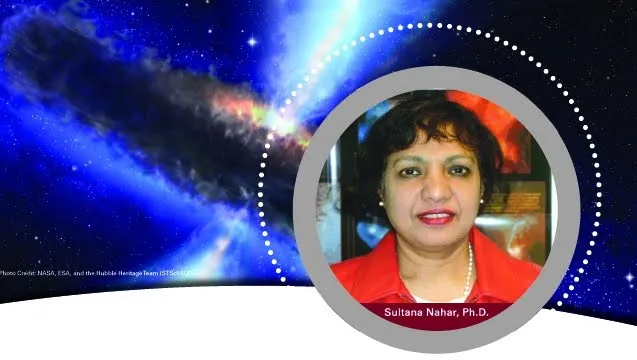
- Composite image of a photo of Sultana Nahar and a NASA/ESA image, from the OSC.