A collection of links to music, images and videos that relate art and science. Today: The Milky Way from Hawaii, M10 and M22, A spiral with double rotation and the great conjunction of the year. Music: A soundtrack from a Spanish short film, Huida a Venus. Video: What does it take to be a professional astronomer?

Images of the decade
Milky Aloha
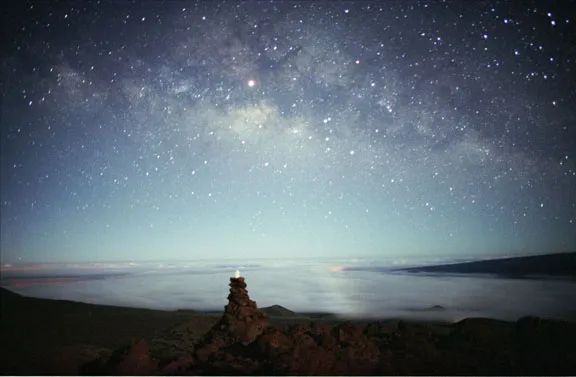
In this celestial landscape, a four-day-old Moon illuminates a dreamlike background, while the bright planet Mars takes over the sky. The image was taken from a location near the Mauna Kea Visitor Center, at 2900 meters above sea level.
The volcanic photograph shows clouds illuminated by moonlight and an "aku hoku", a star marker or altar for the stars – built of rocks, crowned with a white piece of coral glowing softly in the moonlight. Astrophotographer Barney Magrath comments that this splendid view of the sky represents a pleasure of photography in itself. While taking the exposure he did not realize that the aku hoku would become such a beautiful element in the composition.
It was the Astronomy Picture of the Day (APOD) of June 27, 2001. Also in Observatorio.
Credit: Barney Magrath
Stellar evolution in M10
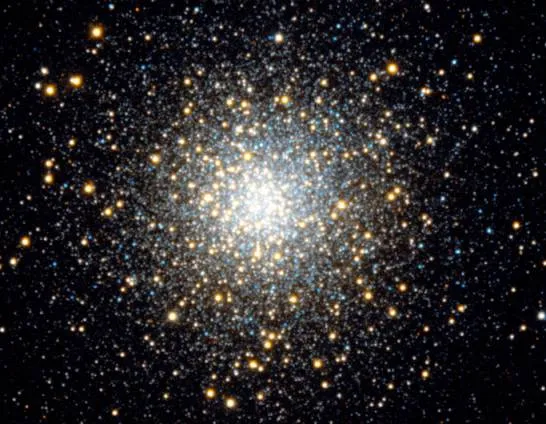
Stars like the Sun use hydrogen as fuel, converting it into helium through nuclear fusion in their cores. Towards the end of the life of these stars, they expand to become red giants. The orange stars in this composition of the old globular cluster M10 are examples of this phase of stellar evolution. At the same time we see bluish stars that are part of what is known as the "horizontal branch" of the giants, with cores so hot that they can convert helium into carbon.
Credit: Till Credner, Sven Kohle (Bonn University), Hoher List Observatory
It was the Astronomy Picture of the Day June 30, 2001. Also in Observatorio.
Microlenses in M22
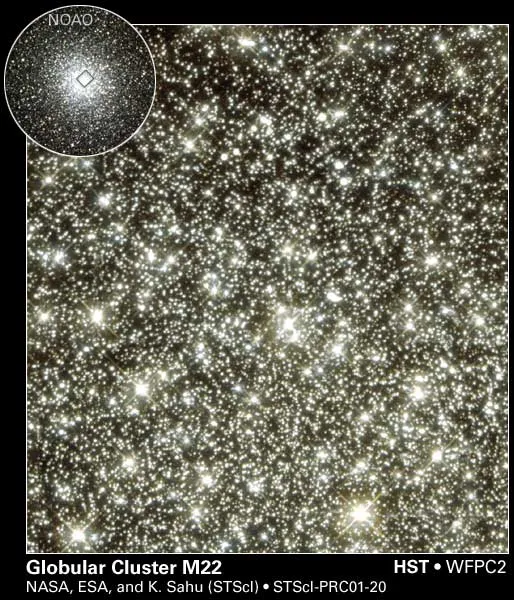
Kailash Sahu, of the Space Telescope Science Institute, reported in Nature six unusual microlensing events in the globular cluster M22.
Microlensing occurs when a background star momentarily increases in brightness, while a closer object transits in front of it. The unusual objects thought to cause these events are too distant and diffuse to be seen directly, but are detected by the way their gravitational field amplifies the light of a distant background star in the giant bulge of our galaxy. Microlensing has been used before to search for low-mass objects in the disk and halo of the Milky Way, but Hubble's vision allows us to go further, towards globular clusters.
Between February 22 and June 15, 1999, Sahu and colleagues monitored 83,000 stars, detecting a clear microlens caused by a dwarf star in the cluster. As a result of the gravitational lensing, the background star appeared to increase its brightness 10 times.
Astronomers think it could be planets that were gravitationally torn from their parent stars, perhaps by the close passage of other stars. However, they would be 10 percent of the mass of the star cluster, which seems too much for "orphan" planets.
The image shows a part of the cluster and in the upper circle an image, taken by a telescope on the surface, of the entire cluster.
The image was released on June 27, 2001 by HubbleSite.
More in Noticias de la ciencia
Credits: NASA, Kailash Sahu, Stefano Casertano, Mario Livio, Ron Gilliland (Space Telescope Science Institute), Nino Panagia (European Space Agency/Space Telescope Science Institute), Michael Albrow and Mike Potter (Space Telescope Science Institute) and Nigel A.Sharp, REU program/AURA/NOAO/NS
Images of the week
A spiral with double rotation
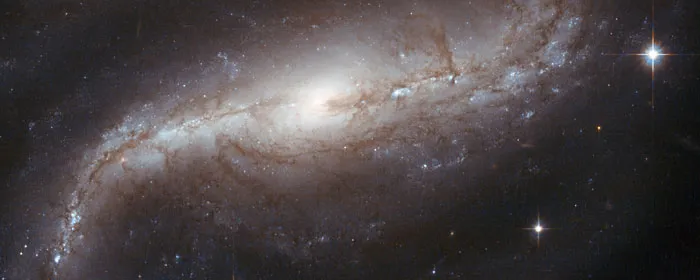
In this Hubble image of NGC 7479, created with observations in visible and near-infrared wavelengths, the tight arms of the spiral galaxy create an inverted "s" as they rotate in a counterclockwise direction.
However, at radio wavelengths, this galaxy rotates the other way, with a jet of radiation, that curves in the opposite direction to the stars and dust in the galaxy's arms.
Astronomers think the radio jet in the galaxy rotates that way after an encounter with another galaxy.
Star formation in NGC 7479 -105 million light-years from Earth- has multiplied, but the three brightest stars in the image are background stars.
It was the Hubble Space Telescope image of the week.
Credit: NASA/ESA
Great conjunction of the year
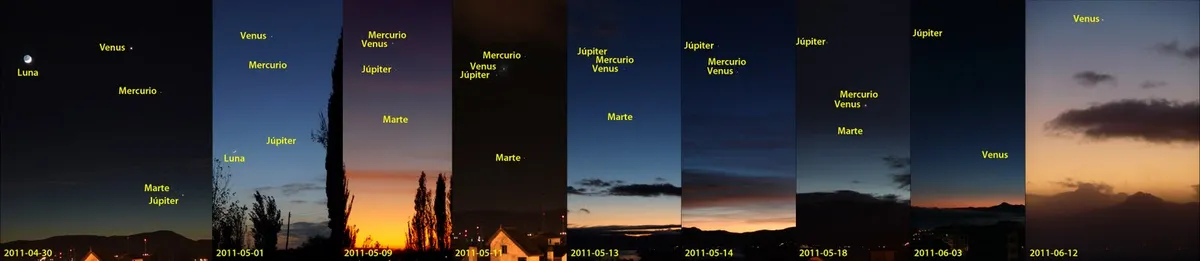
Guillermo Abramson provides us with this annotated composition of the dance of the planets from Bariloche.
In the blog En el cielo las estrellas, he gives an account of the image and the apparent, but marvelous, movement of these wandering objects of the solar system.
Space Music
Today: Huida a Venus (OST)
It's no news that Enrique Collado (alias Pictures) makes good music. I commented on his work in a previous edition of this Sunday multimedia section.
This time it is the Soundtrack of the short film Huida a Venus made by the Sevillian Raúl Romera.
The short film can be seen in full (14 minutes) on the film's website Huida a Venus. Here is the trailer:
HUIDA A VENUS tráiler from RAUL ROMERA on Vimeo.
I thank you for the notice and congratulate you on the work. Great!
Science in motion
ESOcast 27: An ESO astronomer at work
What does it take to be a professional astronomer, working with the most powerful telescopes, producing top-level science?
http://www.eso.org/public/videos/esocast27a/
To access previous editions of this section, consult the Multimedia Selection Series.