A collection of links to music, images and videos that relate art and science. Today: NGC 1850 two unusual clusters; Air pollution; The Heart Nebula. Music: Luminance Factor from La Rioja. Video: Children of Africa.

Images of the decade
NGC 1850
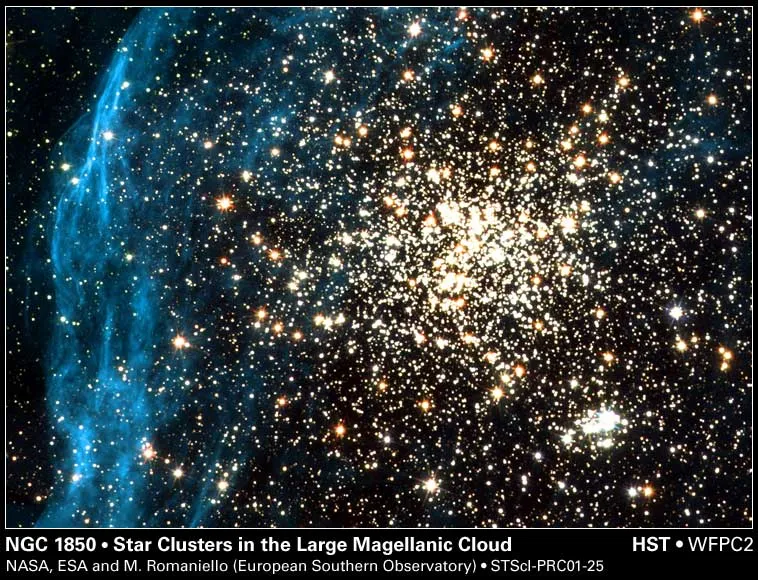
Two incredible clusters, NGC 1850 A and B, are found in one of our neighboring galaxies, the Large Magellanic Cloud. In the center of the image lies a young star cluster. Is it open or globular? It is considered the first type of cluster, but it looks like the second. Something truly atypical. Below, to the right, a smaller and even younger cluster. Both are located in the constellation Dorado, about 168,000 light-years away.
The image was published on HubbleSite on July 10, 2001.
Credits: NASA, ESA, and Martino Romaniello (European Southern Observatory, Germany)
Air pollution
Where is the air most polluted in our world? Images from the Terra satellite show not only areas of high pollution, but also how polluted air moves. In the image above, the places with the highest air pollution are shown in red. What is tracked is carbon monoxide at a height of 5 kilometers. Clearly, the Northern Hemisphere shows more CO than the Southern. But the data indicated that pollution moves on a global scale. About half of all CO emission is of human origin, and it is mainly created in large fires.
Credit: MOPITT, Terra, NCAR CSA, NASA
It was the Astronomy Picture of the Day July 9, 2001. Also on Observatorio.
Images of the week
Return to the Carina Nebula
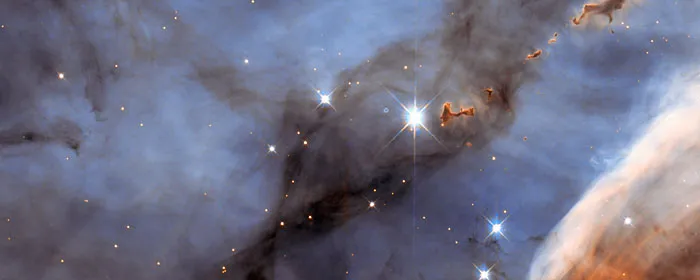
As if it were a true piece of abstract art, the Hubble image is of a small portion of the Carina Nebula. Part of this gigantic nebula was documented in the well-known "Mystic Mountain".
The nebula is a star-forming region about 7500 light-years from Earth in the constellation Carina, the keel.
It was the Hubble Space Telescope Image of the Week.
Credit: NASA/ESA
The Heart Nebula
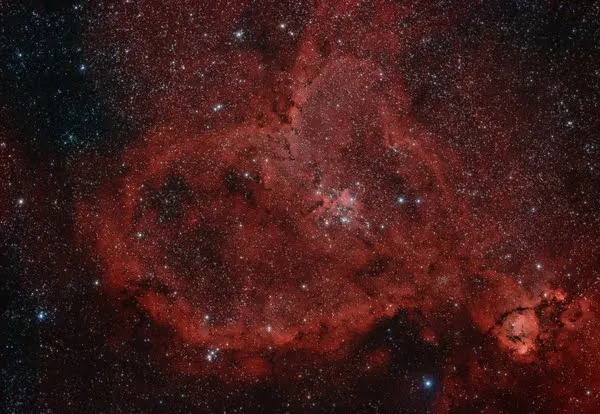
IC 1805 is an emission nebula that, together with 1848, is located in Cassiopeia, 7500 light-years from Earth. Both form the Cassiopeia OB6 stellar association.
IC 1805 is also called the Heart Nebula. Inside it there is an open cluster that ionizes the hydrogen of the nebula and gives it that color and brightness.
It was the Amateur Astronomy Picture of July 6, 2011.
Credit: lizarranet from Arbaiun (Spain)
Space Music
Luminance Factor (Factor Lumínico)
Factor Lumínico or Luminance Factor is the musical project of Gonzalo González. A riojano (La Rioja, Argentina) who was born when the Sun was transiting Capricorn (although the horoscope erroneously indicates Aquarius) back in 1974.
His father gave him a keyboard when Gonzalo had completed 16 revolutions around the Sun, but he also gave him something even more important: good music.
Later he was able to buy two synthesizers and began to shape his own project Factor Lumínico. In 1997 he recorded his first compilation "Electric AM" with sounds of his own rhythm.
The following year he was part of the band Detective and in 2002 he joined another band, with Daniel Tonti, "Expansive Techno Project".
He recently published his album Atmósfera "very experimental, 95% computer, 5% synthesizers, minimalist because it is very simple, perhaps due to the experimentation itself, that album was fundamental because it made me decide to publish and make my art known", according to the musician's own words.
The cover art of Atmósfera and its tracks make one think of space. What inspired and motivated him was thinking: What are we doing with our Atmosphere? One of the images of the decade, above, shows that his concern is real.
The photo used in the artwork, taken by the musician, was taken between Catamarca and Salta in the Salar del Hombre Muerto.
Atmósfera includes 5 tracks that can transport us wherever our imagination wants. They are songs that could perfectly be part of a documentary or soundtrack of some film.
He also published Into the universe - part One. It is a work that is new and not so new: "I am thinking of editing and publishing my old tracks and projects from years ago that I have stored away, for that reason I wanted to publish them as singles, there is a lot to listen to, I have a lot of music recorded in analog form, when I experimented I made the big mistake of not digitizing it, now that material is sensational, more than now I am on standby with compositions since I lost my keyboards due to electronic failures, it is for this reason that I will be working for a while with my old songs, also as always there is a lot of space sound and it is a shame that this material is lost, I would like it to come out and be published and people can enjoy it. I am sure that those who like my music will enjoy it", Gonzalo told me.
Gonzalo González Goza. It is the pleasure of making music in itself, feeling the vibrations of the sounds that run through the blood and the mind that drives him.
What is the fastest means of transportation in the universe? Light, some will say. Others, on the other hand, will say Music, which allows us to traverse the cosmos in 5:18, as in Into the Universe.
Gonzalo is part of Jamendo, meaning he shares his music freely. He has a website for his project Luminance Factor, where you can also buy his music. Some previous tracks can be heard on his site and I invite you to visit it.
"I would like my first space video to be from the fans themselves, they would remain as official Luminance Factor videos". Hopefully someone picks up the gauntlet and a virtual, free and expansive collaboration of visual art and music is propelled from here.
Thank you Gonzalo for your music and for the good willingness to tell me your ideas, your story and your projects. I hope recognition multiplies and we can hear you live someday.
Science in motion
Our story: Symphony of Science: Children of Africa
Video: Children of Africa
http://www.youtube.com/watch?v=f0vlrTVC2tQ&hd=1
This new production by Symphony of Science talks about what we are: descendants of our ancestors, probably all arisen from Africa.
Evolution and Ecology, but also global awareness of humanity as a whole, is the message of this new track that combines music with phrases from popular science communicators and scientists.
An approximate translation could be:
[Jacob Bronowski]
Man is a simple creature;
he has a set of gifts that make him unique among animals.
But, unlike them, he is not a figure in the landscape.
He is the shaper of the landscape.
[Alice Roberts]
We are all children of Africa; they say that's where we began
[Bronowski]
In a dry African landscape;
Man set his feet on the ground
[Roberts]
Africa was our only home;
for tens of thousands of years;
until a small handful of people made their way out of Africa
[Carolyn Porco]
These beings with high imagination;
finally managed, they and their machines, to fly into interplanetary space
[Roberts]
We are all children of Africa;
This landscape has been the home of humans;
200 thousand years
[Porco]
We have come so far
All this is cause for a great celebration
We have come so far
It's a story of us
[Roberts]
Those early Europeans were people like you and me but it's a lesson in humility when you see the changes they faced
People like you and me outlasted the Neanderthals
People like you and me made it through the ice age
Chorus
[Jane Goodall]
We are not the only beings with personalities, minds and feelings
Chimpanzees have clear personalities
[Robert Sapolsky]
Take a fetal chimpanzee brain and let it go two or more divisions and you'll have symphonies and ideology
[Neil deGrasse Tyson]
Everything we are that distinguishes us from chimpanzees emerges from a 1% difference in DNA
[Roberts]
People like you and me outlasted the Neanderthals
People like you and me made it through the ice age
[David Attenborough]
Using this growing intelligence the most successful of mammals has exploited the environment to produce food for an ever-increasing population instead of controlling the environment for the benefit of the population
Perhaps it's time to control the population to allow the survival of the environment.
*Note: The links, obviously, are not part of the lyrics, but I added them to know who the people are whose texts are used in the song and to have some references on certain aspects mentioned. I recommend reading Mundo Neandertal, if there is interest in the topic, and Poblamiento de América.
The original lyrics can be accessed from Symphony of Science.
To access previous editions of this section, consult the Serie Selección Multimedia.