A brief tourist trip that sparked reflections on the connections between science and society.
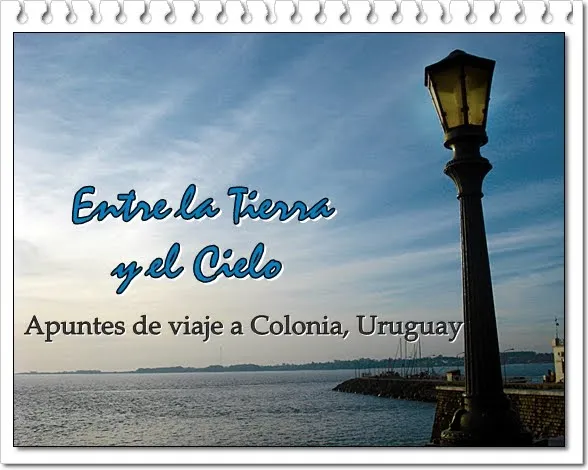
I had my winter vacation from work and decided to take a short trip I had been postponing for a long time. I went to Colonia del Sacramento, Uruguay, on a day trip.
I left at 9:30 from the port of Buenos Aires and arrived back at the same place at 22 hours.
During the journey I interacted with different people and some conversations sparked certain reflections in me. Before that, allow me to briefly recount how the little trip went.
I want to tell this because I have seen pages (even before traveling) that recount negative experiences about a particular "excursion."
Traveling to Colonia from Buenos Aires is simple and pleasant thanks to Buquebús or Colonia Express. I have no relationship with the companies, this is not covert advertising. Buquebús is a very well-known company in the industry and I had a good experience in this case. The company offers, in addition to the transfer, some "city tours" that allow you to explore the city with a tourist bus and also a historical walking tour.
But I also saw that they offered "A natural day" on a farm. This is Granja Arenas, a ten-minute drive from the port of Colonia. They offer a barbecue, a visit to a particular museum of curiosities, and the possibility of riding bicycles and horses. The latter was something I had never done and really wanted to do.
I went there, despite the fact that some tourist experience pages speak negatively of the farm. I didn't let myself be swayed by those comments and went anyway. At the port of Colonia, I was greeted by Martín from Buquebús, who very kindly took me in a van to the farm, along with a family. This family, with whom I had lunch, consisted of a woman and two children (a boy and a girl) originally from Colombia, living in Bolivia, on vacation in Argentina and visiting Colonia.
After visiting the museum of curiosities (thousands of pencils listed as a guinness record, cans, keychains and other objects) we indeed ate a barbecue, after a good appetizer. You could also have dessert and coffee.
Then I was indeed able to ride a horse. Moro, the white horse, seemed more willing than a brown mare that looked younger and more athletic than the male, but less inclined to do anything other than eat grass.
I petted him for a while and rode him for about ten minutes with total inexperience and much respect. The horse took me where he wanted, giving free rein to his instinct and domestication. He treated me with great compassion, but he kept me at a trot.
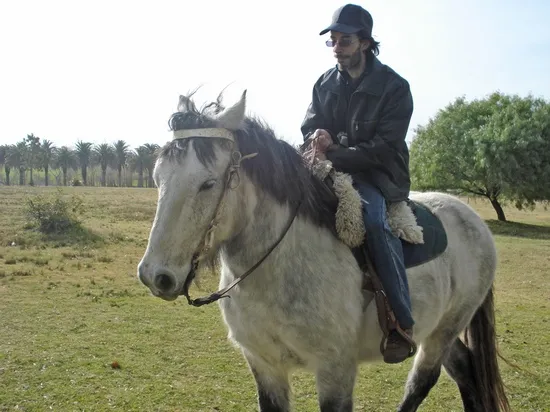
The older of the children from the family that accompanied me also did the same and then they were able to ride bicycles without problems (though with a few falls). I bought some local alfajores and two hours after our arrival at the farm, Martín came to pick us up, just as we had agreed.
From there we went directly to stop 1 of the tourist bus with which I covered the entire route, admiring the islands and the Real de San Carlos, while the Moon accompanied us even though the tour guide completely ignored it.
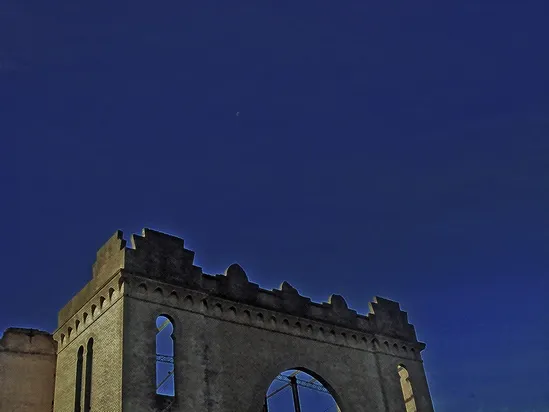
Then I did the walk through the historic neighborhood where a guide told us about the influence of the Portuguese and Spanish in the place. I remembered history classes in high school (a couple of decades ago) and the famous "Treaty of Tordesillas". I missed going up the lighthouse, and visiting the museums (they close at 17:00!).
I did that walking tour with a Colombian couple, Alexander and Luisa, very interested in the local economy, food, customs, etc.
If the interaction had been very interesting up to that point, it was even more so after the tour. We stayed talking and continued the conversation later, on the return trip.
Among the various topics, the conversation led to talking about the different facial features of the inhabitants of America and the native peoples. It seemed opportune to me, then, to point out some of the current theories about world population. The idea of the Bering crossing is well known, and another, somewhat more modern one, of crossing via the Red Sea. The idea that ultimately we are all part of the same branch. An idea that leads to thinking about evolution. You know the father of the Theory of Evolution, right? It's...
The question went unanswered. I thought of Valeria Román. I would have liked at that moment to give the couple the book Darwin 2.0.
Astrotourism: mythology and culture in astronomy
The idea of taking the trip on this occasion and not another also had to do with my desire to witness the presentation of Astroturismo on board the Eladia Isabel. I hope soon to be able to interview the girls who carry out this beautiful initiative that I talked about here on another occasion.
I didn't arrive in time for the viewing through telescopes and binoculars (although I brought mine) that they do before setting sail (between 18 and 19 hours), but I did know that they would later present on the outer part of the ship.
I mentioned it to the couple I was chatting with and there we went. Despite the cold and not having much interest in astronomy, I do believe it impacted them in a couple of ways.
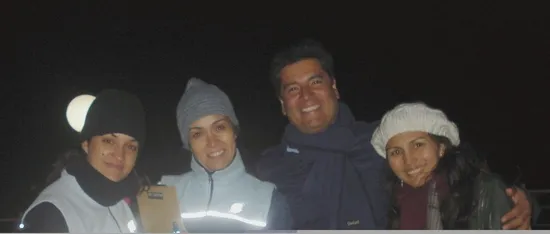
On one hand, Luisa told me she had no idea that stars are other suns. And the comment impacted me even more than the ignorance of Darwin.
They also didn't have much idea about constellations, although they did remember some zodiac signs!!
In fact, at one point Alexander referred to these topics I was talking about as...astrology!! He found it funny when I told him I felt like committing harakiri!
This couple, middle-class but socially conscious, who care about people and their well-being, who are concerned with knowing the reality beyond the tourist facades of each place, and therefore have a good cultural level, nevertheless clearly expressed some ignorance that I hasten to define as important.
It's subjective. Those who like astronomy think that is more important than other things. That happens. But aside from that subjectivity: we learn the rivers of Europe in school, and we don't learn the constellations, which are there not just for lovers of astronomical science. They are a story of who we were and are. They speak of the culture of each place.
Patricia Juárez, from Astroturismo, gave a talk despite the cold and volcanic ash, excellent on the subject. There is the Southern Cross. Well, no. There are four stars there. Why do we see a cross? The original inhabitants of the area saw something else: The footprint of the Choique. (I promise to tell that specific story this week).
The contrast
It made a lot of noise to me that this young Colombian couple, interested in the cultural and social aspects of peoples, had no knowledge of the impact of constellations in that regard.
I have been writing here about a thorny topic for those who like astronomy: What is astronomy good for? It is a long and varied topic that leads, among other things, to questioning whether it is right to allocate large sums of money to install an instrument that will not have a great impact on people's lives, while there are other more basic and urgent needs.
I believe those questions can be answered more or less solidly and with a variety of arguments of different tenor, among which, undoubtedly, education is a topic to highlight.
Because as I try to point out here, beyond the strictly scientific, astronomy is a human practice, which speaks of our uses and customs, which speaks of who we are.
On the other hand, the conversation led me to other topics that arise when talking about science, but that go beyond science itself. While traveling there and for a good while at the farm I was reading "The Quark and the Jaguar" by Murray Gell-Mann.
I commented to the couple, Alex and Luisa: The atom is made up of protons and neutrons around which electrons "revolve," as the simplest image. But Murray Gell-Mann discovered that inside protons there are even more basic "things": quarks. The subtitle of the book is: "Adventures in the Simple and the Complex."
I asked the couple: What is the simple and the complex in the phrase "The Quark and the Jaguar"? "The quark is the complex," Luisa told me.
And the answer is logical. For her, it is not "complex" to think about a jaguar, she has a complete idea of what it means. But it is not "simple" for her to think about something she learned about 30 seconds before.
And yet, it's the opposite.
In a way, all quarks are the same (yes, I know there are several "flavors"), all protons can be compared to each other with enormous ease, they are easily describable. With living beings, even though we are a sum of quarks, it's not the same. Therein lies an adventure of thought. An adventure that inspires science.
There in the sky and here on Earth there are quarks, protons and neutrons. There are also stories we create with our feet on the ground. There are great suns, much, much larger than ours, which we see as pale points of light. And we have seen them since almost forever. In Africa, in Europe, in the East and West, in the Northern and Southern Hemispheres. How did modern man get to where he is? What path did we take? What were our ancestors like? Why are we different and in what ways are we?
Martín Cagliani pointed out to me on one occasion that the movie "Quest for Fire" is outdated in terms of scientific data. But it could undoubtedly be a great trigger for the topic.
The effort of Astroturismo, in this context, is motivating and an excellent trigger for questions. At least for those with a certain predisposition to these topics.
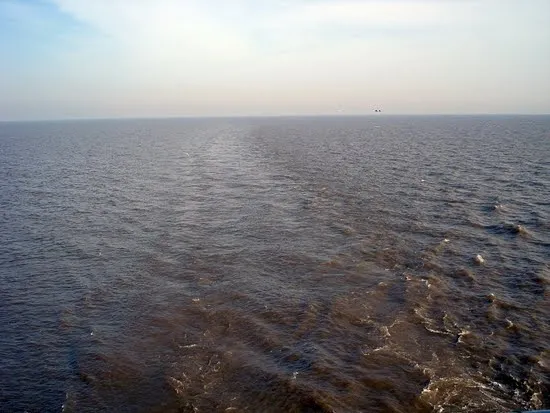
Sometimes, it seems we sail in lonely waters. And sometimes not. This Friday my hopes in this sense did not sink.