The Ministries of Tourism and of Science presented projects to promote emerging regional tourist centers, through the incorporation of technology. Research centers and wi-fi internet will be created in different localities of that province.
The Minister of Tourism, Enrique Meyer and the Minister of Science, Lino Barañao, presented projects belonging to the Asetur call, Technological Support for the Tourism Sector 2009 – CofecyT, to promote emerging tourist centers through the incorporation of technology.
During the event, Meyer stated: “Working on programs to promote emerging destinations like the municipalities of Tolar Grande, Santa Rosa de Tastil, San Antonio de los Cobres, Campo Quijano, redoubles our effort and enthusiasm because, as our President says, through tourism we can reach the deep Argentina, the farthest corner of the country.”
Barañao highlighted the importance of two new ministries working together on tasks related to job creation and social inclusion.
“It seems fair to me that science, through the signed projects, reaches all the inhabitants of our country. It can be demonstrated with concrete facts that technological development returns to the common citizen as an improvement in their quality of life,” he expressed.
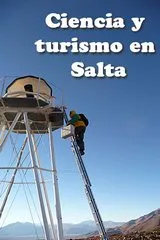
One of the signed agreements called “Ñawi Puna: Astronomical and Geological Interpretation Center, viewpoint and observatory,” in the locality of Tolar Grande, aims to develop the scientific tourism product through the creation of an astronomical and geological interpretation center.
A dome that will house a telescope on Cerro Macón will be built and works will be developed to improve a natural viewpoint located at 4,600 meters above sea level and the facilities of a municipal property. We talked a while ago about Cerro Macón in reference to the documentary El ojo de la Tierra. Let's remember that the place was a candidate for ESO to install the Extremely Large Telescope. In addition, free-access Wi-Fi internet will be installed.
The objective is to ensure that services meet quality, environmental safety and sustainability standards through the training of tourism providers; and the implementation, verification and measurement of the application of sectoral standards.
Asetur was held for the first time in 2008 and aims to provide non-reimbursable financial support for technological innovation projects in the Tourism sector, both public and private. For the 2009 call, 396 projects were submitted, of which 102 were approved for funding. The total amount is $600,000 per province, including the City of Buenos Aires.
The Ministry of Tourism and the Ministry of Science, Technology and Productive Innovation through CofecyT, carried out the evaluation of the projects, based on the introduction of technological innovation for the region, consistency with the 2016 Strategic Plan for Sustainable Tourism and transfer to the socio-productive sector.
The Asetur 2009 call resulted in three provisions and annexes (006, 009 and 013) with the ideas approved with observations and the disapproved ideas. The approved ideas detailed in the annexes on different provinces include:
the installation of telescopes for Cosmic observation in Mendoza as well as the already mentioned Astronomical and geological interpretation center, viewpoint and observatory in Salta.
Among the disapproved ideas is a Provincial Project for a flexible didactic astronomical dome in San Juan.
Sources and related links
- They will present the scientific – tourist project “Ñawi Puna” in Salta
- Argentina - They promote Scientific Tourism in Salta
About the images
- Cerro Macón. Credit: ESO