Loose thoughts on my visit to Tecnópolis and the look toward the future.
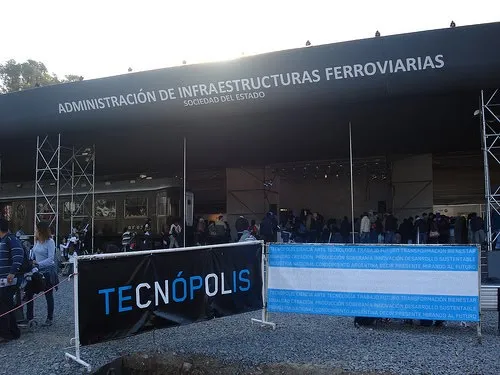
A couple of weeks ago I was at Tecnópolis, the Science and Technology fair that -despite what one might assume- was packed with people.
Describing what the fair is like is impossible. There is so much to see and experience. From racing simulators to airplanes, educational science games, techno-artistic installations, talks, concerts.
There are those who question the fair because, they indicate, it involved an enormous expense. I believe it is a wonderful investment of money. The cost is incredibly less than what is allocated, for example, in "Fútbol para todos", with different results.
While it is true that this and other fairs are, in some aspects, still a spectacle, even in that facet they are an informative show and not mere pastime entertainment. It informs what is being done in the country in science and technology and that is extremely valuable because we have often thought that only foreign things were good.
The Auger Project is one of the most important experiments in astrophysics in the world and it is here, in Mendoza. And at Tecnópolis, for those of us who have not yet had the opportunity to go to Malargüe. The fair brings it closer.
That it exists also speaks of intentions. Aside from partisan issues -that's why I didn't comment on my visit the previous week, in view of the primary elections- Tecnópolis indicates the importance that the Executive Branch, through the Ministry of Science, is giving to the sector, not only with a view to a strategic plan, but also with the idea of smoothing the public's path toward scientific knowledge, often unknown or misinterpreted due to stereotypes.
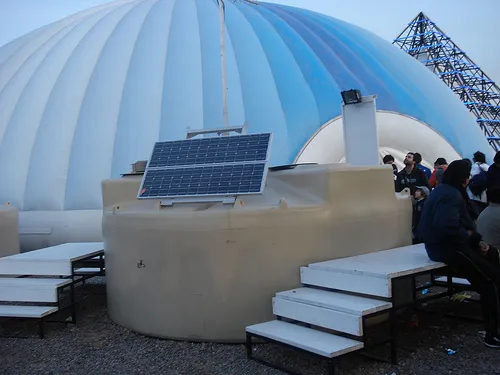
Since the place is huge, I recommend to those who wish to visit Tecnópolis for the remaining time -supposedly until November 27- to take a little time to plan which areas interest them most. On weekends a lot of people crowd together and that generates long lines in front of the tents of each place. And since they have a limit capacity (about 50 people) and each tour can last about 20 minutes. And given that in some cases the capacity is lower or the tour is longer in time, that number can double.
As constructive criticism I will say that:
-There is a radio and speakers along its streets announcing the start of some event or activity. But many times the general sector is indicated and not the particular place. The streets have names and upon entering a map of the place is given out. That way it would be very easy to locate the public so they can attend such and such talk or event. Also the buildings are identified with letters and numbers, so it would be easy to indicate exactly where such and such event will occur.
-In front of each tent there is very little information. One sees a long line of people to enter a place where they don't really know what will be shown to them. This was noticed at the Auger tent, for example, in front of which many people had gathered. One of the researchers came out to explain, without a poor loudspeaker, what could be expected from that tour. I think some more detailed explanatory signs could be added in each place.
At Tecnópolis there are no problems going with kids, quite the opposite. It is a safe place, it has appropriate bathrooms, there are many events designed for them and many places to have a snack or have lunch and dinner. I ate in two places, a while after arriving and before leaving and everything was very good. The pizza portions offered by Soberbio Isósceles are the same.
Video: Tecnópolis Mix 2011
And where is the future?
Tecnópolis presents itself with the slogan: "Saying present looking at the future". What is at the fair is mainly the past and the present. What has been being done in science in our country. Of course it is possible to glimpse something of the future, for example about biotechnology, but basically what is seen is what is already being done. The future is in the existence of Tecnópolis. In the notion that it is possible to do science by Argentines.
And it is extremely powerful to generate empathy. It allows one to know that it is possible, that studying planets or string theory should not be just a dream. The approach with real scientists by young people and their parents should generate an impulse toward the sciences in the public.
In any case, we should value the current effort to bring science to the general public. And it should be constituted as a value independent of the partisan, as a demand of society as a whole. That they sell t-shirts there with Evita's face doesn't contribute much.
The following happened to me: I was leaving and I hear the show "It's not magic, it's science" starting. I was right at that place and I went for it. The stands were full of kids of various ages with their parents. A kid sits next to me. What's here?, he asks me. I told him and a conversation started.
"Too bad it's political," he blurted out. "Everything is political," I told him. The young man in question is, according to what he told me, in the last year of high school (3rd year of polimodal). 17 years old. "Do you think the people who come here are going to vote in favor of the Government, that they are being induced to do that?", I questioned him. He told me no, that at least he wanted it not to be that way. "Do you talk about those things at school?", I inquired. And he told me that with his group of friends yes, but that many are not interested. But that he is. That he is interested in the country, especially because...he is a father. He didn't want it, it came and he took responsibility.
I looked at him without speaking, while the actors appeared and the kids broke an enormous silence with their noise. Yes, it was true, I thought later, Tecnópolis is saying present to look at the future. Everyone's.
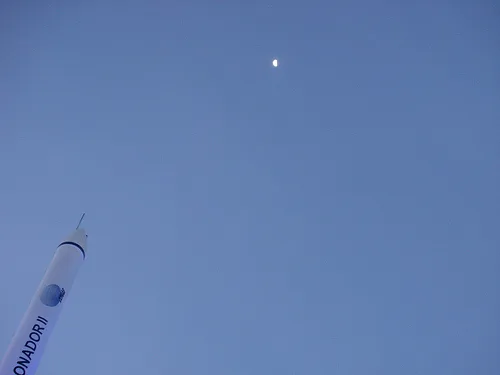
Two things
There are two things that I found very remarkable at Tecnópolis:
-The projection (mapping) in the CONICET Room A. At the place I asked who had created it and they didn't know, but later ConicetDialoga pointed out to me that it was done by the production company NOS. It is a 3D mapping as has been used for projections on buildings. In this case, it is done in a room where a section of the wall is illuminated, with shapes that look like puzzle pieces. Each piece, however, is made up of other smaller ones that flip over. In each section, images and even video sequences are displayed narrating the history of science and Argentine science through some milestones and characters. It is very well done and I recommend seeing it. It lasts about 20 minutes.
I also want to recommend the Ciencia para todos stand, especially because Children's Day is approaching. You can learn more about this venture at cienciaparatodos.com.ar.
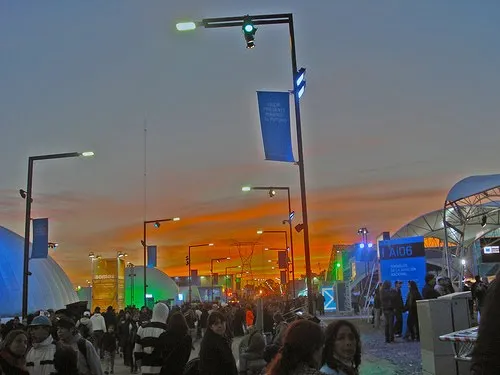
The Future of the Future
On Friday, July 15, I had the opportunity -thanks to an invitation from people at Muchnick PR- to attend a talk by Santiago Bilinkis, who created OfficeNet. It took place in the company's new auditorium, now Staples, in Barracas. Bilinkis, who left the company after 14 years, had the opportunity to attend a course at the Singularity University on innovation and technology. After three months at NASA's Ames center, Santiago returned with a lot of information he wanted to organize, for which he made a presentation for himself. But then Barcamp 2010 happened and he thought it would be good to share the presentation. He also presented it at the Planetarium and more recently gave a talk at Tecnópolis.
Bilinkis begins by stating that unlike what had been happening until now, technological changes are exponential and not linear like the advancement of cars or airplanes can be.
But, what about computers? We all already know the famous Moore's Law.
What Bilinkis points out is that in the first two cases we have linear growth, while in the last one the growth is exponential.
If the Comet 4 airplane (from 1950) had had an improvement in its speed of 40.5% per year (average improvement in computers) we would have today a 787 that travels many times faster than light!! (*)
The present of the future, says Bilinkis, is with computers that grow exponentially in their performance in a world that continues to be linear. Hence, so many times the future has not been well understood.
Synthetic biology, personalized medicine, robotics, space and energy industries are also growing exponentially, as if Moore's Law were contagious.
You can view version 2 of Santiago's presentation here, but he himself points out that he keeps updating it. Also, his comments and anecdotes are not to be missed, so those interested in these topics should not miss attending a future presentation, if there is one, because it's worth it.
View more presentations from Santiago Bilinkis
I was thinking that Santiago would be one of the Integrated, more than the Apocalyptic, to reuse Eco's terms. And I was wrong to prejudge him, at least according to the talk I attended.
What I would like to add is the following: I have the feeling that although there are scientific and technical institutions that actually take advantage of innovations, the great mass of computer users -which is expanding- does not. It seems that most people use the PC/Notebook to browse the web or take photos. But those enormous computational resources are wasted, when, to cite one example, BOINC can be used. And many people have no idea that distributed computing projects exist.
Thinking about the future is also thinking about how we have or have not taken advantage of scientific innovations today. What should improve exponentially, perhaps, should be education, in the broad sense of the word.
Sources and related links
- Tecnópolis MinCyT
- Tecnópolis.ar
- My photos of Tecnópolis
- Tecnópolis on Google Maps
- (*) If you don't believe me, check this spreadsheet:
What you will see are some of the initial parameters. Next to it, the increase in percentage, below the sum of the initial value + the percentage increase. This iterated for as many years, depending on the case.
After a column of space, the same is repeated, changing the percentage. In the spreadsheet, the points are commas. (Surely there is a financial formula, like those used to calculate the interest rate of a loan, that would make the calculations much easier. Something like i=((VF/VA)-1)/n, where VF is Final Value, VA Present Value, and n the amount of the period in years, months, etc., i the fixed annual, monthly rate).