A collection of links to music, images and videos relating art and science. Today: Images of A galaxy in turmoil; The Lagoon Nebula in Three Colors; Far from home; Helix Nebula; Music by Nelson Ressio - DJ qbIT and a video about the most distant quasar, from ESOCast.

Images of the decade
A galaxy in turmoil
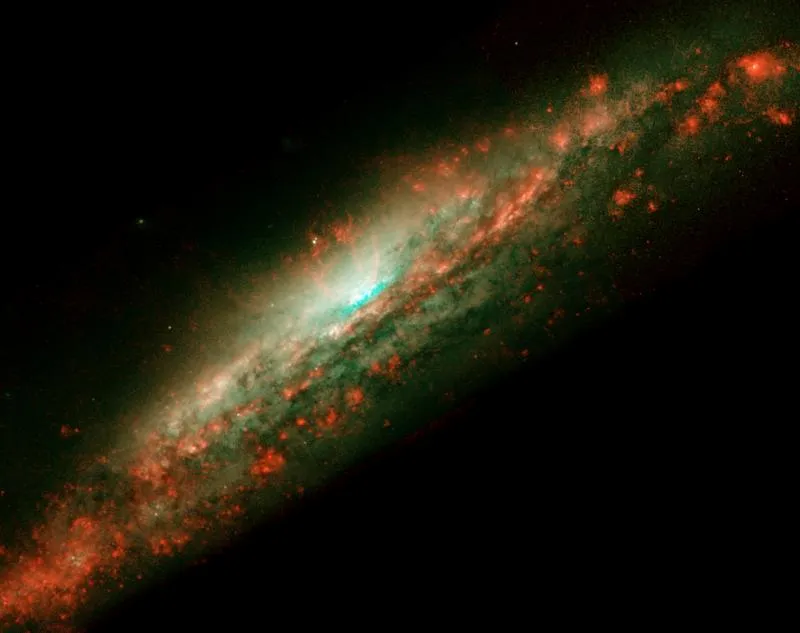
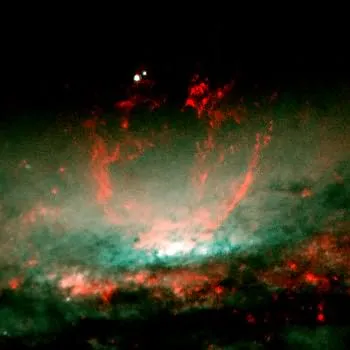
This Hubble image reveals the dramatic activity in the core of galaxy NGC 3079 where a bubble of hot gas is being generated from a cauldron of radiant matter. The top image shows the bubble in the center of the galaxy and the bottom image is a close-up view of this structure over 3,000 light-years in diameter that grows to 3,500 light-years above the galaxy's disk. Astronomers suspect the bubble is generated by winds (streams of high-speed particles) released during a burst of star formation. The gaseous filaments at the top of the bubble are swirling around a vortex and are being expelled into space. Eventually that gas will fall onto the galaxy's disk where after colliding with gas clouds, it will compress them and form new stars. The two white dots just above the bubble are probably stars in the galaxy.
NGC 3079 is a spiral galaxy in the constellation Ursa Major, at 15 Megaparsecs, about 50 million light-years away.
The image was published on HubbleSite on August 16, 2001.
Credits: NASA, Gerald Cecil (University of North Carolina), Sylvain Veilleux (University of Maryland), Joss Bland-Hawthorn (Anglo- Australian Observatory), and Alex Filippenko (University of California at Berkeley).
The Lagoon Nebula in Three Colors
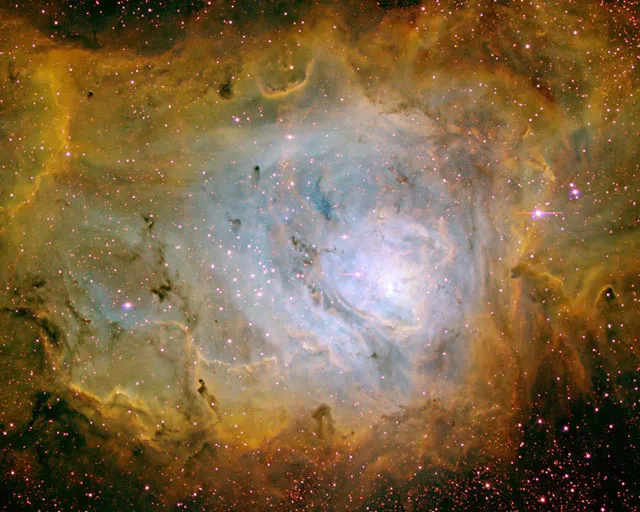
The bright Lagoon Nebula harbors a wide range of astronomical objects. Particularly interesting are a bright open star cluster and several very energetic star-forming regions. Viewed by eye, the light from the cluster is dominated by a red glow produced by luminous hydrogen gas, while the dark filaments are due to absorption by dense trails of dust. However, the image above, from the Curtis-Schmidt telescope, made by a team of Argentine astronomers, shows the nebula's emissions in three exact colors, specifically emitted by hydrogen, oxygen and sulfur. The Lagoon Nebula, also known as M8 and NGC 6523, is about 5000 light-years away, and can be located with binoculars in the constellation Sagittarius, spanning a region three times the diameter of the full moon.
Credits: Rodolfo Barbá, Nidia Morrell et al. (UNLP), CTIO, NOAO, NSF.
It was the Astronomy Picture of the Day (APOD) of August 20, 2001 (Also on 10/6/2002) . Also on Observatorio.
Images of the week
Far from home
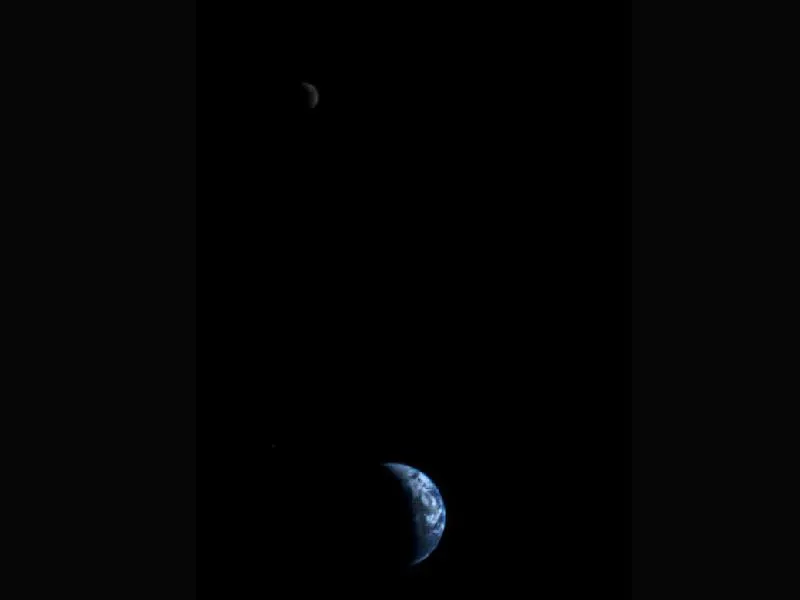
The image of a crescent Earth with its Moon -the first of its kind taken in space- was recorded on September 18, 1977, by NASA's Voyager 1 probe when it was 11.66 million kilometers from Earth.
The photo was created with three filters, then processed at JPL. Since Earth is many times brighter than the Moon, the satellite was artificially brightened so both can be seen in the image.
It was NASA's Image of the Day.
Credit: NASA.
Helix Nebula
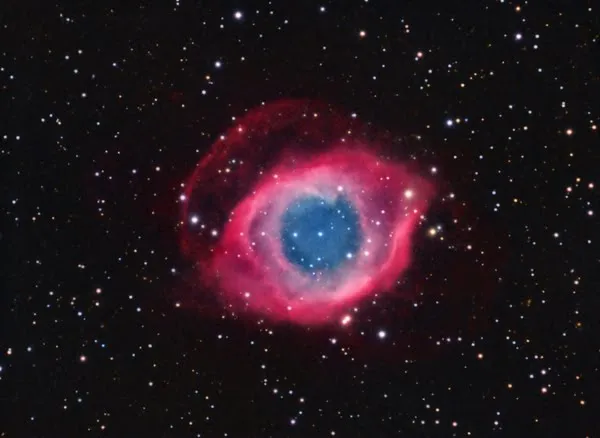
NGC 7293, sometimes called The Eye of God, is a planetary nebula in Aquarius, 680 light-years away.
The image was taken by Javier Ballesteros Bonald from Torcal de Antequera, Spain and was the Amateur Astronomy Picture of the Day (AAPOD) of August 19, 2011.
Space Music
Nelson Ressio - DJ qbIT
Nelson is an Argentine, born in Concordia, Entre Ríos, a computer specialist. He says of himself:
"Raised in an environment where music reigned in all areas.
Mother and Grandfather teachers of piano and violin respectively, where he began to feel music at a very early age. At 16 he played music on an FM station in his town where every Sunday morning he had a program with his high school classmates. The program called «Mas Allá del Silencio» varied from music news to contests, passing of course through the comments of each particular track.
A few years later he was a DJ, being able to express, along with the tastes of others, his own regarding music.
He is currently dedicating himself more fully to the production of his own tracks related to Trance/Progressive.
He is also a Computer Programmer for more than 20 years, a lover of science in general and philosophy. His second passion is that of DJ & Producer, where these passions combine to generate a very rich mix between technology and music.
Among his productions is Singularity Vol. 1, which includes tracks with titles like Horizonte de eventos, Nebulosa and Agujero negro.
But Nelson has much more music, which I invite you to listen to from his personal sites:
http://www.nelsonressio.com/
http://www.tumundodance.com
He has also published a track about Comet Elenin, on SoundCloud, which we can watch and listen to in this video:
More videos on Nelson Ressio's Youtube channel.
Science in motion
The most distant quasar
A team of European astronomers managed to discover and study the most distant quasar found so far thanks to observations made with ESO's Very Large Telescope at Cerro Paranal (Chile) and other telescopes. This bright beacon, powered by a black hole with two billion times the mass of our Sun, is undoubtedly the most luminous object discovered so far in the early Universe. These results will appear in the June 30 edition of the journal Nature.
More in the ESO press release, in Spanish.
Video on DotSub - Video on ESO
To access previous editions of this section, consult the Multimedia Selection Series.