Is there censorship, discrimination, and austerity at CONICET? Questions about the "narrative".
From "everything rosy" to fiery red.

According to the RAE, a narrative is a Knowledge that is given, usually detailed, of an event. It is also a narration, a story.
Are we talking about fiction or reality?
I maintain that all reality is a fiction. It is because how do we know how reality "is"? What we know is an interpretation that at some point is somewhat fictitious. What are atoms like? Like little solar systems with electrons orbiting the nucleus? It's a fiction. But, isn't saying that electrons form a "cloud" around the nucleons also one? Cloud?
However, aside from epistemological issues, from the interpretation of reality of which we are all hostages, sometimes we citizens end up being prisoners of another type of ideas that consciously try to manipulate the data of reality to create a false image of it. That is called a "narrative". It is often used as a derogatory term.
For example: It is possible to think that there is an idea, transmitted by the media, political and social leaders, educators, etc., that Science in Argentina has advanced a lot in recent years.
Is this a "narrative"? That is, is it a fiction or a reality?
All reality is a fiction. But, aside from the subjectivities inherent to the human being, is there an attempt to "create" a "virtual" reality?
Well, things get complicated, unless we fall into binary thinking.
And the truth is that while this idea of Argentine scientific prosperity is established, as well as the professional valuation that scientists have, at the same time there is a majority of citizens who are not very interested in science.
And this fact is not minor. Without assuming that what follows is an absolute idea of reality, and considering that it is somewhat simplistic, it is logical to understand that greater interest will lead to more information, a higher level of detail of knowledge.
So, on the one hand, in macro numbers and acts, it can be argued that that idea is NOT a fiction: the creation of a specific portfolio for science, the scientific-technological hub, the Raíces program for the repatriation of scientists, a greater flow of funds, Tecnópolis, Atucha II. There is also symbolism in these data: that they are generated implies support for science.
But, with a greater level of discernment, it is possible to start separating the wheat from the chaff. Having a Hall of Scientists in the Casa Rosada, inaugurated in 2009, will not generate better science in the country. But it does function as a symbol: this matters to us.
The same could be said of Tecnópolis or other events linked more to outreach than to research, although it is possible to glimpse that they will have some kind of impact on the influx of students into science careers.
There have also been a number of events recognizing scientific work that function in the same way.
But if the topic interests us, how to evaluate if, aside from these points, Argentine science is doing well?
"Doing well" is a relative concept. It would imply some comparison. There seems to be no doubt that in recent years there has been greater support from the State in scientific matters. An active support with some strategic planning, especially linked to nanotechnology and with emphasis on the transfer of technologies and applied sciences to solve concrete problems of society.
The macro image does not seem to be in dispute. Neither the political opposition to the national government nor the "opposition" media make different claims.
The latter is (was) striking. The country's main print media, in open confrontation with the national government, did not have an "opposition" discourse on scientific policy, as is obvious on the front pages of the well-known morning paper.
Could it be because there is nothing "bad" to say?
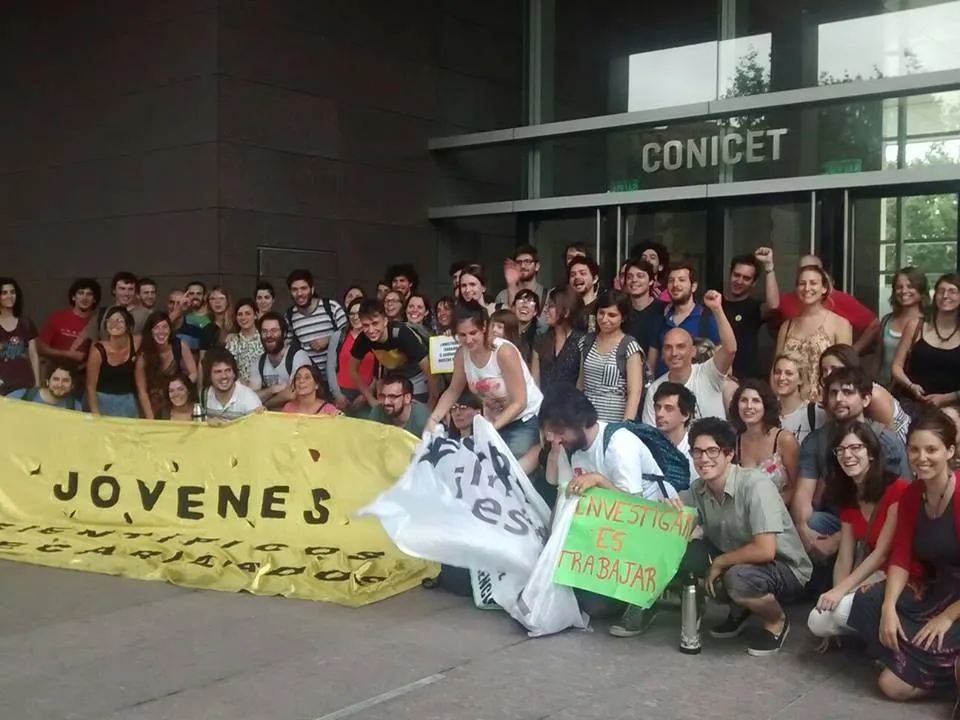
In recent days this "rosy story" of science in the country began to change, even in "pro-government" media. The claim by CONICET workers regarding doctoral and postdoctoral fellowships and allocation criteria could not be hidden. And after those claims, voices that have existed for a long time began to appear, like those of Diego Harari.
It all started with the unfortunate letter from the Vice President of Scientific Affairs of CONICET Dr. Faustino Siñeriz:
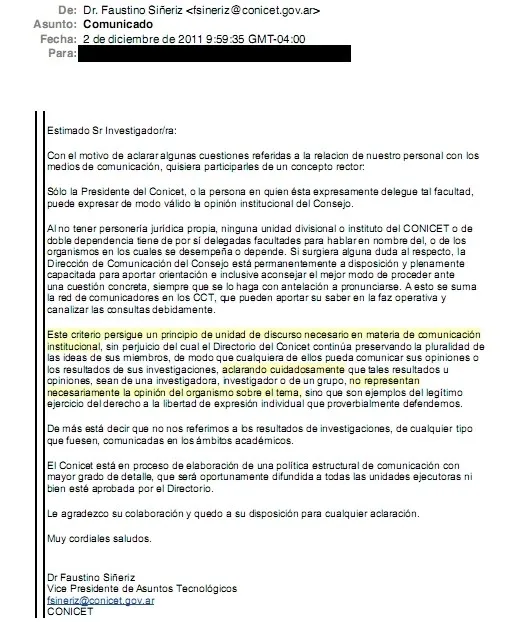
The first thing one might think is the following. The content is quite obvious, a priori. I am an employee of a company. If they asked for my opinion on the company's commercial policy, I am not in a position to respond, not only because I do not have specific knowledge of it, but because it is not my responsibility. When Clarín echoed this letter, I thought: if I asked a journalist from the newspaper what they think of its editorial policy, they probably wouldn't answer me. It's not their place.
However, it is possible that this same journalist does have a formed opinion. And it makes no sense to prohibit its expression because, ultimately, they will be responsible for their words and they will not be representative of the board. This is so obvious that I immediately asked myself: if it's obvious, what's the point of the letter?
The problem is that it is ambiguous, as Andrés Carrasco points out.
Shouldn't CONICET employees give their opinion on fellowship criteria?
It should be said that on December 30 it was announced that in its last ordinary meeting, the CONICET Board resolved to appoint Eng. Santiago Sacerdote as Vice President of Technological Affairs, replacing Dr. Faustino Siñeriz.
Yes, a Priest in Science...
However, ATE-CONICET elaborated on this, raising doubts that on the one hand can generate an in-depth debate about what type of criteria are the best, but on the other with uncertainties about a certain moral laxity in some dealings of the main organization dedicated to the promotion of science and technology in Argentina.
Harari's proposals are not the first nor the only ones. The same is pointed out by Dr. in History Eduardo Saguier, whom I interviewed for this blog a while ago (See "A voice in the tangle").
However, it gives the impression that the statements of both arise from personal situations, although Saguier has made a series of complaints related to favoritism that are difficult to prove, of course.
Even back then when I interviewed him I expressed some skepticism on my part about his statements, but I didn't want to settle for the dismissive idea that he was a "nutcase," as some claim out there, discrediting him. It seemed to me that while it's possible his situation clouds his judgment a bit and his entire view of CONICET is biased in that sense, it is perfectly plausible that conflicts of interest exist and that it would be good to seek more transparent systems.
There is a whole discussion about whether the peers consulted in science at different stages should be anonymous or not, with logical positions on both sides.
Another situation that is starting to become more public, but that has existed for a long time, is that of the "precarious workers."
Argentine science changes color
Given what has been said, the "narrative" that everything was rosy in the country's science is starting to darken.
I believe this is positive. It is because I don't believe in single narratives and because reality is not only macro and quantitative.
But I believe it would not be logical or fair to go from one extreme to the other. The Ministry of Science last year made a recount of its management. It certainly forms a biased "narrative" because it values the official policy, without much self-criticism. But there is a set of facts and initiatives there that are true, although there will surely be more or less questionable points.
That science is no longer seen as rosy, but in red (a bit more "dark") could well be the kickoff for some aspects to be illuminated by reason in search of a transparency aimed at the common good.
It would also be good if there were more scientists capable of stepping outside the official discourse, of taking off the cassette, and raising their rational criticisms about planning, resources, infrastructure, evaluation criteria, etc.
It wasn't Clarín scrutinizing CONICET surreptitiously to see if they could find something. It was the researchers themselves who came out to complain. But they complain with their wallets. This is not a criticism. It happens to all of us.
But just as it would be better if employees of the transportation system did not take industrial action solely to raise salary or labor condition demands, but also to have better tracks, more modern cars, etc., it would also be good if scientists did the same.
However, they seem reluctant to engage in public debate, although discussions do take place behind the doors of laboratories and institutes.
No person with minimal intellectual training can like the formation of "narratives" about a reality that is not. Until now, that has been happening with respect to science in Argentina. There is a certain responsibility of the media (from newspapers to blogs like this one), but the truth is that the media echo voices or documents forged among the scientists themselves. And there is not much criticism there, outside the doors, except for these exceptions linked to personal issues or fund distribution.
But do scientists agree with the directions science is taking in the country? Is there a direction?
Each discipline has, although science cannot be understood as watertight compartments, its own universe. We should ask ourselves, then, what is the situation in astronomy?
What color is Argentine astronomy?
Here I echoed certain future proposals and reported on situations like that of the Gemini Office.
It's not the only thing there is, let the reader know. Argentine astronomy is illuminated by fabulous professionals and educational institutions, but not all that glitters is gold. As soon as you start scratching a little, the more mundane personal issues, survival instincts, excuses, and bureaucracies emerge.
Sometimes, expanding the "narrative" so that it ceases to be one is difficult. In this blog I have not yet spoken about some complex and difficult-to-approach topics, like "plagiarism," although in Córdoba and in Santa Fe they know what I'm referring to. In La Plata too.
Tomorrow I will make a year-end review here for the blog and the writer. But it must be known already that there are topics left in the inkwell and I will do my best to remedy, at least in part, the next trip around the Sun.
How is Argentine astronomy? What challenges lie ahead? What initiatives are being evaluated? What relationships will be established between professionals and volunteers? What projects exist to deal with the flood of data?
2010 is ending on a calendar that perhaps it's time to change (and it would be good to debate it seriously). But for the cosmos there is no beginning or end. That is also a "narrative."
Sources and related links
- About CONICET doctoral and postdoctoral fellowships
- Information about CONICET Fellowships 2011
About the images
- CONICET logo.
- Background image: INQUISAL.