About the upcoming presentation of Paenza's new book, the public and official recognition of the mathematician, and a photo with some noise.
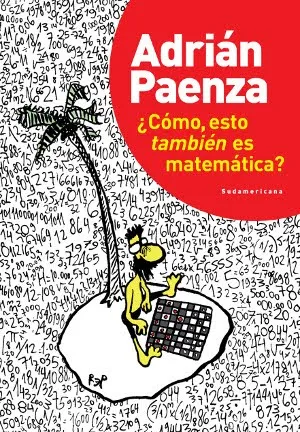
Next November 9, Dr. Paenza will publish a new book from his already extensive production that attempts to popularize mathematics through pleasant, fun, and didactic stories and puzzles. The new work is titled "¿Cómo, esto también es matemática?".
On many occasions I have commented here on what I consider to be a formidable dissemination work by Paenza. For the presentation of his previous work, I held a giveaway here among the readers, and it is possible that the same may happen in this case.
The previous paragraph is part of a set of clarifications I consider timely to mention in this post, which at the same time, as the title indicates, is also somewhat critical.
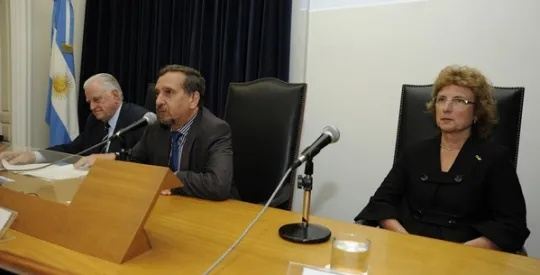
Recently, Paenza, Dr. Kornblihtt, and Jorge Aliaga (dean of Exactas) were distinguished by the Minister of Science, Lino Barañao, at the initiative of Senator Filmus.
Here is a photo of the moment when the three scientists received the "Senador Domingo F. Sarmiento" Honor distinction.

What does the reader see in the photo?
I see an official, political, state recognition of science. The three know mathematics.
Is there a recognition of mathematics in Argentina, in this photo? By the distinction, it seems so. The situation of INDEC, however, contradicts at least part of that official discourse.
Paenza earned his doctorate in that subject. And although Aliaga is a physicist, he is the dean of Exactas, a faculty that participated in the Consejo Académico de Evaluación y Seguimiento (CAES) and that in the middle of last year presented a report on the situation. In that 55-page document, the conclusions (which extend from page 37) include the following paragraph:
"As noted at the beginning of this document, there is a state of generalized skepticism regarding the validity of the statistics generated by INDEC, and in particular about the CPI. The examination carried out in this document substantiates the diminished public confidence in said indicator. In this sense, it is not possible to consider the CPI prepared by INDEC as a reliable measure of the aggregate level of consumer prices, nor as an adequate indicator to use as a deflator for estimating variables such as the real exchange rate or real wages or poverty levels. The arguments presented by INDEC, meanwhile, do not dispel doubts about the quality of the index, nor do they change the perception about the existence of problems in the estimation of the CPI series."
Paenza has made few public statements on the matter. But some can be rescued, such as the one made in the Science Commission of the Chamber of Deputies in April 2008:
"The problem is that in Argentina there are no reliable data. The problem of INDEC is from this last year and is very serious, but so is the lack of statistics to be able to measure.
I'll give you an example, a car is moving and we take a picture of it; I tell you that car was going 130 kilometers per hour, you don't know if the car is accelerating or braking. It is important –and all those who have ever studied mathematics will know– the importance of a derivative to know if it is growing or decreasing.
I cannot affirm if the gap is growing because I don't know, I can conjecture that it seems to me that it is. But the 'it seems to me that it is' is not useful because 'the it seems to me that it is' is for a coffee chat and not for a meeting like this where you are supposed to be helping to think about the country. A conclusion that could be drawn is that it matters to have the data in order to be able to speak."
http://www.youtube.com/watch?v=tiwFyklw-bU
Functionalism and Solipsism
How many times have we heard Dr. Paenza make positive references to the political process linked to science that began in recent years, at least since the creation of the science portfolio? Many. And it is valid and I personally agree that it is excellent that there is a ministry, an attempt at planning, active policies, repatriation programs, thinking about where we want to go in this matter. And it is very good to say it. There is no 'but'. It is very good.
How many times have we heard Paenza appeal for INDEC to regain the prestige and confidence it once had?
Possibly Paenza discusses this in private with colleagues and officials. Publicly, very little. And he has the opportunity. To the public and to officials. Could it be that it is easier to highlight the positive than the negative? Constructive criticism, I mean.
Well, this is where the idea of functionalism arises: If I criticize the attitude of INDEC, I criticize the State as a whole. Since I don't want to do the latter, then I say nothing about the Institute of Statistics.
This seems to be the prevailing reasoning. On this issue and many others.
For a few years now, in parallel, we have been attending a "communication class." The media distort, manipulate for particular interests. They lie. And not only by what they say, but by what they hide.
Ok. Thanks. I didn't know. I was born yesterday. Good thing they tell me. (Irony: Off)
Certainly this is not news in academic and journalistic circles, but it is possible to understand that part of the public opinion was not aware of that.
Now, if I say that is wrong, wouldn't it be wrong for me to do the same?
The issue of the "double standard" is attempted to be justified with "functionalism." Carta Abierta and its pseudo-criticism of Filmus's campaign in the City have been criticized for being "functional to the opposition."
The idea of functionalism implies not speaking, keeping silent, hiding for fear of misinterpretation. For me it is a kind of communicational solipsism that I cannot share.
Communication Strategy
I understand, however, that communication goes hand in hand with strategy. After all, we want what we say and encode in a certain way to then be understood by our interlocutors appropriately, for the decoding to convey our ideas to the receiver and not something else. Otherwise, our communication will not be efficient. And achieving this can be extremely difficult. But it always is. And not for that will we remain silent.
Criticizing does not imply, of course, being against everything. And if we fear that such an interpretation may arise, we can make the necessary clarifications. Like that first one with which I began, taken up again here to state that what I am doing is indeed criticism and not, in any way, a negative view of everything. Just read the previous posts. But if that is not enough, here is an explicit statement: I think it's fabulous that there is a greater flow of funds for science, that scientific activity is seen as a necessary producer of knowledge that must be promoted by the State. I think it's fa-bu-lous. That there is State involvement there is not in doubt and I don't think it's bad. Bravo. An applause or two.
Now, let's be serious and see what can be improved, right? There must be something. Is there?
Media and criticism of science
If the reader reviews the blog, they will not find much criticism of Argentine science. I would say almost none, with some exception. Is the reader reading a "brown-nosing" blog?
No. I do not have a partisan stance. Does it have an impartial stance? No, hence the statements made before.
What about Clarín and La Nación? Let's read the Science/Health section and Nora Bär's columns and we won't find ruthless criticism. Not even many veiled criticisms of the country's science. I would even say quite the opposite.
Let's read Valeria Román's articles in Clarín and not there either.
Could it be that no criticism is made because everything is fine?
It's a difficult question to answer. It's like asking: How is science in the country? In this or other countries. For that we must turn to data. There are official indices (not from INDEC) linked to production, number of researchers, papers, etc.
Even so, it remains difficult to draw a general conclusion for all of science through numbers. Numbers don't speak for themselves, do they? And each discipline can have a different scenario, even though it should be possible to have a broader diagnosis that includes relationships between institutions, federalization, etc.
The feeling seems to boil down to the economic issue. If there is a flow of funds, criticism is almost non-existent. As in soccer, the negative view is covered up by the results.
When that is not the case, when the scissors come out, as in Spain or the U.S., budget cuts have a broad repercussion among researchers and in the press.
What needs to be told
What importance do the INDEC numbers ultimately have?, some may ask. It gives the feeling (personal, mine, particular) that the discourse is that there is no science there.
I understand that Economics is not equal to Mathematics. I also understand that science IS statistics. I don't say exclusively, but to a large extent it is statistical induction.
The situation of the Statistics Institute must be told. It must be said. We must push for the experts to have the influence they deserve. Not so that INDEC says that inflation or the basic food basket or the CPI are what private consulting firms or the poorly suited popular inference stipulate. That never happened, not even when it supposedly had public approval. I'm referring to the CPI, because I, single and without children, don't buy the same as a typical family and I permanently change my purchases.
But it is demandable that the methodology for obtaining and analyzing data be carried out with competence and judgment, with transparency. Without partisan interference. There cannot be a "convenience strategy." I cannot "model reality" to be what I want. THAT IS NOT SCIENCE. That must be told.
With enormous backing from society, the government should promote the changes that allow INDEC to once again generate reliable tools, with the consensus of experts, of Argentine scientists who are prepared for that. Prepared mathematically and ethically. And those who explicitly support the current administration, it would be good if they also promoted those changes, without fearfully silencing criticism.
"Denying the changes is an unfair reading" says Paenza in Veintitrés. With due respect, I say, hiding what is wrong, too.
That photo implies official recognition of science. There is a mathematician there who also has great access to officials and the public. A disseminator of that science who tries to narrow the gap between what we know and ignore, between what mathematics potentially is and our idea of what it is. Who tries to make us lose our fear of numbers, who encourages our creative interest. Who tries to show that mathematics is everywhere. There would be no astronomy without mathematics. There would be no music. Would there be INDEC? That is also mathematics.
Sources and related links
- Mincyt: Barañao participated in the distinction for scientists in the Senate
- INDEC
- How, Is This Also Mathematics?, new book by Adrián Paenza
About the images
- Photo of Dr. Lino Barañao at the presentation of the "Senador Domingo Faustino Sarmiento" Honorary Mention to Drs. Alberto Kornblihtt, Adrián Paenza and Jorge Aliaga. Credit: Ministry of Science.
- Cover of How, Is This Also Mathematics?. Editorial Sudamericana.