A collection of links to music, images, and videos relating art and science. Today: Images of AFGL 2591, 2001 KX76, NGC 6914, and NGC 2146. Music: Beyond the sky, by Juan Manuel Guerra. Video: 1st 3D Broadcast from space.

Images of the decade
AFGL 2591: The Fireworks of a Massive Star
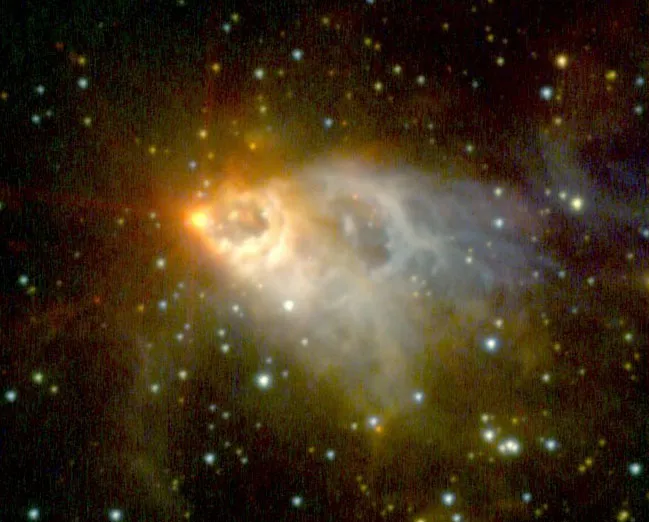
The young and massive star AFGL expels its outer layers due to the internal forces of the star that push the inner material outward. It is estimated that the star is one million years old and that it created a nebula 500 times larger than the Solar System in the last 10,000 years. The image is in infrared light, taken at Gemini North. A closer inspection reveals at least four expanding rings. AFGL 2591 lies 3,000 light-years away toward Cygnus.
It was the Astronomy Picture of the Day (APOD) for August 29, 2001.
Also in Observatorio.
Credits: C. Aspin et al., NIRI, Gemini Obs., NSF
The Size of 2001 KX76
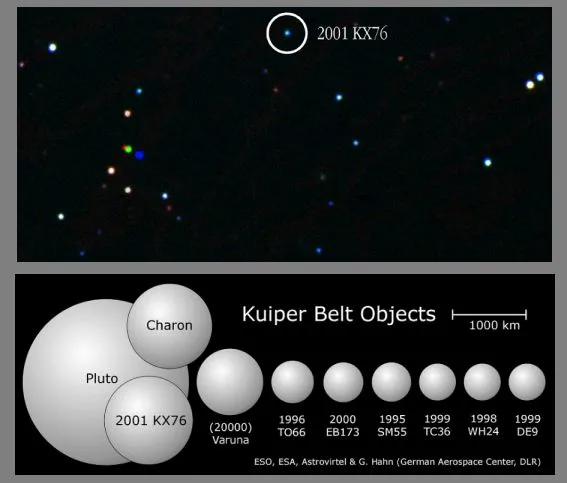
2001 KX76, also known as Ixion, was discovered in May 2001. The image shown here has two parts: in the top one, the position of the object is marked on a composite from the La Silla Telescope, of ESO. But although it looks like a simple dot, this Kuiper Belt object is 1,200 km in diameter, larger than Ceres. In fact, in the lower part of the image we can see a comparative illustration of several objects.
It was the Astronomy Picture of the Day (APOD) for August 30, 2001.
And in Observatorio.
Credits: ESA,ESO,Astrovirtel,Gerhard Hahn (German Aerospace Center,DLR),et al.
Images of the week
NGC 6914
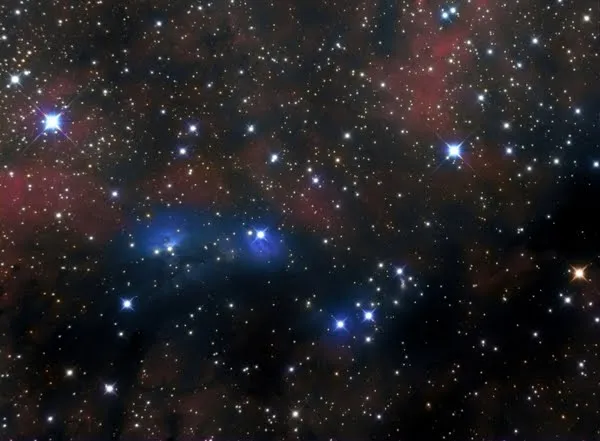
The beautiful nebula was captured by Italian astrophotographer Fabrizio Francione
It was the Amateur Astronomy Picture of the Day (AAPOD) for August 25, 2011.
In March of this year, an image of the same object, but taken by astrophotographer Vicent Peris of the Astronomical Observatory of the University of Valencia, was part of the Astronomy Picture of the Day (on March 4).
The nebula complex is located about 6,000 light-years away, toward the northern constellation of Cygnus, and toward the plane of our galaxy the Milky Way.
Feeling the Pressure
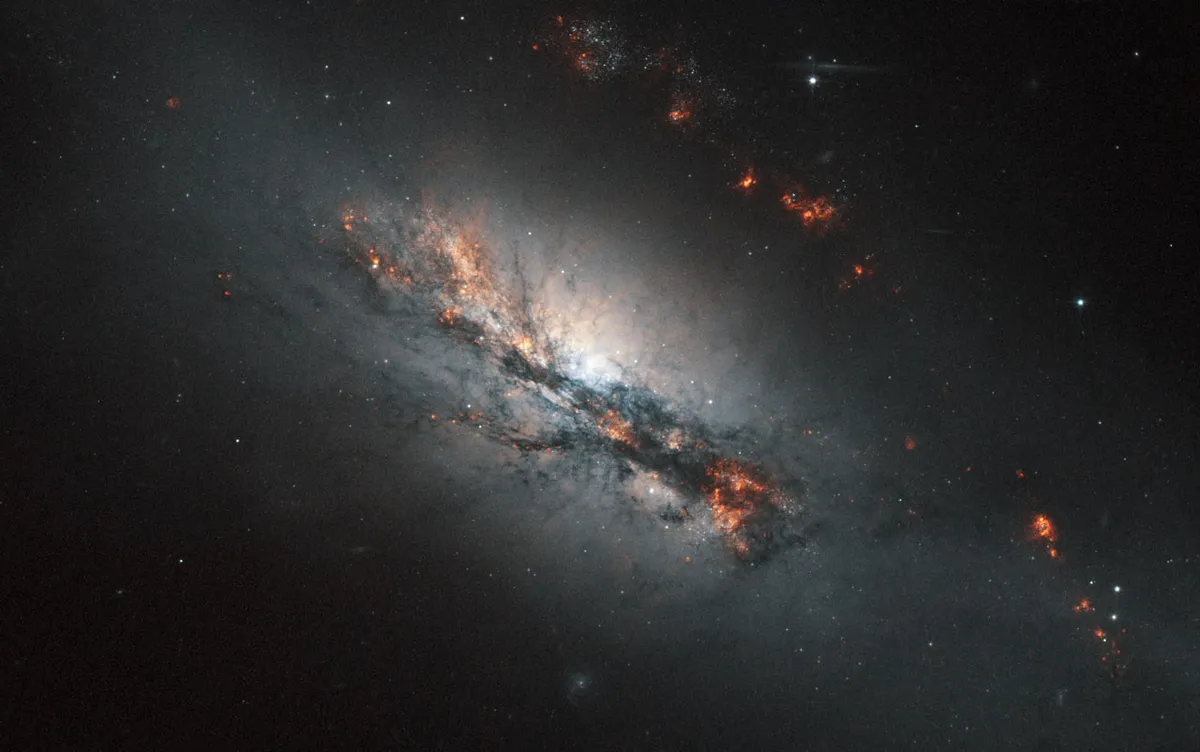
NGC 2146 is classified as a barred spiral due to its shape, but the most distinctive feature is the dusty spiral arm twisted in front of the galaxy's nucleus, seen from our perspective. The forces required to change the natural shape of this structure and bend it 45 degrees are colossal. The most likely explanation is that a neighboring galaxy is gravitationally perturbing and distorting the orbits of many stars in NGC 2146.
With an extent of 80,000 light-years, it is somewhat smaller than our Milky Way. It lies 70 million light-years away, toward the constellation of Camelopardalis.
It was the Space Telescope Picture of the Week.
Credit: NASA/ESA
Space Music
Beyond the sky: Juan Manuel Guerra
From Palma de Mallorca, this young Spaniard makes wonderful music. His album Beyond the sky, published on Jamendo in August 2009, is flawless. Right from the first track, its enveloping and spatial sound is captivating. The influence of Oldfield is noticeable, especially in track 4, Nightingale.
According to what José Manuel (The Viper) reports on his blog, he is preparing his second work, which would be called "Sunshine In The Dark" and of which we can glimpse something on SoundCloud.
We can learn more about The Viper at SleepingRoom.es, through different social networks.
For example, we can see and listen to José Manuel performing covers of Oldfield, Vangelis, as well as the making of Migration, an album by Onofre Gracias in which he participated.
Beyond The Sky is available on Spotify.
Science in motion
First "3D" broadcast from space
Half a century after humanity's entry into outer space, a camera developed by the European Space Agency produced the first live-transmitted 3D images, showing the International Space Station as never before.
On August 6, NASA astronaut Ron Garan operated the ERB-2 camera (Erasmus Recording Binocular) to open a new window on the ISS through stereoscopic eyes, in high definition. As Flight Engineer for Expedition 28 and also a video blogger, Garan placed the camera in the Columbus Laboratory.
This video, ESA promises, will be the first in a series: European astronaut Paolo Nespoli recorded part of his life aboard the ISS during his MagISStra mission. His colleague André Kuipers is training to use the ERB-2 during his six-month mission that begins in November.
Take your anaglyph glasses and see the ISS in "3D"
Video: First 3D broadcast from space
http://www.youtube.com/watch?v=riJ0eHTCeig
To access previous editions of this section, consult the Multimedia Selection Series.