A collection of links to music, images and videos that relate art and science. Today: Images of Centaurus A, July Dawn. Robledo de Madrid Complex, Smoke signals in space. Music: Echoes from Jupiter. Video: The pleasure of having a problem to solve.

Images of the decade
Centaurus A: A nearby elliptical with an active nucleus

First observed by Chandra in September 1999, Centaurus A was a clear demonstration of the spectacular science the powerful X-ray observatory could do.
This Chandra image of Cen A, or NGC 5128, shows a bright central source: the Active Galactic Nucleus (AGN) suspected of hosting a supermassive black hole. The galaxy is located 11 million light-years from Earth.
The image was published on August 6, 2001.
Credit: NASA/SAO/R.Kraft et al.
A July Dawn
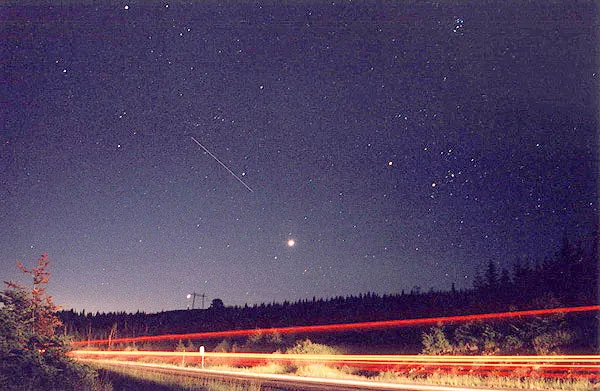
Those who got up before dawn in late July in the northern hemisphere could see planets, stars, and a spacecraft in a quick glance before starting the day. Towards the eastern horizon shone Jupiter, and not far away, above, to its right we had very bright Venus. By connecting these two points, we would point towards Saturn. Far away, already near the upper right corner of the image, we have the Pleiades cluster. Orbiting Earth, almost in the foreground, the International Space Station reflected light, creating a faint line. Completely in the foreground, a passing van produced the bright yellow and red lines. The image was taken on July 26 from Quebec, Canada. Why are the bushes visible through the van? The van was present only for an instant of the 25-second total exposure.
It was NASA's Astronomy Picture of the Day (APOD) for August 7, 2001.
Also on Observatorio.
Credit: Dominic Canti
Images of the week
Smoke signals in space
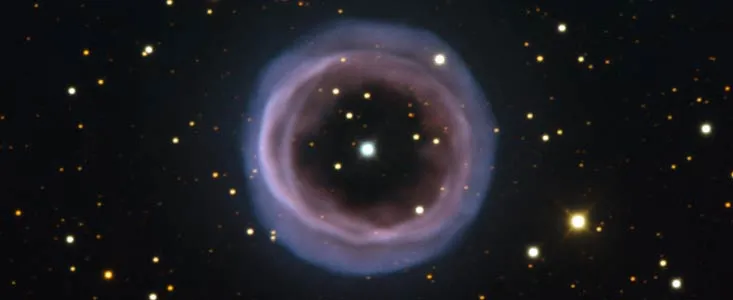
This annular planetary nebula, in the constellation of Norma, should not be confused with the popular M57 or Ring Nebula. It was discovered by Harlow Shapley in 1936 and is located 1,000 light-years from Earth.
It has been cataloged as Shapley 1 or Sp 1 although it is also known as the Fine Ring Nebula.
Planetary nebulae form when dying stars, after having expanded into the red giant phase, eject their outer layers of gas as they evolve into white dwarfs. Most are spherical or elliptical in shape.
But Sp 1 appears almost circular. Astronomers think these more unusual shapes form when the progenitor star is a binary system.
It was the ESO Picture of the Week.
Credit: ESO.
Satellite tracking
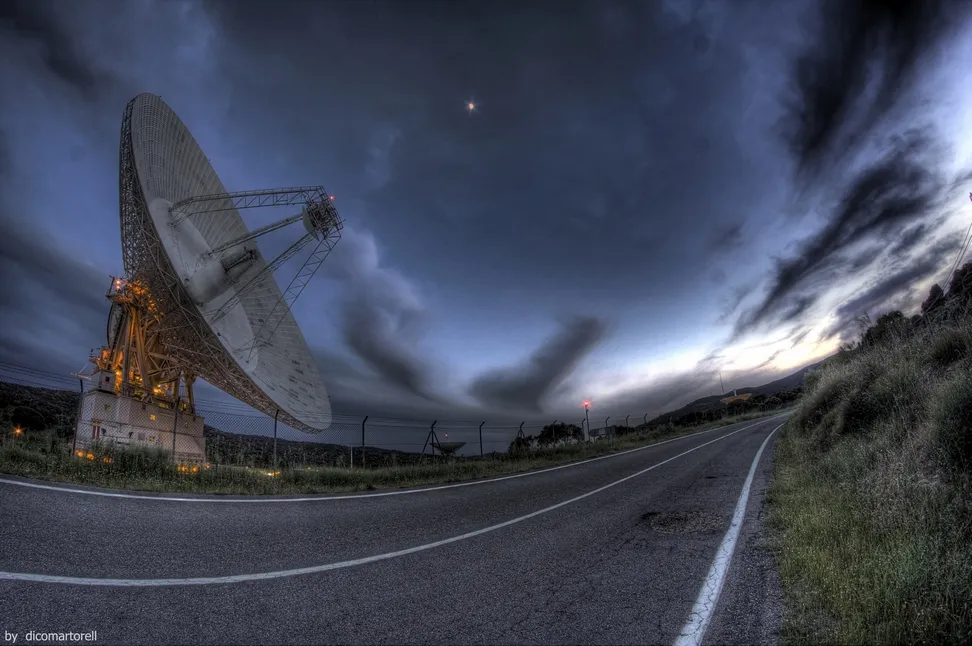
Dico Martorell made this HDR (High Dynamic Range) combination on the 70-meter antenna (DSS-63) of the Robledo Complex in Madrid (MDSCC), NASA's facility in Spain.
The image is from May 5 of this year, but it was the Amateur Astronomy Picture of the Day on August 5, 2011.
What is the bright object that appears to be in a straight line to the primary focus, almost at the top center of the image?
Space Music
Echoes From Jupiter
NASA just launched a probe to Jupiter: Juno. An opportune moment to listen to "Echoes from Jupiter," a Canadian band that has two albums or books:
The first, Io. The second, Europa.
Made up of Mathieu April (guitars), Mathieu Blais (percussion), Francois Gagnon on bass, David Paradis (guitars) and Steve Trudel (guitar, voice)
Echoes From Jupiter mixes post-rock melodies and textures with some grunge and the melancholy of shoegazing. By combining those styles together they try to find their own sound, while paying tribute to bands that inspired them, like The Smashing Pumpkins, The Cure and others.
They formed in 2005 in the city of Québec and after several lineup changes they stabilized in 2009, the year they released their first EP, Io. In September 2010 they gave birth to Europa with a somewhat more elaborate sound.
We can find Echoes from Jupiter on Soundcloud, Jamendo and on their website, with access to other social networks.
From their first album, the second track has its video:
Video: The Silver Module - Echoes from Jupiter
http://youtu.be/4e4ZjCDwgy4
Science in motion
Adrián Paenza - The pleasure of having an unsolved problem in your head
The following talk by Dr. Paenza was recommended to me by a blog reader, Julio, to whom I already thank for the contribution.
In his speech, Paenza states that scientists do not have all the answers to all problems and that it is not bad to say "I don't know."
Since statements can be interpreted in many ways, it should be said that there are those who rely on declarations like this to point out that then everything said outside the scientific realm is possible, even if scientists say it is not.
What is also necessary to point out is that, although in a way that is true, there is a very important distinction, not in what is NOT known, but in what IS known. When a scientist makes a statement, they do so supported by a theoretical framework, certainly, but also by concrete observations through statements that try to be as unambiguous as possible.
Do those who make extraordinary claims about any topic act in that way?
Surely there are things in Nature, in the Universe, that the sciences do not understand and have not discovered. That researchers do not even imagine. Surely there is "something more" than what is known so far.
But, does that mean that things exist like those cheerfully postulated by many pseudo-scientists?
Well then, let's analyze what claims are made and based on what theories and observational data.
And of course, the thing also works the other way around. What pseudo-scientists say can also be wrong or incomplete, although you don't hear them say "I don't know."
http://www.tedxriodelaplata.org/videos/placer-tener-un-problema-no-resuelto-en-cabeza
To access previous editions of this section, consult the Multimedia Selection Series.