A collection of links to music, images and videos relating art and science. Today: Images of Solar Eclipse in Madagascar, A distorted galaxy. Sunset in Orion, ARP 286. Music from the Chandra Observatory. Video: Mathematics and art.

Images of the decade
Totality in Madagascar
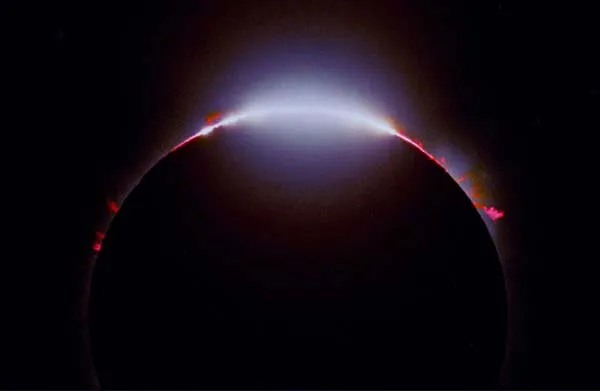
When the moon's shadow reached and touched the southern hemisphere of Earth on June 21, 2001, the first total solar eclipse of the 21st century began. Starting in the Atlantic, the central lunar shadow or umbra traced a path that crossed southern Africa and the vast island of Madagascar, before ending at sunset in the Indian Ocean. Of course, as the lunar disk covered the Sun, the total phase offered splendid views of the elusive outer solar corona. Also, as seen in this stunning telescopic view from southern Madagascar, it revealed an active solar limb with incipient pink prominences the size of a planet. Taken as totality began, this image of the last rays of sunlight shining through the valleys and depressions of an irregular lunar terrain gives the sensation of a bright jewel set in a celestial pink ring.
It was the Astronomy Picture of the Day July 26, 2001.
Also on Observatorio.
Credits & Copyright: Vic & Jen Winter /ICSTARS Astronomy, Inc
Hubble photographs distorted galaxy
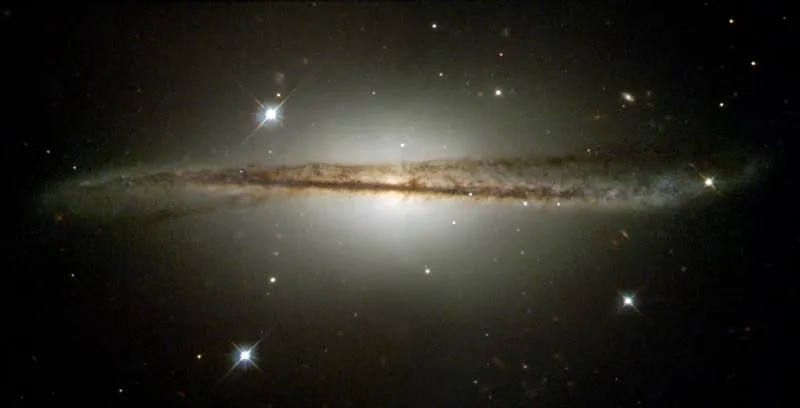
Hubble captured an image of an unusual edge-on galaxy, revealing remarkable details of its dusty disk and showing how galaxy collisions unleash the formation of new generations of stars.
The dusty spiral arms of galaxies like the Milky Way appear flat when seen edge-on. But Hubble photographed galaxy ESO 510-G13 has a "warped" disk. This had already been noted with images from ESO in Chile. The galaxy lies in the constellation Hydra, almost 150 million light-years from Earth.
The strong deformation of the disk indicates that ESO 510-G13 recently underwent a collision with a nearby galaxy, swallowing it in the process. Gravitational forces distort the structures of galaxies, as gas, dust and stars merge in a process that takes millions of years.
In the outer regions of the galaxy, especially to the right of the image, it can be seen that the disk contains dark dust but also bright clouds of blue stars. This shows that young, hot stars are forming in the disk.
While taking this photograph, the WFPC2, Hubble's Wide Field Planetary Camera, took its 100,000th image since its installation in 1993.
The image was published on August 2, 2001 by HubbleSite.
Credit: NASA and The Hubble Heritage Team (STScI/AURA)
Images of the week
Sunset in Orion
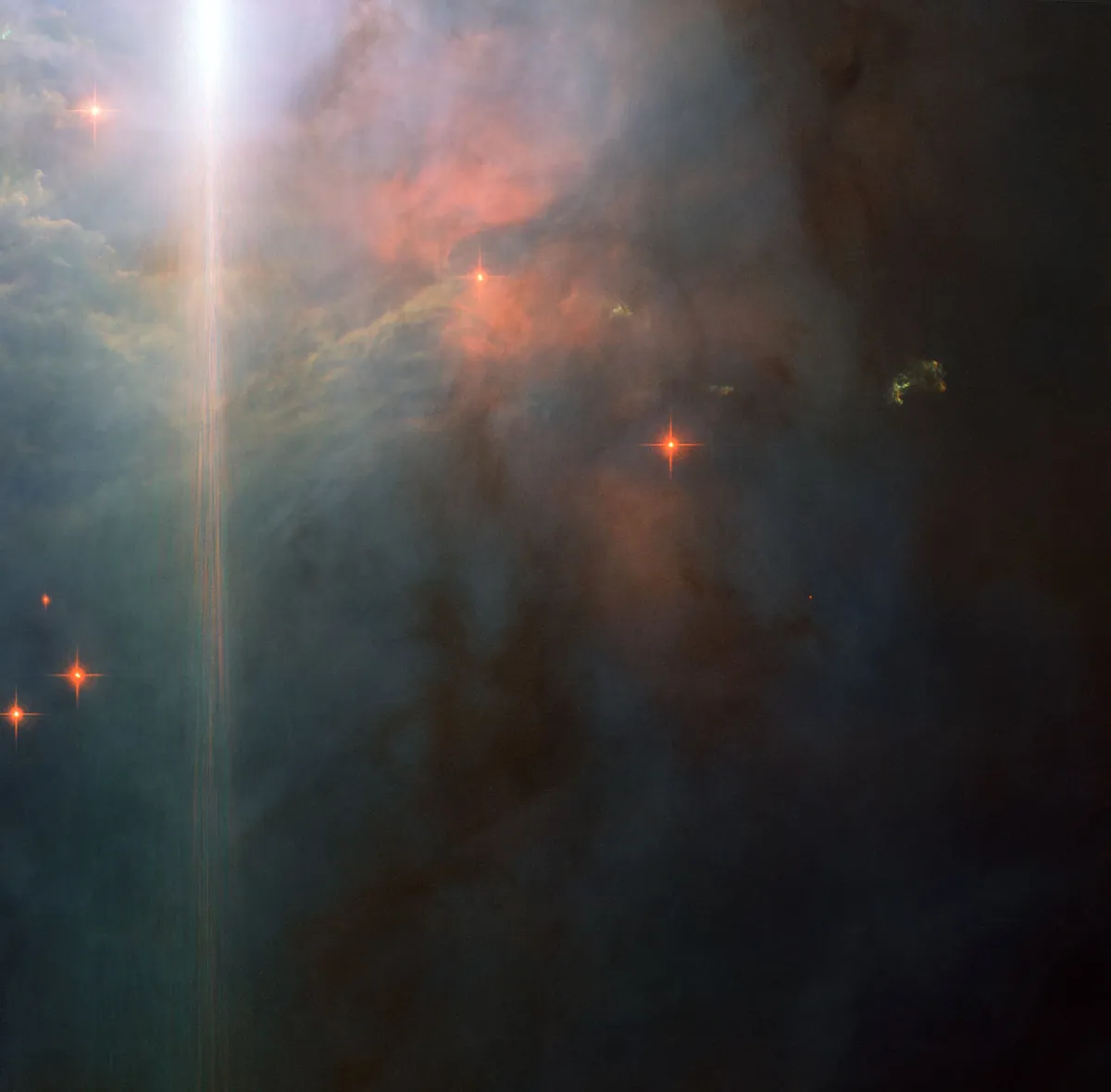
NGC 2023 surrounds a massive B-type star. These stars are large, bright, blue-white, with high surface temperatures, much hotter than the Sun. The energy emitted by this star illuminates the nebula. The star is outside the field of view, above and to the left, and its bright light scattered by Hubble's optical system creates this glow on the left side, which is not a real element in the nebula.
New stars are forming in NGC 2023. Hubble's image captures the rippling gas, 5,000 times denser than the interstellar medium. The greenish clumps are thought to be Herbig-Haro objects. These are objects in star-forming regions created when gas ejected at very high speed from new stars impacts the surrounding material. Shock waves cause the gas to glow and result in the strange shapes seen here.
The image was the Astronomical Image of the Week from the Space Telescope.
Credit: NASA
Looking for NGC 2023
This reflection nebula is a good object to search for in the sky. The B-type star alluded to earlier is HD 37903/HIP 26816 and is located near Alnitak, one of the "Three Marys" of Orion's Belt.
We can visualize a map of the region with an educational tour of the area in "Ajustándonos al Cinturón de Orión", by Rodolfo Ferraiuolo and Enzo De Bernardini of Sur Astronómico.
From the north you can consult Observing at Skyhound.
To observe it, from Buenos Aires, we will see it towards the East. We must find Orion, locate "the three Marys" and look a little above Alnitak.
These days we can see Orion's Belt around 6:30 in the morning at about 30º above the horizon.
Let's say Rigel appears around 3:30, while Jupiter is in Aries. An hour later Orion's Belt will be visible, very close to the horizon, to the right of Aldebaran. At 5:40 Mars will show its reddish face.
Trio in Virgo
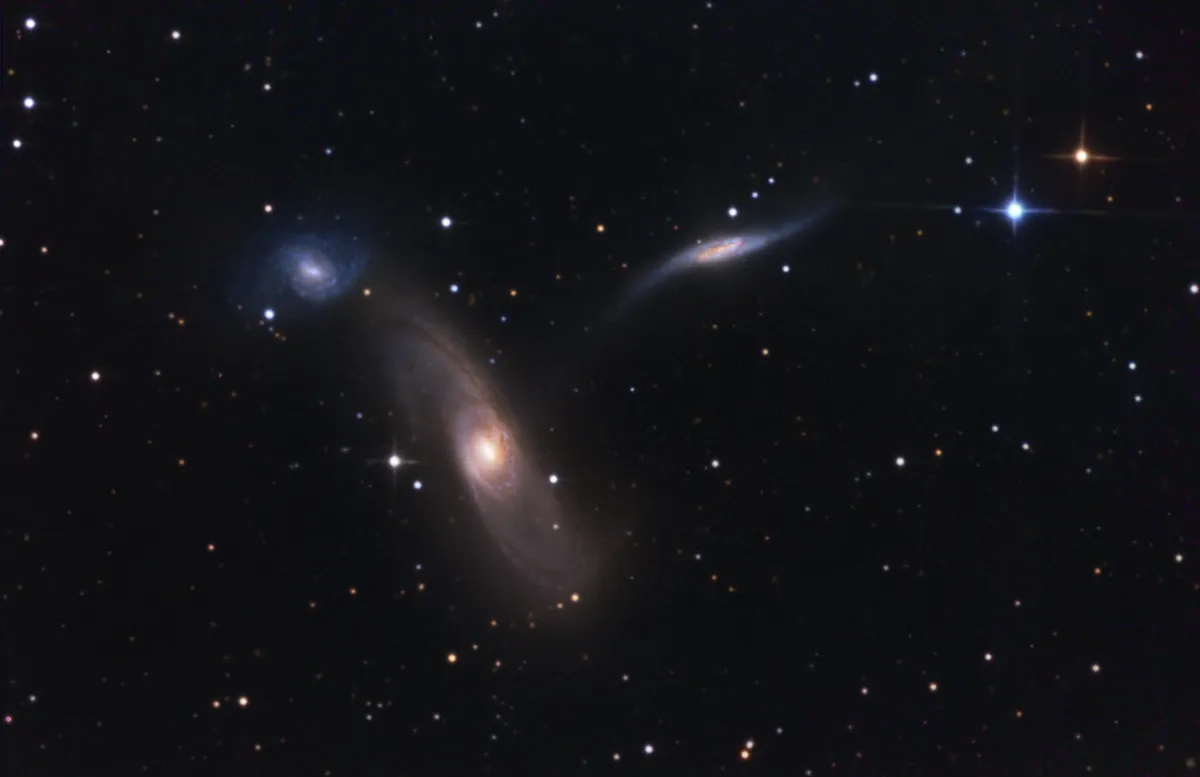
ARP 286 is a trio of galaxies. The designation comes from Halton Arp's 1966 Atlas of Peculiar Galaxies.
This image was taken by amateur astrophotographer Stefano Conti and was the Amateur Astronomy Picture of the Day, AAPOD, of July 28, 2011.
A similar image, taken by Stephen Leshin, was the Astronomy Picture of the Day August 13, 2010.
This trio of interacting galaxies is almost 90 million light-years from Earth and contains the predominantly yellow galaxy NGC 5566, with its enormous arms. The galaxy is huge, about 150,000 light-years in diameter. Above, the smaller and bluish NGC 5569. To the right, the multicolored NGC 5560.
Space Music
Komarken Electronics - Chandra X-Ray Observatory
This album was released on June 6, 2011 by Komarken Electronics and is available to listen to and download on badcamp.
On July 23, 1999, 12 years ago, the Chandra X-ray Observatory was launched.
Tip: To download the entire album for free, click "Buy Now". A small window will appear where, if desired, you can indicate a value in euros to buy the album in different formats and pay with a card or paypal. If you enter "0" (zero) in that box, a green Download button will appear immediately. Clicking it will load a web page where the file is prepared, after which a blue Download option appears. From there you can download without problems and choose the format. The album in MP3 320 is 67 MB in a compressed file.
Science in motion
Mathematics and art
Lecture by mathematician Pablo Amster, author of a couple of very interesting books that I emphatically recommend, such as La matemática como una de las bellas artes and the more recent ¡Matemática, maestro!, a concert for numbers and orchestra. Both are part of the Ciencia que ladra collection from Siglo XXI Editores.
The lecture, held at Parque Explora, is part of the Ciencia en bicicleta series.
These meetings foster social dialogue around science and technology, allow for conversation between the expert and their audience, celebrate citizen creativity, induce debate, and form an updated and deliberative public opinion. Ciencia en Bicicleta becomes an opportunity to re-signify this knowledge in our environment, to give it renewed meaning for people, and to make it attractive and engaging, the only way it will have to achieve, through social appropriation, the elusive character of being transcendent.
Parque Explora is an interactive center for the appropriation and dissemination of science and technology with 22,000 square meters of internal area and 15,000 of public plazas in Medellín, Colombia.
Matemáticas y Arte from Parque Explora on Vimeo.
To access previous editions of this section, consult the Serie Selección Multimedia.