Just as it is possible, without leaving home, to calculate the distance to the horizon (even on other worlds), we can also calculate the Earth's radius.
In his Recreational Geometry, Yakov Perelman presented us with the problem of how to calculate the distance to the horizon and its corresponding solution.
For those who still don't know how to do it, I recommend doing a web search or visiting these selected links:
Recreational Geometry - Yakov Perelman
ECYT-AR: Distance to the horizon
Distance to the Horizon, Dr. David Stern
RecursosTIC: Distance to the horizon (with GeoGebra java application)
To calculate the distance to the horizon, the famous Pythagorean Theorem is applied, and it is concluded that the formula to use is that the distance h = sqrt (2.a.R), where a is the person's height and R is the Earth's Radius.
Let's use this idea to now calculate the Earth's radius.
Let's think about the following:
We position ourselves on the Earth's surface and mentally draw a line to the center of the Planet. What we will have done is draw a line equal to the Earth's radius. Now we walk. Suppose we walk a quarter of the perimeter and draw a second line from the final position also to the center of the Earth; what we will have between those two lines is a right angle. And what we walked was a quarter of the sphere, that is 360º/4=90º. There is a correspondence between the angle and the distance traveled. We can walk halfway around the perimeter and we will have a straight angle corresponding to 360º/2=180º.
This implies that the angle and the distance traveled correspond.
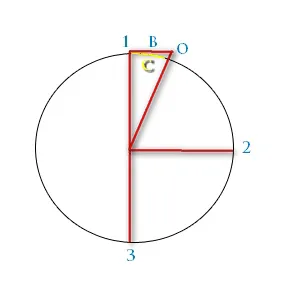
Since the angle is very small, segment B and C are approximately equal
But to make a calculation like this, do we have to walk on the Earth's surface? No, we can take advantage of the fact that our planet rotates on its axis. If we are on a beach, we can sit and wait for the Sun to set. At that moment we stand up. Now, standing, we will see some rays of the Sun and we start measuring how much time passes until we stop seeing it again. For a person of average height, say 1.7 meters, the elapsed time will be about 10 seconds.
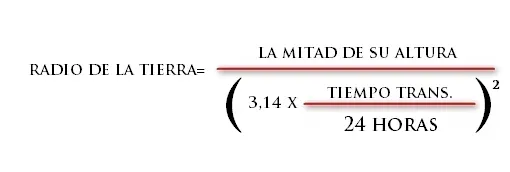
With this data we can simply apply the following formula:
Let's see if it works:
The second term has a divisor and a dividend. In one case it is half our height. Let's say it is then 1.7 / 2= 0.85.
Below: 10 seconds (the elapsed time) / 24 hours (86,400 seconds)= 0.00011. We multiply it by 3.14 and get 0.00036. That squared is 0.00000013.
0.85/0.00000013= 6,435,571 meters, a bit more than 6,400 km, close to the 6,378 that is the planet's radius.
But what good is the distance to the horizon to me and where does the formula come from?
We started by saying that the angle traveled corresponds to the distance traveled. This distance traveled is similar to the distance to the horizon:
As seen in the figure above, when the angle is very small, as in this case, the distance traveled will be approximately equal to the distance to the horizon. That is, segment B in the figure will be almost equal to C.
Segment B is the distance to the horizon, which we already know is the square root of 2xaxR.
We also know that the Earth makes a complete turn (360º) in 24 hours, so the angle traveled/360 is equal to the elapsed time/24 hours.
From this we can deduce that:
elapsed time /24 hours = distance to the horizon / Earth's perimeter.
If we square both terms, the equality is maintained (5).
Now, we replace the distance to the horizon with the formula indicated earlier (which we do not explain here, but we point to other websites that explain it) and we also replace the Earth's perimeter with its corresponding equation (6 and 7).
Again, more graphically:
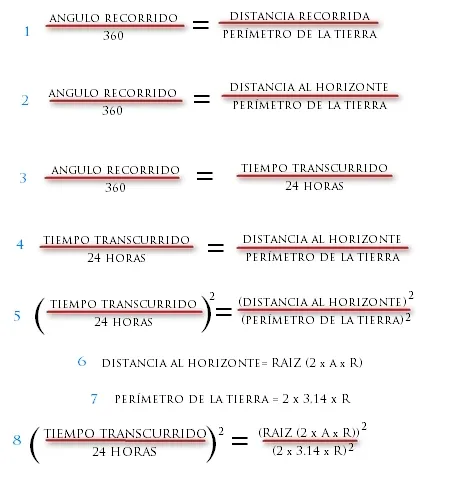
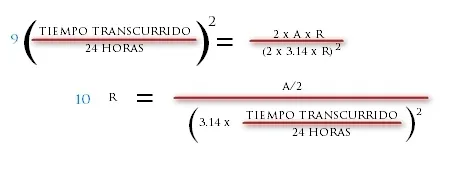
Since the distance to the horizon is a square root and we square that member, we can cancel.
Then it is easy to solve for R. We can distribute the power on the second member, cancel the two and R, move Pi squared to the other side multiplying. We move a/2 and obtain the formula used earlier.
Distance to the horizon and variable height
If we have seen in the indicated links how to calculate the distance to the horizon, then perhaps we are curious to know:
1-What height would we have to be on other worlds if the distance to the horizon were x?
2-What would be the distance to the horizon on other worlds if our height were x?
We can easily calculate that data with a spreadsheet, like DistHorizonte.
Let's see:
In sheet 1 I have each planet and Earth's Moon with their corresponding equatorial radius data according to NASA. Below, for each case independently, I can calculate both parameters:
In sheet2 I can change only one parameter, the height, but for all planets/Moon:
We see that a person 1.7 meters tall would have a distance to the horizon of 2.4 meters on the Moon and 15.59 on Jupiter.
Then, in sheet3, the same but only for the distance to the horizon. This is more unusual because it implies what height we would have to be on each world for our distance to the horizon to be the same as on Earth. All at sea level.
Note written for the XXII Carnival of Physics, in this edition hosted by BioUnalm. To join and read the entries there is a social network on Ning.
Sources and related links
- Physics in Everyday Life, Alberto Rojo, Siglo XXI Editores.
- Recreational Geometry, Yacob Perelman.