A collection of links to music, images and videos relating art and science. Today: The Rotten Egg Nebula, Moon and stars. Images of the week: A butterfly and a starfish. Music: Ron Garan on the ISS. Video: Mars in 3D.

Images of the decade
The evolution of the Rotten Egg Nebula
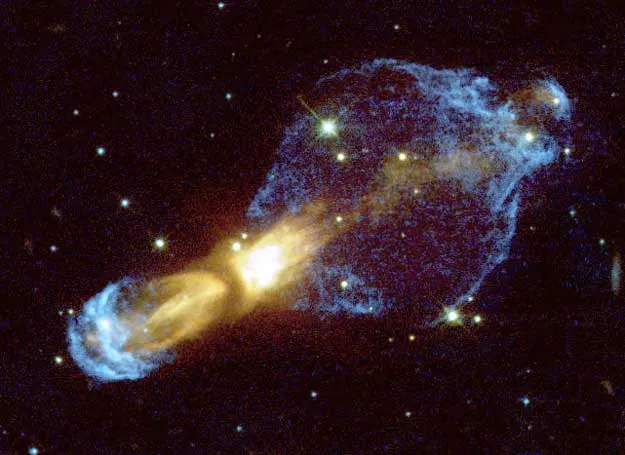
The rapidly expanding gas clouds mark the end of a central star in the Rotten Egg Nebula. What was once a normal star has run out of nuclear fuel, causing the central regions to contract and form a white dwarf. Some of the released energy causes the star's outer envelope to expand. In this case, the result is a photogenic protoplanetary nebula.
The Rotten Egg Nebula, also known as the Calabash Nebula and OH231.8+4.2, will very likely become a full bipolar planetary nebula within the next 1,000 years. It is located about 5,000 light-years away in the direction of the constellation Puppis.
Credit: V. Bujarrabal (OAN, Spain),WFPC2,HST,ESA,NASA
It was the Astronomy Picture of the Day (APOD) September 3, 2001.
Also on Observatorio.
Moon and Stars
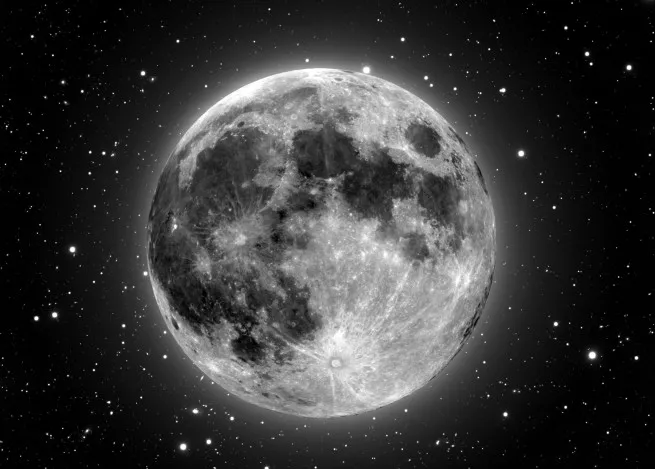
Here we show something not seen every day... a detailed photograph of the full Moon surrounded by a star-filled background.
The image is rare because to take pictures of the lunar surface, short exposures are usually used, while for stars and galaxies, longer exposures are required.
So obviously, the phenomenal view is a combination of two digital images — one short exposure, recording the exquisite lunar surface that highlights the full Moon, superimposed on another very long exposure, made with the Moon absent in the star field.
Credit: T.A. Rector,I.P. Dell'Antonio,NOAO,AURA,NSF
It was the Astronomy Picture of the Day (APOD) of September 6, 2001. And on Observatorio.
Images of the week
M6: The Butterfly Cluster
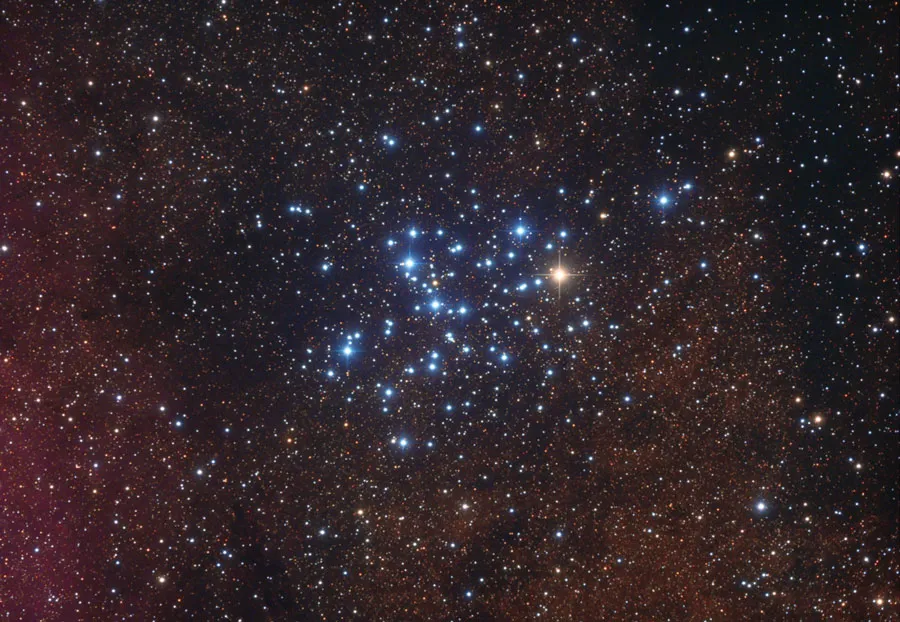
To some, the shape of the open cluster M6 resembles a butterfly. The object, also known as NGC 6405, spans about 20 light-years and lies 2,000 light-years away, in Scorpius. Like other open clusters, it is composed mainly of young blue stars, although the brightest one is almost orange.
It was the Astronomy Picture of the Day September 6, 2011, captured by Argentine astrophotographer Sergio Eguivar from Buenos Aires Skies.
A starfish in the sky
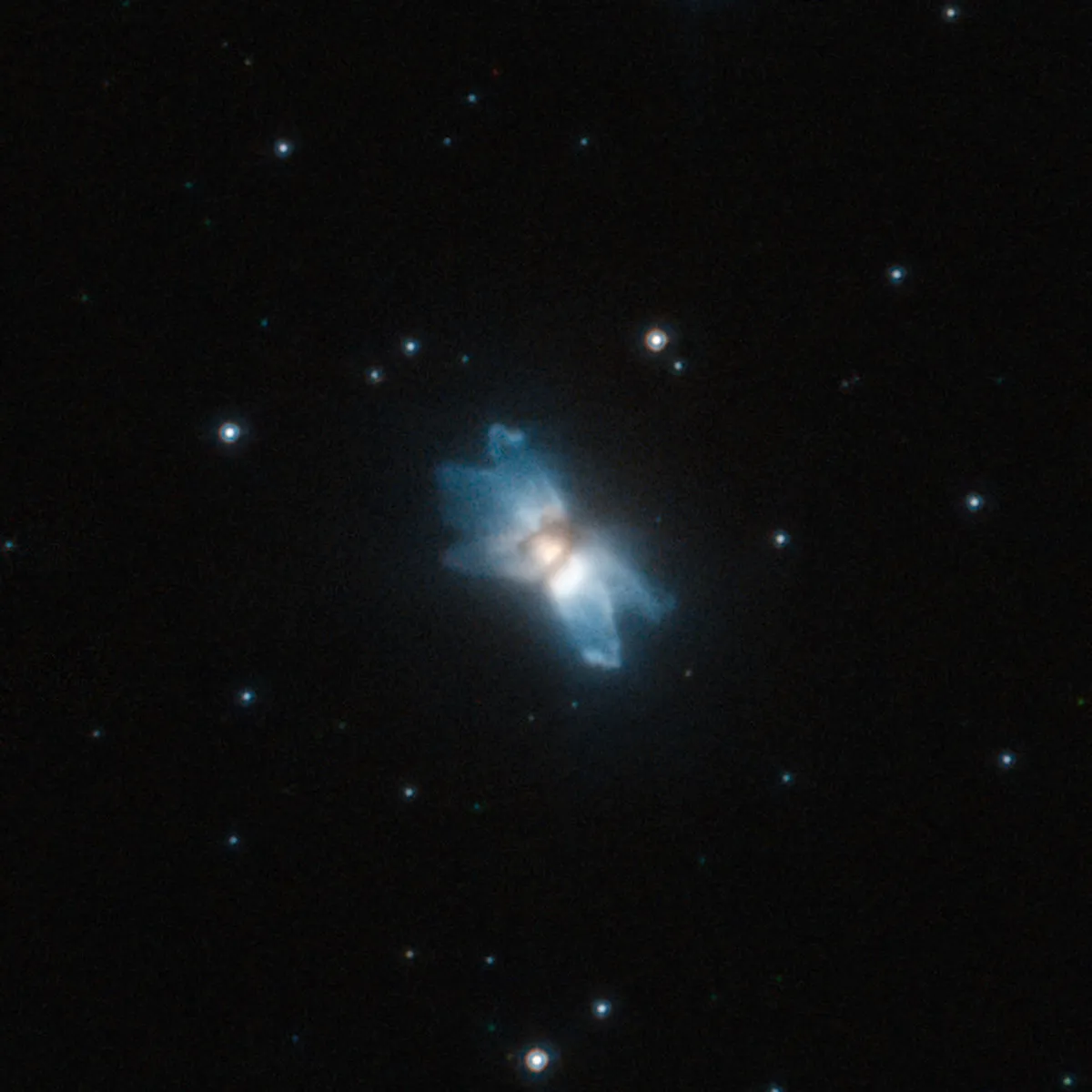
In the constellation of Aquila lies a star in the final stages of its life, surrounded by a cloud of gas and dust that, to some, resembles the shape of a starfish. (Perhaps here you do see a butterfly).
An incredible image of the object, known as IRAS 19024+0044, was made by Hubble.
Protoplanetary nebulae offer clues about how sun-like stars end their lives and how they transition into white dwarfs surrounded by a planetary nebula. As it ages, a star like our Sun will eventually expel its outer layers into space, creating a beautiful and sometimes intricate shape of gas and dust around it. At first, still relatively cool, the star is unable to ionize the gas, which glows only by reflected and scattered light from the star. Only when the star's temperature increases enough to ionize the protoplanetary nebula does the pattern of gas and dust become a full-fledged planetary nebula.
It was the Space Telescope Picture of the Week.
Credit: NASA/ESA and R. Sahai.
Other images of the week
It is impossible not to mention the great photo: A high-definition view of the Apollo 17 area, nor the Winning Images of the Contest of Astronomical Photography held by the Royal Observatory in Greenwich, London.
Space Music
Blues in Progress
On September 1, Ron Garan, from the International Space Station, commented on NASA blogs and his blog network Fragile Oasis that his return to Earth would be postponed. The delay was due to a failure of Progress 44 on August 24. Since the rocket that carries the spacecraft is the same that carries the crew on the Soyuz, the next launch to the ISS was delayed until determining the cause of the failure.
Not only would the astronauts have to stay there a while longer, but also the ground control teams. And it is still a job where they need vacations.
To show that "we are in this together," Ron Garan and Mike Fossum made a video to bring a bit of fun to the Station.
Since they made the video they know (as of 9/1) that their return would be for mid-month, but that if the next expedition cannot be sent on time, the ISS would be left uninhabited, which creates uncertainty. Well, there would be one "metal inhabitant" left...
In the video, Mike Fossum looks for Ron Garan around the Station, in the cupola, in his bunk. He asks Satoshi Furukawa who tells him he saw him in the Russian module. There he consults Andrey Borisenko, Alexander Samokutyaev and Sergei Volkov. Finally he finds him, in the highest part of the Station, where, temporarily, Garan is the man at the greatest height in the solar system!
In that unique, somewhat lonely place, what better than to play a blues?
With due apologies to guitarists and music lovers, Ron Garan and his "work in progress."
http://www.youtube.com/watch?v=Uk9ptueTDwY
Science in motion
Mars in 3D
The different probes sent to Mars, Phoenix, Spirit, Pathfinder, Curiosity, produced 3D images of the red planet, but what was done with the Viking probes is great. Emily Lakdawalla from Planetary Society explains that it is a 32-minute video made with shots from Viking 1 and 2 both from orbit and on the surface. That mission was incredible: each probe consisted of two parts: an orbiter and a lander. The original film was produced by Stanford University in 1979 with 16mm film.
Since each descent probe had two cameras, separated by about 0.8 meters, when used together they could produce right and left images to generate the stereo effect.
For the orbital views, two images taken by the moving probe from slightly different locations were used to produce the 3D effect.
The video includes NON-3D images and is entirely in English, but even though what the narrator says adds to it, if that is not understood, someone who doesn't know the language can still appreciate the images with a three-dimensional effect.
Another point is the music: developed by the CCRMA at Stanford, in 1979. One of the creators of the music, Michael McNabb, explains on his site how the task and the restoration of the project in 2009 were done using a software emulator.
For that video, McNabb created a Mars Suite, the first movement of which can be heard and seen on YouTube.
http://www.youtube.com/watch?v=ubRHSg5daMs
Don't have 3D glasses? Make them yourself! Check out Ikkaro. Also Paperproject.
To access previous editions of this section, consult the Multimedia Selection Series.