A collection of links to music, images and videos relating art and science. Today: Rosette Nebula, NGC 3310, ESO 540-030, Garradd and M71. Music and video: Crrraanc! Tactile music!

Images of the decade
Rosette Nebula in X-rays
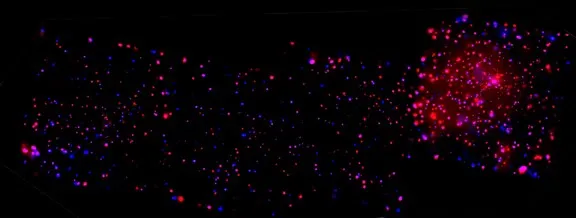
This mosaic of images of the Rosette Nebula was made with observations from the Chandra Observatory. The colors represent the various levels of X-ray energy: red the lowest energy and blue the highest. The image was made by combining four shots, starting from the OB association, a group of hot stars, in the center of the Nebula, to the right, towards the southeast (left) to the molecular cloud.
To visualize it better, we see here an optical image of the nebula, with the zones registered in X-rays superimposed.
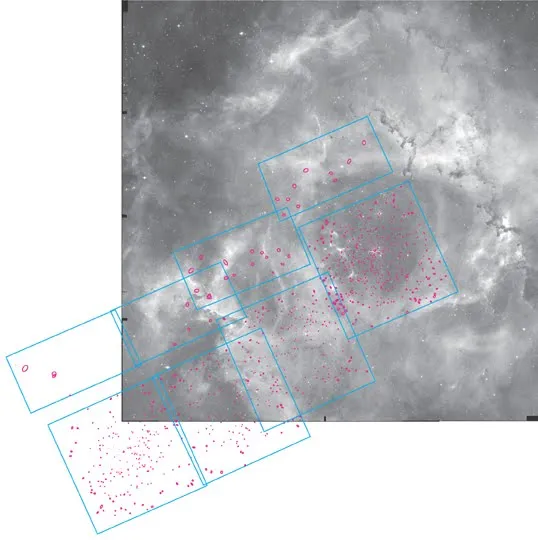
This region, cataloged as Caldwell 49, is a quasi-circular H II zone, located in Monoceros and is a complex formed by several objects such as NGC 2237 (a designation often used to denote the entire nebula), NGC 2238, NGC 2239 and NGC 2246.
The zone lies 5,200 light-years from Earth.
The images were published by the Chandra Observatory on September 6, 2001.
Credits: NASA/Penn State/L.Townsley et al.
A very busy galaxy
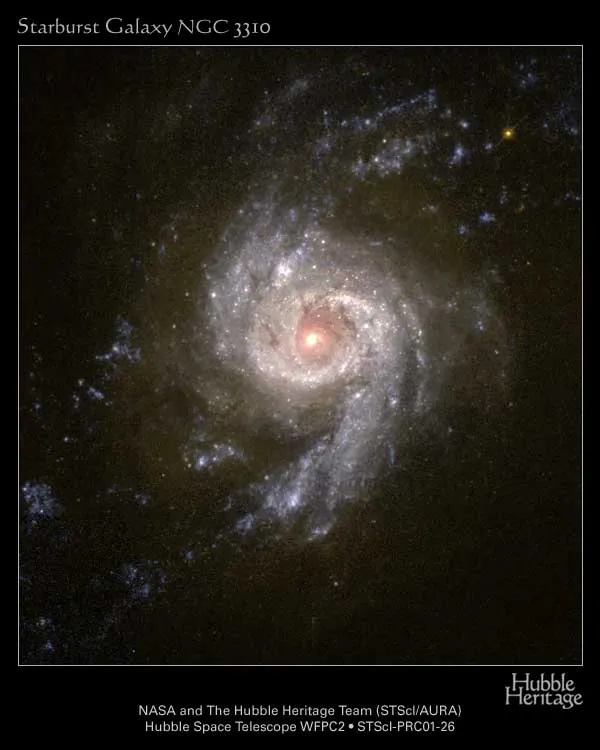
Most galaxies form new stars at a fairly low rate, but some, known as "starburst" galaxies, burn with a much more active formation rate.
In this case, Hubble took an image of NGC 3310 which is forming clusters of new stars at a very high rate. The spiral is located 59 million light-years away, in Ursa Major.
The image was published on HubbleSite on September 6, 2001.
Credits: NASA and The Hubble Heritage Team (STScI/AURA)
Acknowledgment: G.R. Meurer and T.M. Heckman (JHU), C. Leitherer, J. Harris and D. Calzetti (STScI), and M. Sirianni (JHU)
Images of the week
An astronomical vision test
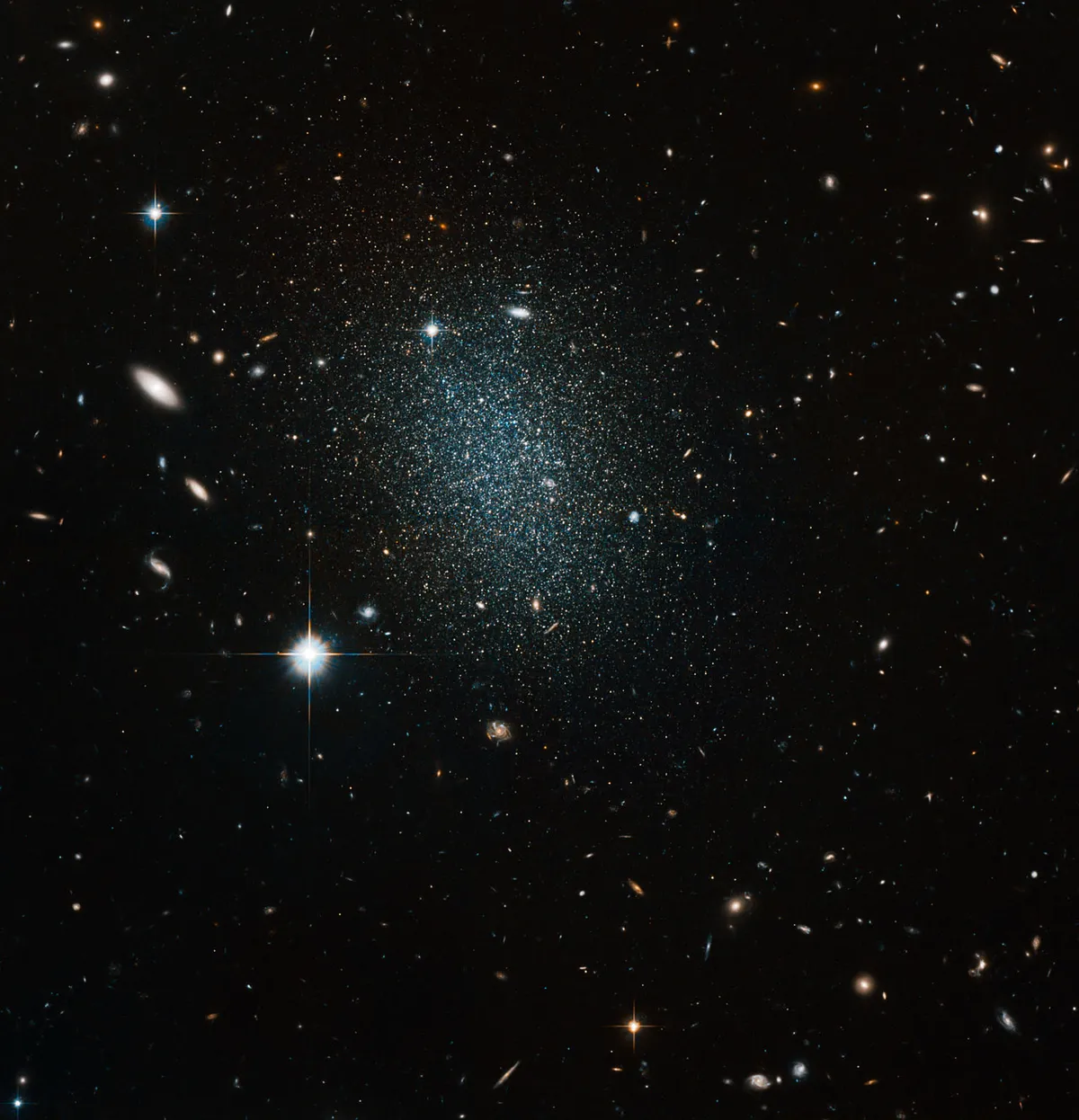
Peering deep into space, Hubble took this image of the nearby but faint dwarf galaxy ESO 540-030. The object appears as a swarm of little stars, although it is not the only point of interest in the image.
The galaxy is located 11 million light-years away and is part of the Sculptor group of galaxies. That collection is the closest in the neighborhood to our own Local Group.
What Hubble shows here is an image with several types of galaxies in the background. We can see spirals, barred spirals, ellipticals and irregulars. Five bright stars are also shown, closer to us than the galaxies. The diffraction spikes - four lines of light emanating at 90º angles - give away the bright stars. Do you dare to find the stars in the photo? Follow the link below to see a larger image.
It was the Hubble Space Telescope's Image of the Week.
Credit: NASA/ESA
Garradd and M71
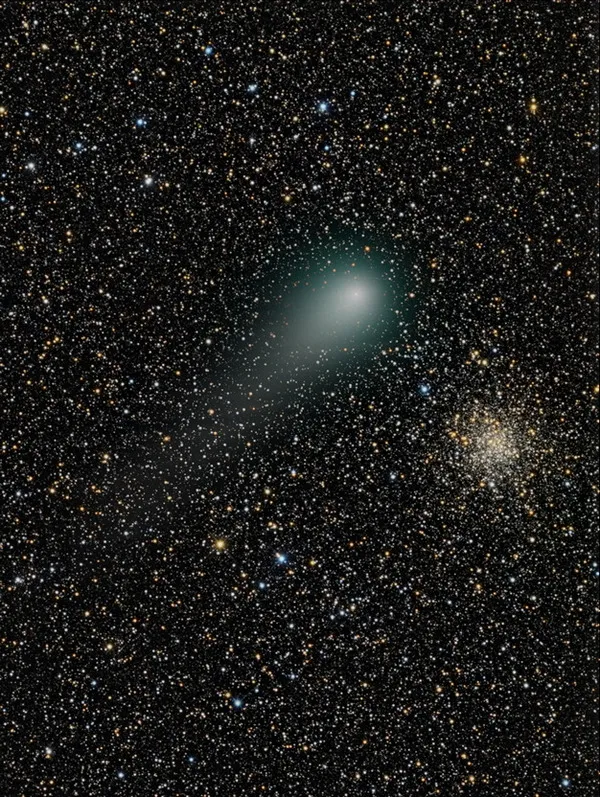
Two years ago Gordon Garradd discovered the comet that, logically, bears his name, also known as C2009 P1.
From Ukraine, astrophotographer Oleg Bryzgalov managed to photograph it while it transited the globular cluster M71 in Sagitta (it is not an apocope of Sagittarius, but another constellation, one of the smallest: "the arrow"). M71 is located 12,000 light-years from Earth. Garradd, on the other hand, is close to home, at less than 1.5 astronomical units.
To know where Garradd or other minor objects are located we can use JPL Dynamics. We go to the minor object search and in the search box we put Garradd.
The result will be a list, since the discoverer of this comet has found several more. We choose C/2009 P1 and go to the comet's data. To see the orbit diagram we will have to click on Orbit Diagram. The page requires Java, so surely the web browser will alert you if you want to run the application for that page.
It was the Amateur Astronomical Picture of the Day (AAPOD) of September 1, 2011.
Credit: Oleg Bryzgalov
Music and science in motion
Unlike the usual, with a section for "Space music" and another for "science in motion" where I share sounds and videos respectively, today both will be present in a particular way.
Crrraanc!!!!: Tactile music
What a strange title!, some will think. Tactile music?
A week ago I was contacted by Iván Anzil, originally from Chajarí, Entre Ríos and a teacher-researcher at UNLP. And he tells me: "As a thesis to obtain the degree of Doctor in Latin American Contemporary Art, I investigate the capacity that sound (and music) has to generate TACTILE SENSATION in human beings".
The first thing that occurred to me is extremely simple: a sound generates vibrations captured by the eardrum that translate into an auditory sensation, right?
But if we go to a concert and we are close to the musicians and the speakers, we will feel those vibrations in our body. Could that be it?
The close relationship existing between the auditory and tactile perception pathways suggests that amplified music can generate tactile and/or audio-tactile combined sensations. Given certain conditions, skin, bones and other constituents of the human body react to vibrations in diverse ways. Faced with the almost total absence of research in this regard, this basic research project aims to explore: a) the pathways through which amplified music can effectively generate said sensations; b) the necessary conditions for said vibrations and sensations to occur; and c) the ways in which the human body vibrates.
According to a series of studies, the senses of hearing and touch are intimately related in terms of the areas of our brain that process information traditionally associated with them. The data of mutual interference question the separation itself and force us to abandon that conception that defined them as independent and compartmentalized.
There are two papers by Anzil that allow us to understand what he tries to study and how, what his working hypotheses are, which we can find at http://www.ceiarteuntref.edu.ar/eci08
Hey, I want to listen to music!
Live at studio dance set by Crrraanc!!!!
There it talks about incomplete studies linked to echo-location (Batman's dream?) and that the sensitivity of human skin to vibrations has been proven in multiple investigations. Very few can be found that have done it for vibrations transmitted through the air, and none from a musical point of view.
Could it be that the bodily location and other qualities of the sensation (tactile and/or audio-tactile) are determined by the relationship between, on one hand, the dimensions of the different parts of the experimental subject's body and, on the other, the frequency and amplitude of the stimulus?
Some studies seem to corroborate this hypothesis.
Another starting point is that "impulsive musical sounds of high sound pressure levels and, by extension, iterations present in sustained body sounds can be interpreted as phonons."
Phonons? Well, yes. Come on, quantum music. That if there is a photon, there is a phonon.
It seems to me an incredibly interesting topic. A new frontier between art and science that could trigger multiple results of different types: artistic innovations, but also, perhaps scientific applications.
In any case, it is fabulous that there are researchers diving into this area.
For more information, in addition to the two papers cited before, we can search for "Crrraanc!!!!" on the web or visit:
https://www.facebook.com/Crrraanc http://www.myspace.com/crrraanc http://www.youtube.com/user/Crrraanc http://www.lastfm.es/music/Crrraanc http://www.reverbnation.com/crrraanc
And soon at http://www.crrraanc.com.ar/
Crrraanc!!!! arises from research carried out by Iván Anzil, aimed at determining the range of frequencies/amplitudes necessary to generate an audiotactile sensation in people exposed to amplified music.
In the tracks on the present page, the application of some of the preliminary results can be appreciated, as well as the application of results obtained as a member of the research team for the projects “Instrumentation through timbral phenomena and Composition.” [2006-09] and “Instrumentation: Technical innovations and relationship with other elements of musical structure.” [2002-05].
Iván Anzil is a Licentiate in Composition and a teacher-researcher at the Universidad Nacional de La Plata. He is a professor of the subject Orchestration.
He also teaches Music Appreciation at the Instituto Universitario Nacional de Arte; and the Sound subjects at the Centro de Investigación y Experimentación en Video y Cine.
He was composer, singer, keyboardist and sequencer of tracks for the audiovisual project Sonocroma [www.myspace.com/sonocroma; www.purevolume.com/sonocroma].
Since 1996 he has directed his own studio "ojOs de mosca" for mixing and mastering music, and sound post-production for audiovisuals.
Hey, show me a video!
Video: Crrraanc!!!! live
http://www.youtube.com/watch?v=uxULS0RiByc
We can also see this other video, Part, but beware:
Where it says 360p, set it to 480p, so you can read the initial warning, which is:
"High speed of image changes. If you know or suspect you are epileptic, refrain from watching this video". Understood? Don't let it be that among the blog's readers the same thing happens as with those TV viewers of Pokemon! (or The Simpsons!). Although today you see on TV, and you hear, truly vomit-inducing speeches...
Thank you Iván for sharing your work! I hope to stay in touch and have news in the future.
To access previous editions of this section, consult the Multimedia Selection Series.