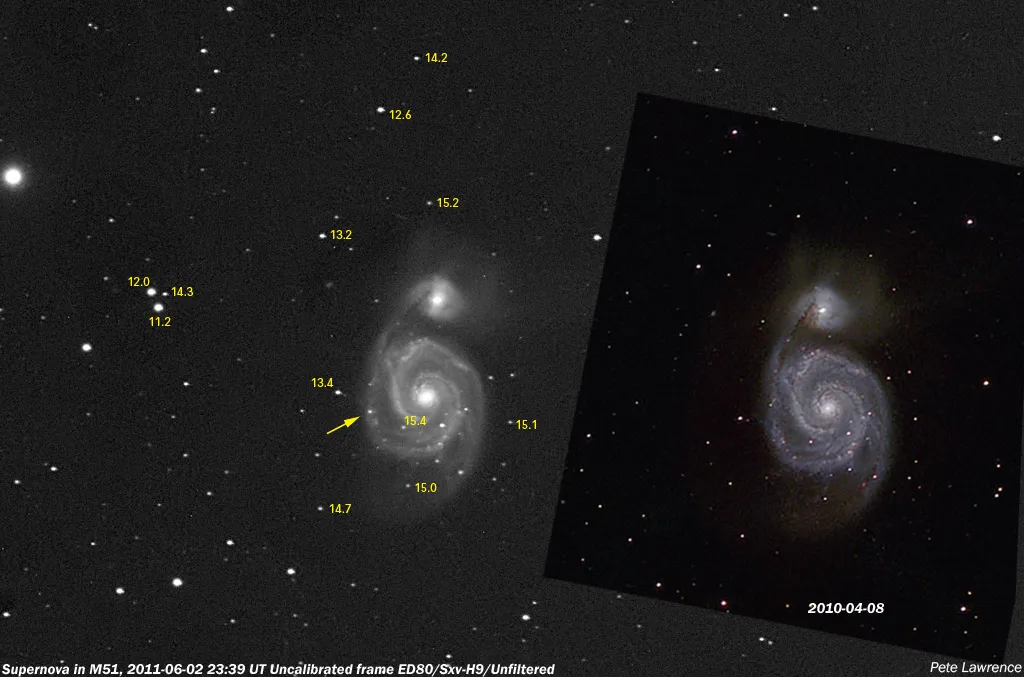
At 21 million light-years, the closest supernova since SN1987a awaits amateur observers in the Northern Hemisphere. Can anything be seen from Latin America? Will there be another opportunity?
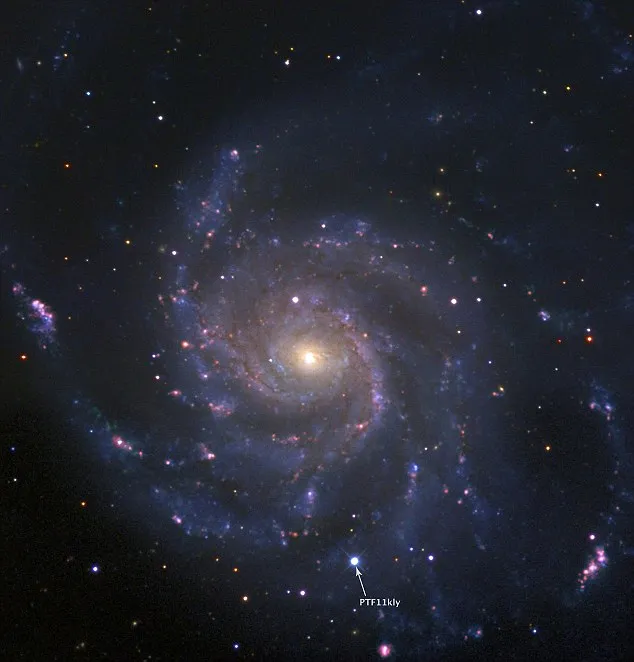
Stars go through life cycles that differ fundamentally due to the star's mass. Generally speaking, the more massive ones complete that cycle more quickly than those of lower mass. That stellar evolution can have different "endings." One very popular one is the supernova event. There are different types of supernovae, but the main ones are related to the explosion of a white dwarf or the collapse of a very massive star.
On August 24, 2011, the Palomar Transient Factory, which is a research program conducted by astronomers from CalTech, discovered a sudden change in brightness in a relatively nearby galaxy. Since then, the event has been known as SN 2011fe or PTF11kly. While observing the nearby galaxy Messier 101, near Ursa Major, they captured the change in brightness and since then the luminosity has increased.
An analysis of the light from SN 2011fe shows that the event was likely generated by a white dwarf, what is known as a Type Ia supernova.
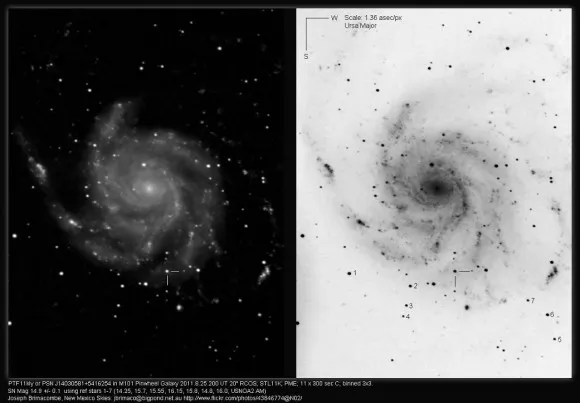
Can it be observed with amateur telescopes?
The supernova is located at the end of the tail of Ursa Major (the handle of the Big Dipper), between Mizar and Alkaid. Currently the supernova shines at magnitude 10, making it possible to visualize it with a 6-inch (15-centimeter) telescope or with some large binoculars, mainly in dark skies.
The coordinates (J2000) of the supernova are: RA: 14 03 05.81, Dec: +54 16 25.4.
For those living on the Equator, they will be able to not only enjoy observing this event, which is not "rare" in the universe, but it is unusual that we have the possibility of seeing a brightness change generated by this phenomenon with an amateur telescope.
They say that seeing is not the same as looking. But observatories are not called "lookatories". Observing is something else, more linked to the recording of what is looked at. What is recorded is data that, together with other data, can provide valuable information.
Type Ia supernovae are used to calibrate the cosmic distance ladder, a sort of standard candle for measuring distances because it is thought that this type of supernova generates brightnesses that vary proportionally to the distance. It's not that the distance to the Pinwheel Galaxy (NGC 5457) is unknown, but this type of information could be used to "calibrate" the relationship between peak brightness and distance, as well as to study in detail the evolution of this particular phenomenon.
That is why variable star observers are particularly attentive to the supernova in M101.
Being a variable star observer requires some knowledge and a bit of patience. But it is possible to contribute scientifically with observations, meaning records of the observed data, since a large community of amateurs worldwide allows for obtaining valuable data.
This does not mean one should take the challenge lightly and contribute any kind of data. It requires some practice, but I encourage those who feel curious to try it.
One of the most important organizations in the world of astronomy is the AAVSO, the American Association of Variable Star Observers. On their page you will find a lot of information and tutorials on how to observe and record data for this type of star and in particular data for SN 2011fe (in Spanish), with charts and photography, as well as instructions on how to report observations.
Telescope size and limiting magnitude
On several sites, such as UniverseToday or Stars with a bang to name a few of the good astronomy blogs in English, it is pointed out that a telescope between 12 and 16 inches (14 inches = 35.56 centimeters) is necessary.
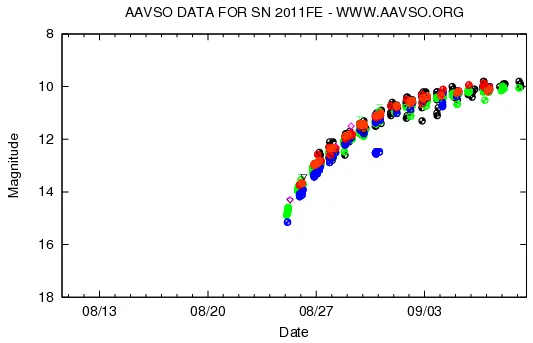
Since its discovery, the brightness has grown as seen in the AAVSO graph. The report from The Astronomer's Telegram stipulated a magnitude of 17.2 in the green for August 24, but it is already near 10.
An estimate of the limiting magnitude of our instrument can be had with the calculation:
M = 7.5 + 5 . Log D [cm], where M is the Limiting Magnitude and D is the diameter of our instrument, in centimeters.
Thus, with a 15 cm telescope, M=7.5+5*log10(15)=13.3.
However, with light pollution, atmospheric turbulence and the full Moon, it will not be so easy.
But with a 15-inch instrument, quite popular nowadays, and very dark skies, one should give it a try.
Background
Many other supernova events have occurred, some of which are popularly known.
It is possible to distinguish between those that occurred relatively close to Earth, in the Milky Way or in nearby galaxies, like Andromeda and the Magellanic Clouds.
It is not the only possible classification: we can list the most recent supernovae in time. And here we could subdivide between the most recent in our galaxy and the "foreign" ones.
And also the brightest ones. The one we are dealing with is close in time and space, and very bright. The combination makes it a more than particular object.
The last supernova of any type with comparable brightness was SN 1993J, a Type II supernova that reached magnitude 10 in M81 seen in Ursa Major, while the last Type Ia supernova of similar brightness was SN 1972E which reached magnitude 8.5, in NGC 5253.
Recent supernovae in the Milky Way:
SN 1604 – Supernova in Ophiuchus, observed by Johannes Kepler; it is the last supernova seen in the Milky Way.
Although, according to a Chandra study, G1.9+0.3 would be the most recent supernova, 140 years ago.
Close in space:
SN1885A or S Andromedae, in the Andromeda Galaxy (M31) at 3 million light-years.
Close in space and time:
SN 1987A, in the Large Magellanic Cloud, at 168,000 light-years, observed in the Southern Hemisphere.
Close in time and very luminous:
SN2005ap and SN 2006gy are two of the brightest observed to date.
Are many supernovae produced per year?
The question can be answered regarding the supernovae that are recorded more than about those that occur.
CBAT has a list of supernovae since 2010. It is long.
The SAI catalog, in text format, weighs 8.9 MB.
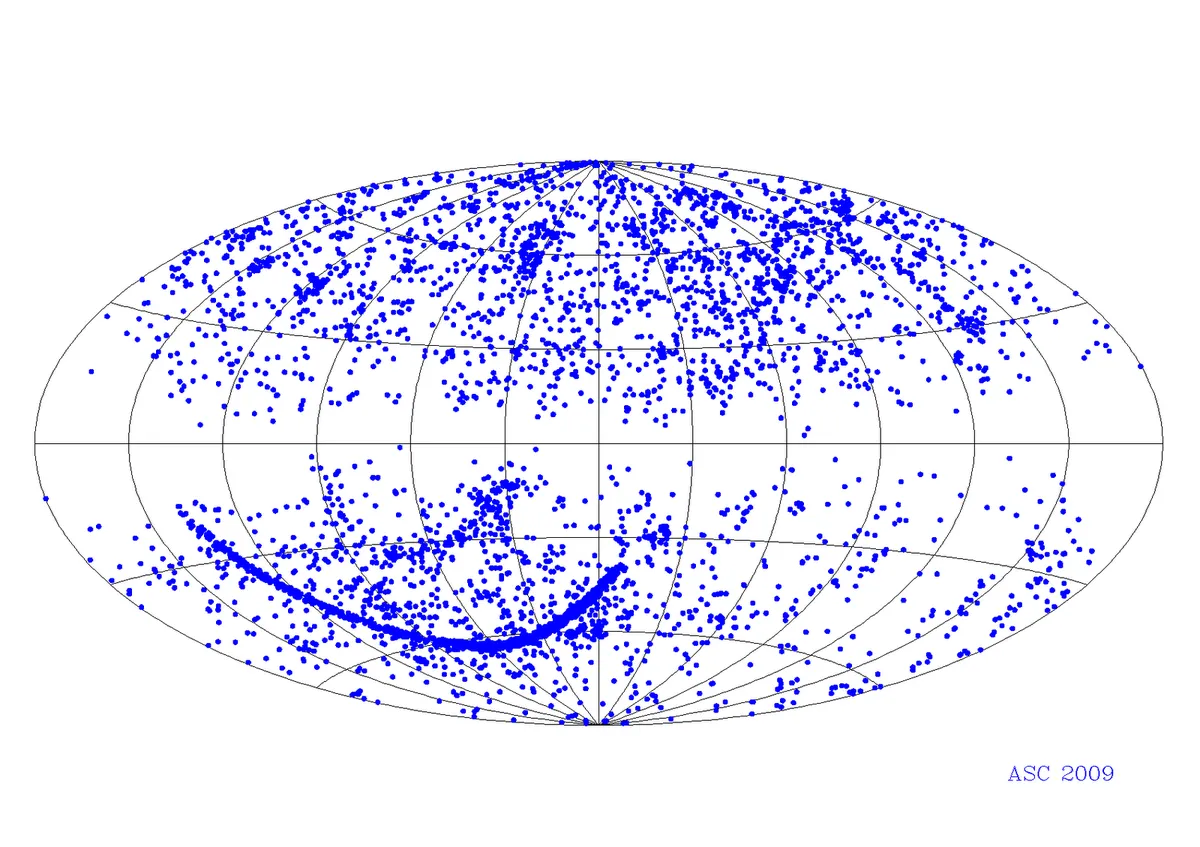
The Asiago Supernova Catalogue (ASC) allows us to visualize where (in the sky) supernovae occurred.
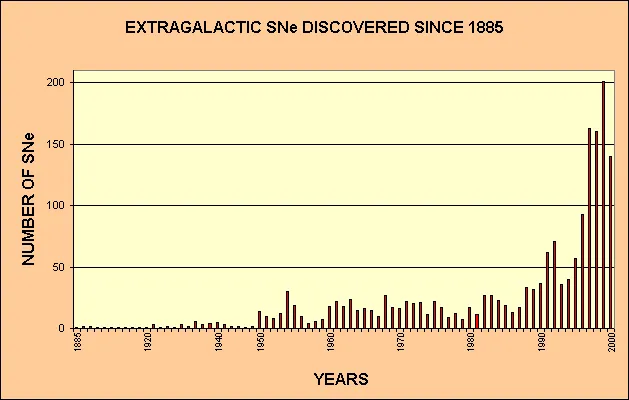
At Supernovae.net they show a chart with extragalactic SN discovered since 1885. The abscissa contains the years and the ordinate axis the number of discoveries. As can be seen, they have increased notably, not because they occur more often, but because the astronomical community has many more and better instruments.
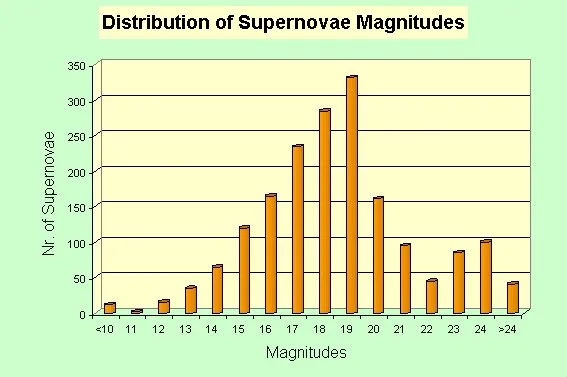
Here the abscissa shows the magnitudes and the y-axis the number of supernovae. Those of magnitudes 17-19 are much more common than those of magnitude 10.
As can be seen, SN 2011fe is rare in this zoo-universe of supernovae, due to its closeness in space and its brightness. It cannot be known if there will be an event with similar characteristics in the coming years or decades, so observers in the North should run out to observe, either with their own instruments or through third parties like associations and astronomy clubs.
What can be done from the South?
Due to the object's position on the celestial sphere, there is not much to do from a northern latitude below 15º. Mexico, perhaps Puerto Rico or the northernmost region of Colombia (which are at lower latitudes), might have the possibility in Latin America to observe the SN near the horizon.
Two things occur to me: first, to use robotic telescopes, for example internet telescopes, that are located in the Northern Hemisphere.
The other alternative is less attractive: wait and prepare ourselves. In 1987 we had a chance. If back then we were not prepared, today the cosmos gives us a wake-up call. Not only so that those who like astronomy take the necessary steps to have our own instruments, but fundamentally to acquire the necessary knowledge to use them.
And, as I said before, observing variable phenomena will not only allow us to get more out of the instrument, but we will be able to make contributions to the scientific community. But we will have to know how and have a lot of practice so that our data are minimally correct.
To take the first steps in this field, large instruments are not needed. With an astronomy binocular (7x50, 10x50) we can start. Even WITHOUT binoculars too. There are many very bright stars, which can be observed with the naked eye and which in many cases are not taken into account (precisely because of their enormous brightness) by automated surveys.
If today the reader feels curious, has interest, but is not in a position to observe a phenomenon of this type (aside from location on the terrestrial sphere), perhaps that is what for the future must change. Let us enlighten ourselves and we will be the future supernovae.
Sources and related links
- AAVSO: Supernova 2011fe: The brightest supernova of the last 20 years
- Sur Astronómico: The brightest supernova of the last 20 years, by Sebastián Otero.
About the images
- Initial image taken with CCD. Credit: Rose City Astronomers
- Fig. 2: PTF11kly. Credit: Joe Brimacombe
- Fig. 3. Light curve of SN2011fe as of 9/9. Credit: AAVSO.
- Fig. 4: Distribution image of SN in galactic coordinates by Asiago.
Barbon, R., Buondì, V., Cappellaro, E., Turatto, M. 2008 VizieR Online Data Catalog, 2283, 0
Barbon, R., Buondì, V., Cappellaro, E., Turatto, M. 1999 A&A Supp. 139, 531
Barbon, R., Cappellaro, E., Turatto, M. 1989 A&A Supp 81, 421
Barbon, R., Cappellaro, E., Ciatti, F., Turatto, M., Kowal, C.T. 1984 A&A Supp 58, 735 - Fig. 5 and Fig. 6: Charts from: International Supernovae Network.