A collection of links to music, images and videos relating art and science. Today: Images: STIRF/Spitzer and A Saturnian Quintet. Music: four tracks not to be discarded. Video: EDDE and the space elevator.

Images of the decade
SIRTF: Spitzer's past
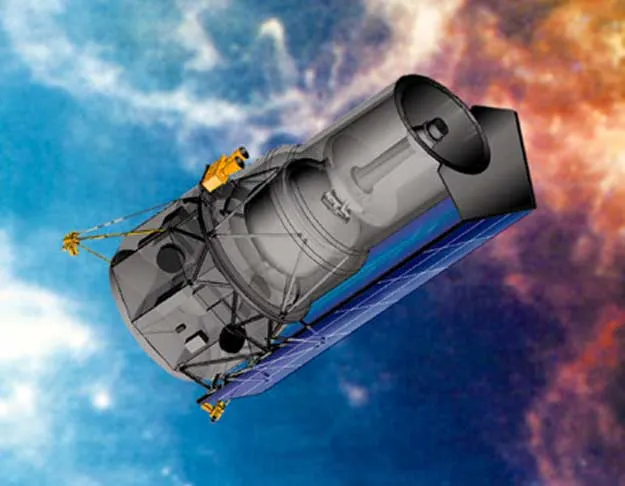
A decade ago, the image above was used to announce a contest to rename the then Space Infrared Telescope Facility (SIRTF). Finally, the telescope was named Spitzer in honor of Lyman Spitzer, Jr. (1914-1997) and was launched on August 25, 2003. Below, a photo of Spitzer atop a Delta II rocket on August 14, 2003.
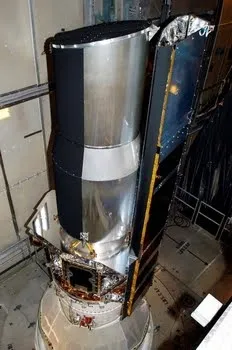
It was the Astronomy Picture of the Day (APOD) for September 19, 2001.
In Spanish, Observatorio.
Images of the week
A quintet of Saturn's moons
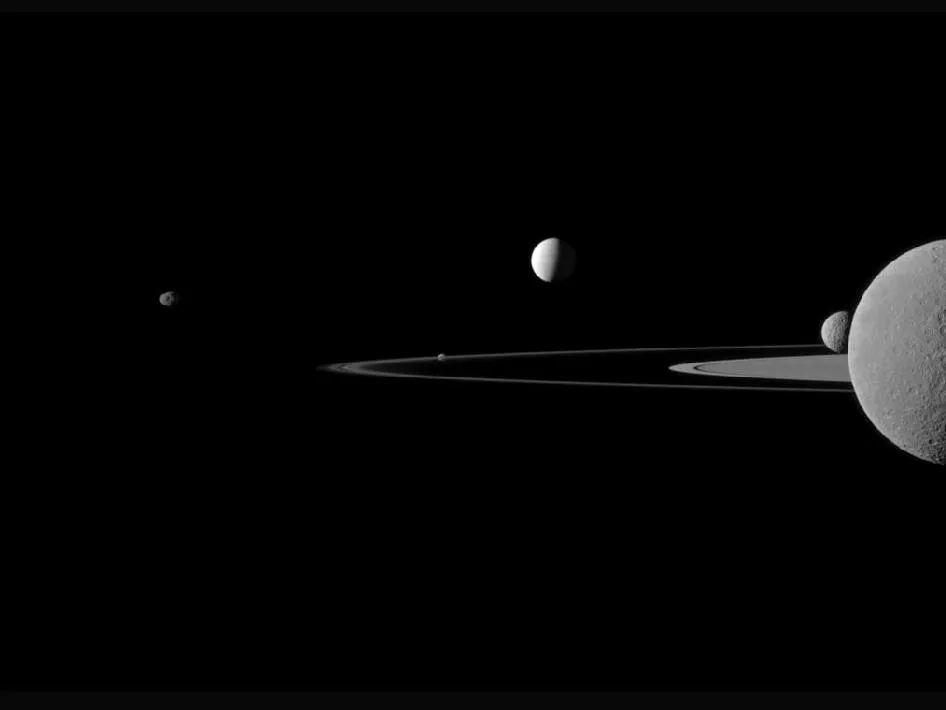
A portrait taken by the Cassini spacecraft of five of the gas giant's natural satellites shows Janus (179 km) on the left. Pandora (81km) orbits between the A ring and the thin F ring near the middle of the image. Bright Enceladus (504 km) appears above the center of the image. Mimas (396 km) is seen behind Rhea (1,528 km), the second largest moon in this system, which appears cut in two at the right edge of the frame.
It was NASA's Image of the Day for September 21, 2011.
Credits: NASA/JPL-Caltech/Space Science Institute.
Space Music
Although in this section I usually include music from independent and current artists, today I make a parenthesis to remember old musical hits.
When it comes to space music, Mr. Bowie must undoubtedly be mentioned with his Space Oddity. The single was released in 1969, the same year as the first moon landing, and tells the story of Major Tom. The first verses include a "countdown".
http://www.youtube.com/watch?v=D67kmFzSh_o
There are other versions and videos, but I recommend watching the particular animated video: Space Oddity (A Sims 2 Music Video) - David Bowie.
Another classic is precisely a sequel to the first track on this list, continuing the story of the protagonist, but in this case by the German Peter Schilling, released in 1982.
Here, according to the lyrics, Major Tom returns home, but the spacecraft has a problem while soaring through the stratosphere. Again there is a final count.
http://www.youtube.com/watch?v=BEG7OzvSMBA
Very well. Before continuing, does the reader know why I am putting these songs and not others?
From two good musical pieces, we move on to... well, a hit, undoubtedly. We jump to 1986 and the release of The Final Countdown, by the group Europe. According to Wikipedia, the lyrics were inspired by Bowie's song. In a forum about the Swedish group, it is suggested that perhaps the inspiration was the "countdown" alluded to in the song by the British musician born on the same day as Stephen Hawking, though five years later. (Same day - January 8 - on which Galileo died, centuries earlier).
The lyrics don't say much: it seems they will travel many light-years... though they travel to Venus!!
Not for this should we overlook that the track is "catchy" and triumphalist, ideal for those moments that never arrive. And for scoring epic dreams. Anyway, here it goes:
http://www.youtube.com/watch?v=9jK-NcRmVcw
And, to finish (for this week), let's go to 1992 to the debut single of the British Tasmin Archer. The track Sleeping Satellite was part of her first album Great Expectations.
The lyrics of Sleeping Satellite can be interpreted in many ways. For example, one might think that the artist sees in the Moon the reason why the romantic vision we had of that natural satellite of Earth has been lost. Although Selene lost none of her charm because we have greater knowledge of that object.
But she doesn't blame the Moon for that, but rather, if anything, J.F.K., as can be interpreted from the second paragraph.
She also asks if, in the rush, we went to the Moon too soon.
http://www.youtube.com/watch?v=oBAMNR0-4Uc
I remembered this song on Friday night, early Saturday morning, while I was attentive to the fall of the artificial satellite UARS.
On one hand, it seemed like a great "countdown" that never reached zero. And on the other hand, I wondered about the state of things. Was it possible to do something different with this and other satellites? The next time this global, somewhat hysterical dance will be repeated will be with the fall of ROSAT and its mirror.
Is the lack of fuel necessary for a controlled re-entry a lack of foresight? Were things done with more haste before than now? There were already precedents, like Skylab in 1979. UARS was launched in 1991.
There is a lot of water on the planet. But there are not few inhabited places. And the positive streak of re-entries - because there have been no major damages so far - will one day end.
On the topic, some proposals in the following section, in video.
Science in motion
Among the options, avant la lettre, to solve the problem of space debris is the EDDE, the ElectroDynamic Debris Eliminator vehicle. It is indicated at Star-Tech Inc that a dozen of these bugs would eliminate the nearly 2,500 debris pieces larger than 2 kg in LEO (Low Earth Orbit) in seven years.
This is a flash animation (Credit: Star-Tech Inc) that started when this page loaded. To see it from the beginning you can use the right mouse button and choose "rewind". What you will see is how orbital debris accumulated since 1959 on two axes (abscissa: inclination, ordinate: altitude). The second part begins with the title in yellow about Debris Removal and shows how 12 EDDEs would act over 7 years. The numbers in yellow are the number of years, advancing by one-tenth of a year at a time.
Another option is the space elevator. On the same previous page we can find information about it. And at The Space Elevator Reference
In Spanish, the irreducible Javier Peláez explains the idea of the space elevator in his blog. And there is this video of physicist Micho Kaku, dubbed into our language.
http://tu.tv/videos/ascensor-al-espacio
To access previous editions of this section, consult the Multimedia Selection Series.