A collection of links to music, images and videos relating art and science. Today:

Images of the decade
The nearby galaxy M33
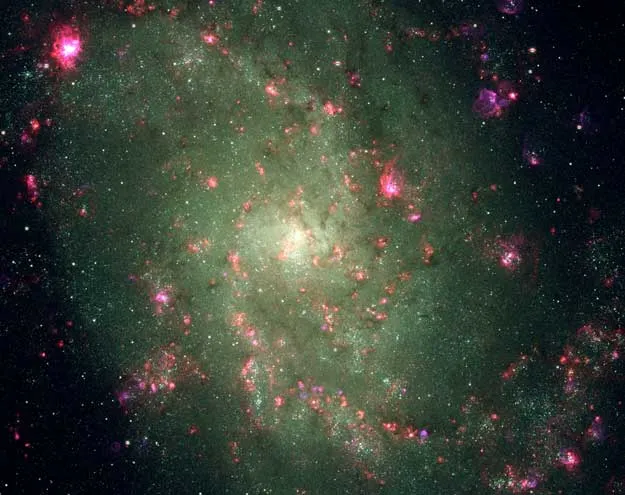
The spiral galaxy M33 is a medium-sized member of our Local Group of Galaxies. M33 is also called the Triangulum Galaxy due to the constellation in which it resides. About four times smaller (in diameter) than our Milky Way and Andromeda (M31), it is much larger than most local dwarf spheroidal galaxies. The closeness between M33 and M31 leads some to think it is a satellite galaxy of this much more massive galaxy. The proximity of M33 to the Milky Way makes it appear more than twice the angular size of the full Moon, and be visible with a good pair of binoculars. The image highlights light emitted by hydrogen, in red, and oxygen, in blue.
Credit: Nichole King (STScI) et al., Mayall Telescope, KPNO, NOAO, NSF
It was the Astronomy Picture of the Day (APOD) September 27, 2001.
In Spanish at Observatorio.
Images of the week
A light opera? Or a faster one?

"Neutrinos cause a lot of anguish for physicists," notes the text of HEASARC's image of the week. "These 'ghost particles,' so called because they pass through matter, are among the most poorly understood of the fundamental particles that make up the universe. They were postulated by Wolfgang Pauli to conserve energy and momentum in certain radioactive decays. They were later theoretically described (and named) by Enrico Fermi in 1934, 25 years before they were experimentally observed. Neutrinos produced in thermonuclear reactions in the Sun's core provide astrophysicists with a direct measure of conditions at the center of the star and, for a time, seemed to suggest that the well-established model of the solar interior did not work, until it was noted that our understanding of the neutrino itself was what was failing and not the thermonuclear physics. Now, studies of the neutrino have undermined one of the fundamental principles of modern physics: that nothing can move faster than the speed of light. This limit is the basis of Einstein's Special Theory of Relativity, a theory that has been confirmed again and again experimentally. But recent attempts by scientists using the OPERA experiment (illustrated above with the photograph) to measure a beam of about 15,000 neutrinos, generated at CERN (a particle accelerator in Switzerland) showed the unexpected. Apparently those neutrinos traveled the 730 km distance separating CERN and OPERA at a speed of 20 parts per million above the speed of light, as reported by the research team. An incredible result and one that would be truly revolutionary, if it were confirmed."
To what HEASARC explained in this image of the week, I would add that experts point out two important things: that the experiment seems to be quite well done, taking care of a large number of variables; and that the very small difference in speed (60 nanoseconds) could well be attributed to some tiny measurement error, since the necessary precision is very high. Until similar experiments are repeated and the result is the same, caution prevails. But if it were indeed confirmed, somehow, Einstein (and Galileo) would still be right: everything is relative!
Image credit: INFN
Space Music
Darren Lock is a very prolific English musician. We can listen to him and see him at Darrenlock.com.
Many of his albums are available for download and on several occasions have references to astronomical topics.
For example, from his album "God Pays Debts Without Money...", the track A Pocketful of Stars.
A Pocketful of Stars by Darren Lock
The album "Every Thing You Have Ever Owned is Mine" contains the track Einstein on the Bleach
On Here Comes the Future the track Ballad for Laika is included.
In his production The Luckiest Man in the World there is a melodic song that could well be a lullaby: In Starry Trees.
And in his most recent work, Steady State of Flux, the first track is Red Shift:
Darren has other more or less direct references to space, so we will talk and listen to him again in this column in the future.
It is also possible to find Darren Lock on SoundCloud.
Science in motion
TED Talk: Janna Levin: the sound of the Universe
We think of space as a silent place. But physicist Janna Levin says the Universe has a soundtrack: a sonic composition that records some of the most spectacular events in outer space. (Black holes, for example, strike spacetime like a drum). An accessible and revealing sonic tour of the Universe.
Whoever liked this talk by Janna Levin and knows English can read an interview with her on TED Blog: The lyricism of science: Q&A with Janna Levin.
To access previous editions of this section, consult the Multimedia Selection Series.