A collection of links to music, images and videos that relate art and science. Today: Images of The Stingray Nebula and the Antennae Galaxies. Music: The Cosmos. Video: Janna Levin: the sound of the Universe

Images of the decade
Hen 1357: the Stingray Nebula
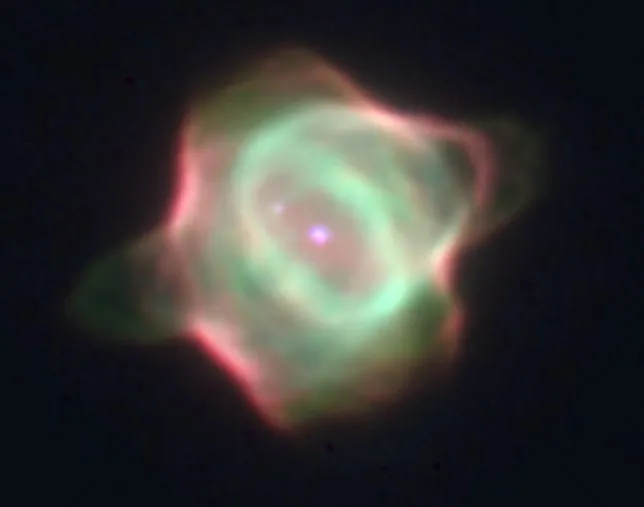
This shot from the Hubble Space Telescope shows Hen-1357, the youngest known planetary nebula. Its elegance, smooth curves and symmetry suggest its traditional name: the Stingray Nebula. Observations made in the 1970s detected no nebulous material, but this image from March 1996 clearly shows the bubbles and rings of collapsed and ionized gas emerging from the Stingray. The image also shows a companion star (toward 10 o'clock) inside the nebula. Astronomers suspect that companion explains the complex shapes and rings of this and many other planetary nebulae. This cosmic baby is about 130 times the size of our own solar system, and is still growing. It is 18,000 light-years away, in the southern constellation Ara.
Credit: M. Bobrowsky, NASA
It was NASA's Astronomical Picture of the Day (APOD) for October 6, 2001.
In Spanish at Observatorio.
Images of the week
The ALMA of astronomy: two antennas for two Antennae.
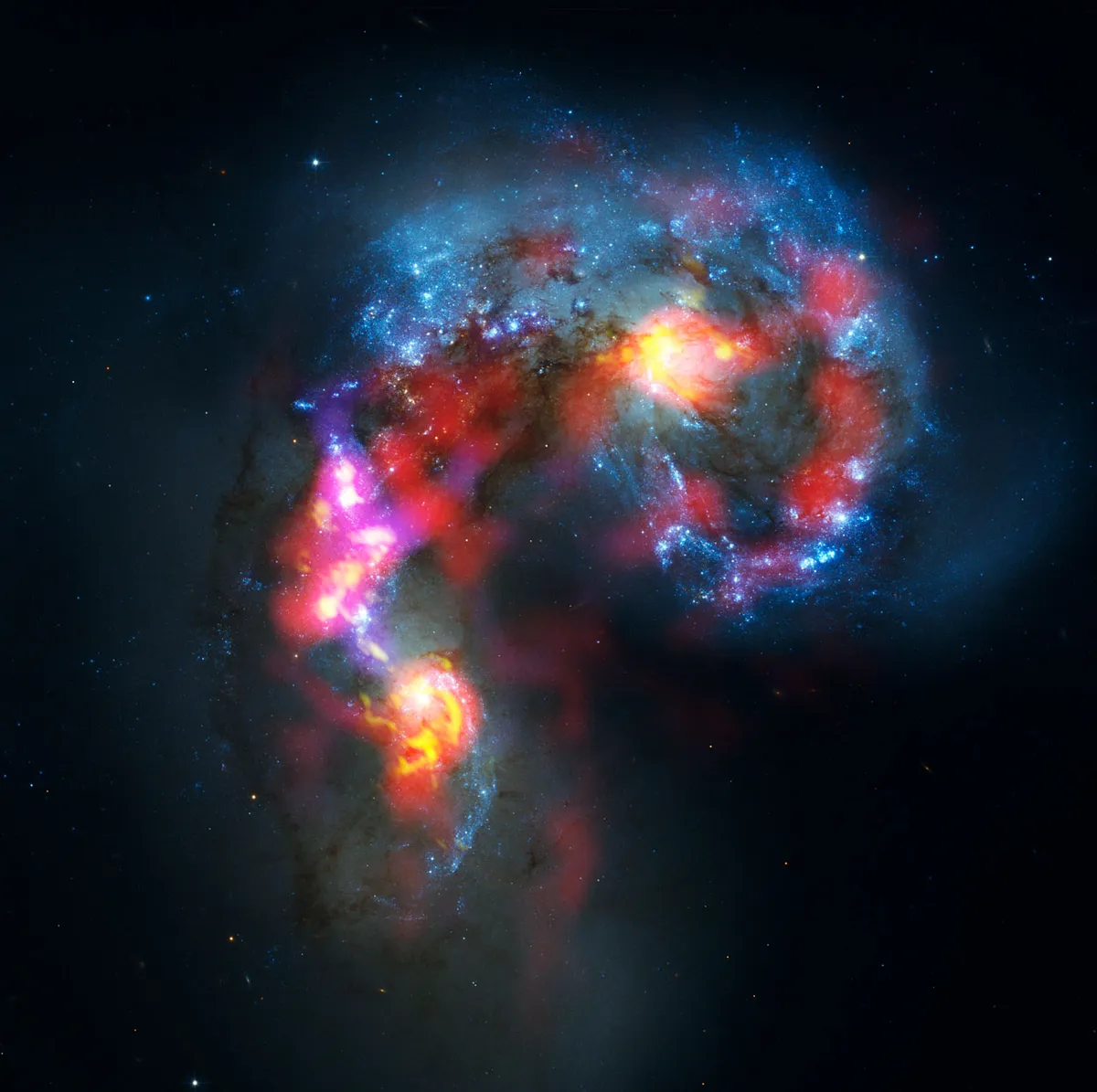
The most complex ground observatory of humanity, ALMA, opened its eyes.
The first image with a telescope still under construction reveals a view of the universe that cannot be observed by visible and infrared light instruments. ALMA observes the universe at millimeter and submillimeter wavelengths, which are nearly a thousand times longer than visible wavelengths. The ALMA team has been testing the observatory's systems in recent months in preparation for the first round of its scientific observations. One result of these tests is the first published image. However, it must be considered that this image was created with just two antennas that are now closer together than they will be.
Ultimately the observatory will have 66 antennas separated by up to 16 km from each other. But currently they have one third of the total antennas, separated by just 125 meters.
The image is of the famous colliding Antennae Galaxies (NGC 4038 and NGC 4039), located 70 million light-years away in Corvus.
It was news on October 3, 2011, at ESO.
Credit: European Southern Observatory (ESO).
At ESO you can see a comparison between an image of the Antennae Galaxies made by Hubble and this one made by ALMA. Use the mouse from left to right, as if pulling a veil, to reveal the ALMA image.
Space Music
Today: The Cosmos
Marty Glassley is a young American who calls himself The Cosmos.
We can find his music at http://www.synthmusician.com/TheCosmos, on SoundCloud and on JunoDownload.
Here we can listen to his tracks on SoundCloud, which are 13 for now. They correspond to different productions, but they have in common being instrumental and many of them have some relation to space.
Science in motion
Janna Levin: the sound of the Universe
We think of space as a silent place. But physicist Janna Levin says the Universe has a soundtrack: a sonic composition that records some of the most spectacular events in outer space. (Black holes, for example, bang on space-time like a drum). An accessible and revealing sonic tour of the Universe.
To access previous editions of this section, consult the Multimedia Selection Series.