On the book "The Quark and the Jaguar" by Murray Gell-Mann.
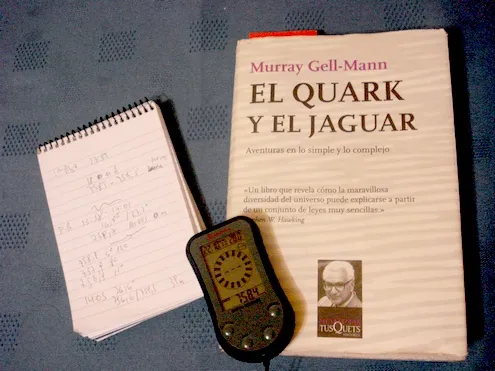
A few months ago I mentioned here that when I started reading this book I brought up the topic in a conversation, held on a trip to Colonia, Uruguay. In front of me was a Colombian couple. I tell them the title of the work is "The Quark and the Jaguar". What is the quark? Roughly speaking: everything observable seems to be composed of atoms. These, in turn, are composed of fundamental particles, such as the proton, neutron and electron. And, beyond what they taught us in school, there are more particles at the subatomic level. Protons would be made up of even more fundamental particles, called Quarks. The author of the book won the Nobel Prize in Physics in 1969 for the discovery of those particles.
The subtitle of the book is "Adventures in the Simple and the Complex".
Between title and subtitle we find two pairs of terms: Quark-Jaguar, Simple-Complex. If we had to connect a term from the first pair with one from the second pair with a line, how would we establish the relationship?
For example, is it conceivable to think that the quark is complex and the jaguar is simple? Or is it the other way around?
That couple answered the first. And it's logical, although in reality the book is written thinking the opposite. The quark is the simple and the jaguar the complex.
It is logical to establish relationships like that couple's because they hadn't even heard of the quark, but they did know what a jaguar is. Ultimately their answer was associated with the familiarity of those terms. But, how to evaluate the simplicity-complexity of things?
Gell-Mann begins by recounting his encounter with the feline in the Chan Chich jungle, northwest of Belize near Guatemala and Mexico, in 1985.
Gell-Mann says that while walking there he meditated on the way quantum mechanics could be used to deal with individuality. The thread of his thoughts broke when a dark figure appeared about a hundred meters from him. It was a jaguarundi.
That experience, the physicist recounts, resonated with his ideas about individuality and reminded him of a previous encounter, in 1956 when he was traveling with his wife on Route 99 and spotted a condor. His observation of those birds made him think they recognized each other by the lack of feathers (later he learned that condors renew their plumage every year).
In a quasi-Sartrean way, Gell-Mann discovers this individuality in the gaze of the other, be it the Jaguar staring at him or the condors recognizing each other. There are quarks there that form atoms, molecules, DNA. But there is also something more.
From there the author delves into the fascinating topic of identifying complexity through ideas like that of complex adaptive systems and algorithmic information. Here he addresses the idea of compression (or simplification). For example: 110110110110110110110110110. This string can be produced by a very short program that prints 110 a number of times. The algorithmic information content is very low, even though the string is very long. Now let's think about Pi...
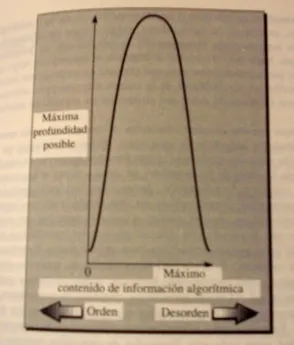
So from there he will tell us about non-computability, Gödel, stochastic processes, the Monte Carlo Method. He thus prepares the stage for the final thrust at why algorithmic uncertainty or information content does not fully fit the idea of complexity. For that he recounts the famous tale of the writing monkeys that strike typewriter keys in a stochastic manner.
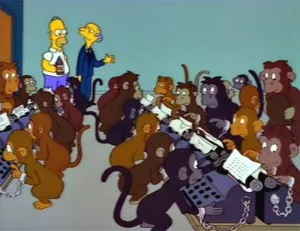
Then he addresses the topic of language learning and in chapter 7 he talks to us about The Scientific Enterprise. What is it to be a physicist? and then he addresses the topic of Theory, illustrating it with Zipf's Law.
He also points out the issue of the hierarchies of the sciences, the place of mathematics and physics. All are prolegomena that attempt to lay certain foundations for what follows: the quantum universe.
Second part: The quantum universe
In the second part of the book, Gell-Mann reviews the theories of modern physics: the standard model, superstrings. Ah, and the very trendy neutrinos!
In this regard, he mentions the famous poem by John Updike titled Cosmic Gall:
Neutrinos, they are very small.
They have no charge and have no mass
And do not interact at all.
The earth is just a silly ball
To them, through which they simply pass,
Like dustmaids down a drafty hall
Or photons through a sheet of glass.
They snub the most exquisite gas,
Ignore the most substantial wall,
Cold-shoulder steel and sounding brass,
Insult the stallion in his stall,
And, scorning barriers of class,
Infiltrate you and me! Like tall
And painless guillotines, they fall
Down through our heads into the grass.
At night, they enter at Nepal
And pierce the lover and his lass
From underneath the bed—you call
It wonderful; I call it crass.
(1)
The discoverer of quarks points out that "It is tempting to allow oneself a scientific license and substitute in the third line 'do not' with 'hardly'.)".
Third part: Selection and adaptation
In these chapters Gell-Mann talks about selection in biological evolution, about learning and creative thinking, superstition and skepticism, machines that learn.
I stop here on the topic of creative thinking. There he recounts "The Barometer Story", referred by Alexander Calandra, from reading Current Science, Vol. 49, No. 14, 6-10, 1964.
It is enough to do a quick search on the internet to account for the famous anecdote of "How to calculate the height of a building with a barometer?". Those who don't know it, look it up on the web. It is very creative.
Among the many times the story is repeated, some point out that the anecdote told by Calandra does not belong to him, but that the student referred to was none other than Niels Bohr and the professor consulted Sir Ernest Rutherford. To read the story I point to this link on Ciencianet. See the comment there by Marcelo Dos Santos (Axxón).
Now, aside from the origin and truthfulness of the story, it is a good way to approach a topic in physics through an experiment that could be done very easily. There are currently several electronic devices capable of measuring atmospheric pressure: from watches to weather stations of various characteristics and economic values.
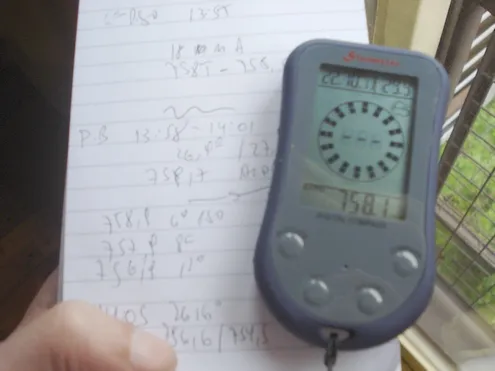
I own a device -like the one seen here above- that works as a digital compass, barometer, altimeter, calendar (date/time), weather forecast (with icons). And I live in a building, so let's get to work:
On the ground floor the data were:
22-10 13:58
26.9ºC
759.7 mmHg
Altitude 0 meters.
The altitude indicated is the absolute one set manually. For the City of Buenos Aires, in reality, although it is often said to be at sea level, it should not be zero.
On the 14th floor the data were:
22-10 14:05
26.6º
756 mmHg
39m
There is one more floor, the rooftop, which cannot be accessed without prior notice to the superintendent since there is a gate locked with a key. I didn't think it necessary.
Now, how to know if the altitude measured by the device is correct?
A first possibility is to measure the height of an apartment, equal to the height of a floor (2.5 m) and multiply by 15 (ground floor + 14 floors). 15*2.5= 37.5 meters.
The other is a bit more difficult, but not that much. It is presented by Juan Miguel Suay Belenguer on his website about the Study of the variation of pressure and temperature of the Earth's atmosphere with altitude.
On the other hand, using a digital compass requires a calibration that includes manually entering the magnetic declination data. And pressure, altitude, and temperature can be expressed in different units. Topics that could well be treated in a physics class through everyday experiments.
Ah... and why not test or consider the data from Google Earth:
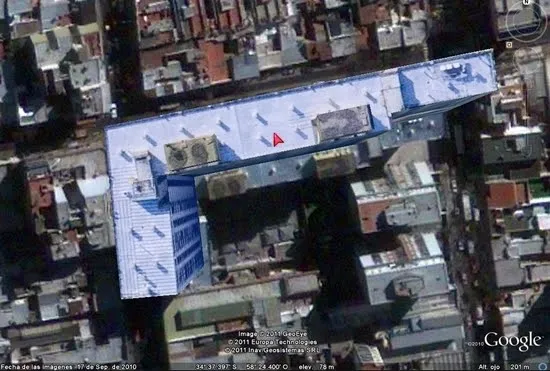
Here I show a screenshot of GE showing a 3D model of the building I live in. For the streets the elevation is about 35m (it varies, which is evident if you walk along Av. San Juan in the San Cristóbal neighborhood of Buenos Aires. Your legs complain!).
If I position myself on the building's rooftop the elevation is 78 meters. If it were an absolute measurement, the building's height would be 78-35=43 m.
Fourth part: Diversity and sustainability
In these chapters the physicist calls for the preservation of biological and cultural diversity. In his own words:
"But humans, through procreation combined with a high environmental impact per person (especially per rich person), have initiated an extinction episode that could end up being comparable in destructiveness to some of the great extinctions of the past."
In another paragraph, he also points out: "From a scientific point of view, it is essential to maintain long-term research, which does not provide immediate results but lasting ones. But, obviously, conservation cannot always wait."
It is possible that some reader interprets these statements as "exaggerated". I can agree on not falling into alarmism. However, it is possible that in order not to exceed ourselves in grandiose statements we fall into immobility. In every sense. We do not move to the scene of the events. And eyes that do not see forests razed by deforestation, heart that does not feel, mind that does not exaggerate, but ridicules. Becoming aware of the environmental impact (especially the truly unnecessary one) also implies mobilizing in another aspect.
The Quark and the Jaguar is a mobilizing book in every sense and on a multiplicity of topics. It generates the need to consult other sources, to put a law into practice through diverse data (as with Zipf's Law), to consider different ways of solving problems and, in particular, to evaluate the simple and the complex.
It is also a tour of modern physics and the particular vision of an award-winning physicist, without that meaning we should worship him or agree completely with his ideas. In fact, in the chapter on superstition and skepticism, Gell-Mann recalls the motto of the Royal Society of London: Nullius in verba. The phrase can be translated and interpreted in many ways, but the author chooses to think it means "one should not believe anyone's words," as a rejection of the appeal to authority, in favor of the appeal to Nature, the observation and experimentation of natural science.
So let the reader know that I heartily recommend the book. I think it is very readable, although some passages are somewhat more complex, precisely, but especially for those interested in the topics mentioned. A work up to the circumstances, literary barometer in hand.
On WebOfStories there are videos (in English) of interviews with Gell-Mann about what the book is about and how he wrote it, among other topics.
Book details
The quark and the jaguar: adventures in the simple and the complex
Murray Gell-Mann
Tusquets Editores
6th edition: May 2007
413 pages
ISBN: 978-84-7223-844-2
View on Scribd
Note written for the XXIV Carnival of Physics, in this edition hosted by this blog. To join and read the entries there is a social network on Ning.
Sources and related links
- (1) The text in the book in my possession, translated by Ambrosio García and Romualdo Pastor, indicates "craso" instead of "grosero".
About the images
- Last exit to Springfield on vxv.
- Fig. 9 from The Quark and the Jaguar. Credit: Tusquets Editores.