Today, October 24, is the day of Argentine astronomy or rather the day of Argentine astronomers. In a way, they were honored by Julio Cortázar in a story that deserves to be remembered.
Julio Cortázar published "La otra orilla" in 1945. The work is composed of three parts, each with four or five stories. The third part, called "Prolegómenos a la Astronomía" contains four short stories, among them "Los limpiadores de estrellas" (1).
At the beginning, the Argentine author indicates:
"Bibliography: This was born from passing by a hardware store and seeing a cardboard box containing some mysterious object with the following inscription: STAR WASHERS."
"Limpiadores de estrellas" would be the literal translation of "Star washers", even though the English term refers to star washers, washers with a "star shape", like the ones we can see here:

But that literal translation, perhaps a product of Cortázar's ignorance of what the Anglo-Saxon phrase really implied, allows the author to think of a society of astronomers dedicated to cleaning stars.
To contact the Society of Star Cleaners you would have to call 50-4765. Thus, soon "the stars in the sky regained the brilliance that time, historical studies and airplane smoke had tarnished".
But this cleaning had consequences: "Astronomical studies suffered such a crisis that the precarious and provisional foundations of science precipitated their resounding bankruptcy." Thus, "poems where Betelgeuse, Cassiopeia and Alpha Centauri were mentioned fell into thunderous oblivion."
And "The names of Copernicus, Martín Gil, Galileo, Gaviola and James Jeans were erased from pantheons and academies". Let's review these names. We know who Copernicus was. Sir James Jeans was a British physicist, astronomer and mathematician. For Gaviola one can think of Ramón Enrique Gaviola, one of the most important scientists linked to astrophysics that Argentina had. He held the position of Director of the Córdoba Observatory between 1940 and 1947.
But, who was Martín Gil?
One of the best sources of historiographic information linked to these topics is the blog Historia de la Astronomía. There, S. Paolantonio wrote an excellent article about this astronomy popularizer. (2)
I invite you to read the biography there. But it is enough here to say that he was a lawyer and writer, passionate about the science of the sky, who published articles in the press of that time, as well as some books. He was popularly known to the point of being mentioned by Julio Cortázar in that story.
The dates are somewhat curious. Gil was born on October 23, 1868. Almost exactly 3 years before the inauguration of the Córdoba Observatory, the first in Argentina, on October 24, 1871.
It is because of this last date that today the day of Argentine astronomy is celebrated. One day earlier Martín Gil was born, named in that Cortázar story about astronomy. The story has other references:
"What had been taken before for insignificance (...) turned out to be constrained fire, waiting to recover its legitimate phosphorescence". This phrase contains an asterisk. At the bottom of the page it reads:
*In November 1942, Dr. Fernando H. Dawson (from the Astronomical Observatory of the University of La Plata) clamorously announced the discovery of a "nova" located at 8 h. 9.5 of right ascension and 35º 12´ of southern declination, "being the brightest star in the region between Sirius, Canopus and the horizon". (La Prensa, November 10, page 10.) Angelic creatures! The truth is that it was the first test -naturally secret- of the Society.
The fact is real, although a couple of clarifications should be made. The nova discovered in the constellation Puppis (the Ship's Stern) on November 8, 1942 was one of the brightest of that time.
CP Puppis was first observed in the city of La Plata, from a house located on Calle 59 between 8 and 9. In it lived an employee of the Observatory of that city, Dr. Bernhard H. Dawson, an American astronomer who settled in Argentina as a young man and acquired citizenship, as Paolantonio also points out. The coordinates (J2000) are: R.A.: 08:11:46.06; DEC: -35:21:05.0.(3)
One more reference, in this case in audiovisual format, can be found in the work done by kindergarten children in the video: "Los limpiadores de EstrellaS", hosted on YouTube.
It indicates that it is a "Short animation made by 5-year-old boys and girls from Sala Verde TM of JiC 3 DE 1, CABA, BUENOS AIRES, ARGENTINA. Coordinated by teachers Sandra Bainotti and Emilse Garriguet between April and October 2010".
Of course, in this case, probably inspired by the story of the author who gave literary life to La Maga (in Rayuela), those who clean the stars are four elves:
http://www.youtube.com/watch?v=ZB5LULFCG8E
Day of astronomy: day of astronomers
Astronomy is a science and, as such, it is carried out by scientists. Professional astronomers study for their bachelor's degree, then do their doctorate and postdocs over perhaps 15 years and do not stop learning, updating and continuing their preparation for the rest of their professional lives. Their research contributes to understanding a little better each day what we see at night. They try to elucidate how astronomical phenomena originate and develop. And their conclusions allow us to form a more correct idea of the Universe as a whole.
Amateur activity, on the other hand, is very different, even though amateur astronomers can also contribute to obtaining data for scientific use. It's that astronomy is a science, but not only that. It is linked to the history of peoples, through the imagination of the constellations. The sky, as part of Nature, is part of our universal cultural heritage, which does not belong only to professional astronomers, but to every inhabitant of this world (and perhaps others).
Martín Gil, there mixed among the Shoulders of Giants of world and Argentine astronomy, denotes that popularizers of astronomy, those passionate about observing the sky, also have a place among "astronomers". The distinction, however, becomes necessary, because the distance in knowledge between a professional and amateurs can be many light-years. Although among those of us who like this science as amateurs there are also differences in knowledge level. Some amateurs currently know the night sky much better than professionals who are increasingly ceasing to put their eye to the eyepiece.
Two interviews recently published here complement this post: the one I conducted with Dr. Jaime García, who holds a doctorate in mathematics, so to be correct we should say he is an amateur astronomer, but who knows much more about variable stars than many professionals. To which we must add his enormous work as a science communicator and as a member of AAVSO.
On the other hand, after that interview, I spoke with Dr. Marina Rieznik, Dr. in History, with whom we chatted about the creation of the Córdoba Observatory and the importance of reconstructing the events that today lead us to celebrate astronomy day.
Cortázar's story is also a history, albeit in another sense, but one that links an amateur communicator with great scientists, in a literary way with his masterful pen.
Perhaps on Astronomy Day we should think about the recognition we owe to the professionals. But we should also take the opportunity to recognize the work of amateurs. Some amaze us with photographs of deep space generated by equipment that in some cases is expensive, but which are far from being the great scientific instruments. Others teach us about the movement of celestial bodies, which allows us to become independent and enjoy the nocturnal spectacle of nature for ourselves. Pro-Am relationships (between professionals and amateurs) have been very fruitful, both for scientific projects, for citizen science, and for demystifying that knowledge can only be obtained through complex studies written in a language that could be extremely hermetic for a novice.
In these times when the search to constitute a "country for all" is proclaimed (aside from merely partisan issues), we can aspire to an "astronomy for all," knowing and respecting the hierarchies or levels of knowledge, but promoting the spread of knowledge and that we can all enjoy these beautiful toothed cosmic washers that the sky offers us.
To all, historians, artists, amateurs, professionals, to Argentines who deal with light pollution in urban centers, and to those who enjoy a clear sky in rural environments, let's celebrate this day and this night, by looking up. In every sense.
Sources and related links
- (1) La otra orilla, Julio Cortázar, original from 1945. Texts obtained from the second pocket edition, 2008, by Santillana.
The text of "Los limpiadores de estrellas" can be found in full on the internet, for example at Literaberinto. - (2) Paolantonio, S. (2009) Martín Gil un divulgador de la astronomía. Available at Historiadelaastronomia. Retrieved on 10-23-2011.
- (3) Paolantonio, S. (2009). Recuerdos del descubrimiento de la Nova Puppis 1942.
Available at Historiadelaastronomia. Retrieved on 10-23-2011. - FCAGLP: Día de la Astronomía Argentina
- Nodo Arg AIA: Día de la astronomía argentina.
About the images
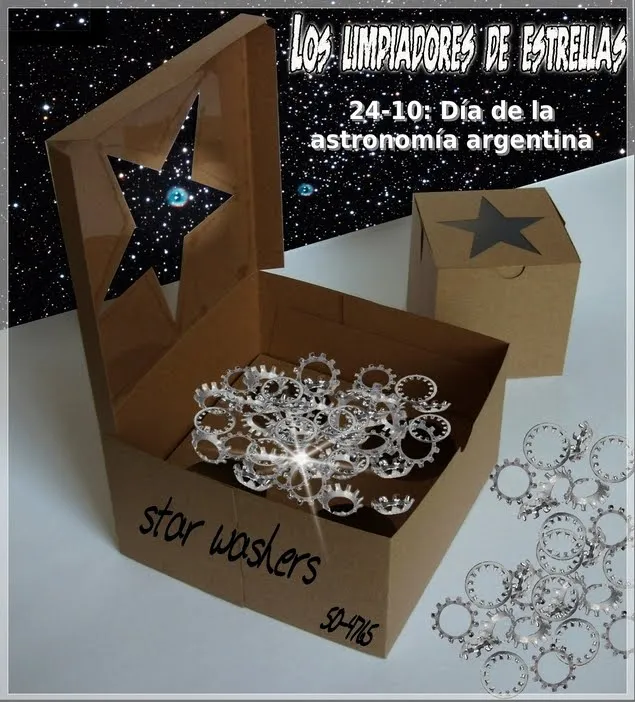
- The initial image is composed of:
Images of toothed washers (Credit: Forch), cardboard boxes with star cutouts (Credit: MOCITA cartonera); and image published in APOD of NGC 2438 (Credit: Roth Ritter/Dark Atmospheres). It is a planetary nebula "shaped like a washer". - Image of toothed washers. Credit: Forch.pt.