An "astronomical plaza" with a sundial, monument, meteorites, time zone and terrestrial globe is created on the esplanade of the Planetarium of the City of Buenos Aires.
As a way to "welcome" all those who arrive at the iconic Buenos Aires building, an Astronomical Plaza was designed on the building's esplanade. It features devices that allow visual enjoyment and motivate visitors to approach Observational and Positional Astronomy, accessing concepts related to time measurement, the apparent motion of celestial bodies, and terrestrial and celestial spatial location.
The Astronomical Plaza features:
Sundial donated by a Japanese engineer in 1970. It is located in the park at the entrance to the building. The sundial was restored, enhanced, and protected with a perimeter fence.
Monument to Copernicus donated by the Polish community in 1973 in homage to Nicolaus Copernicus. The monument was restored, enhanced, and protected with a perimeter fence.
Real meteorites that fell in Campo del Cielo, one of the most important meteorite impact areas in the world, located between the provinces of Chaco and Santiago del Estero.
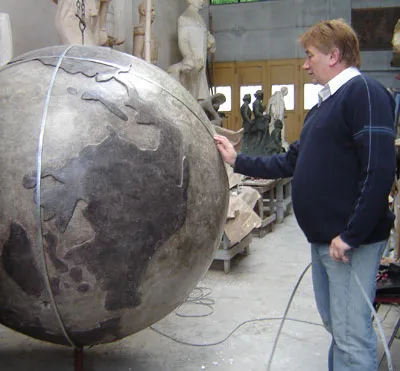
Parallel terrestrial globe: A 1.5-meter diameter sphere representing the Earth with schematized continents, the Equator, the Tropics, the Polar Circles, the Greenwich Meridian, the Buenos Aires Meridian. Its axis is parallel to the Earth's rotation axis and the City of Buenos Aires is directed towards the zenith of the place.
The work was made of reconstituted granite by professionals from the Perlotti Museum under the direction of sculptor Darío Khler.
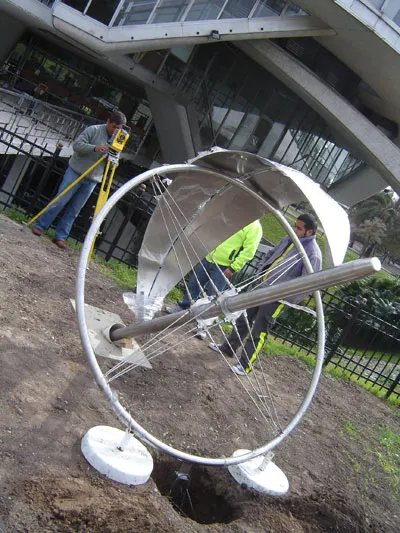
Time zone. A 2-meter diameter work made of stainless steel. It represents the time zone in which the City of Buenos Aires is located: -4 (4 hours West of Greenwich). Its axis represents the Earth's rotation axis and is oriented along the meridian of the installation site, pointing to the celestial South Pole; the circumference represents the terrestrial Equator.
The Planetarium and the IGN
The Planetarium reports that it had the advice and collaboration of the staff of the Geodesy Directorate of the Instituto Geográfico Nacional (IGN) who carried out the measurement work to determine the geographic coordinates and materialize the meridians passing through the sculpture installation sites, in order to orient them correctly.
The values were calculated in the Official Geodetic Reference Framework of the Argentine Republic POSGAR 07 (Argentine Geodetic Positions 2007), for epoch 2006.632 using topographic and GPS instruments, with a planimetric accuracy of ± 8 mm.
Lighting and landscaping tasks will soon be carried out to inaugurate the Planetarium's Astronomical Plaza, as reported from the institution's website.
What was not reported is the status of the renovations that have been underway since December of last year, which is why the hall has remained closed to the public since that date.
It would be good to inform the public about the status of the renovations that, as indicated at the beginning of the year, would include the exterior lighting (which has been seen in operation for a few months), the interior dome, and the seats. Furthermore, the planetarium instrument, originally analog, would have been replaced by a digital one. It had been indicated that the work would be completed by mid-year, although it was clarified that, as with almost all construction projects, a delay was possible. It is expected that the officials in charge will issue some report on the progress of the work before the end of the year. The inquiries I have personally made, so far, have yielded no results. It is possible that the official silence is due, in part, to activities related to the past elections. As of this Monday, that argument is no longer valid, so it can be expected that soon the officials of the Government of the City of Buenos Aires will fulfill their public duties and inform the city's population.
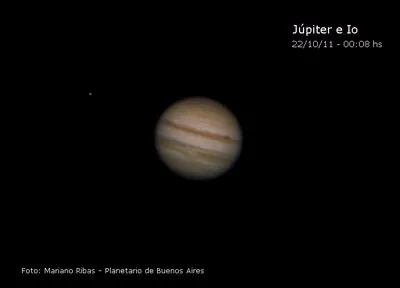
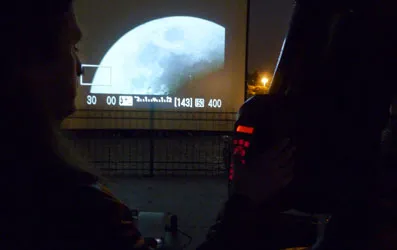
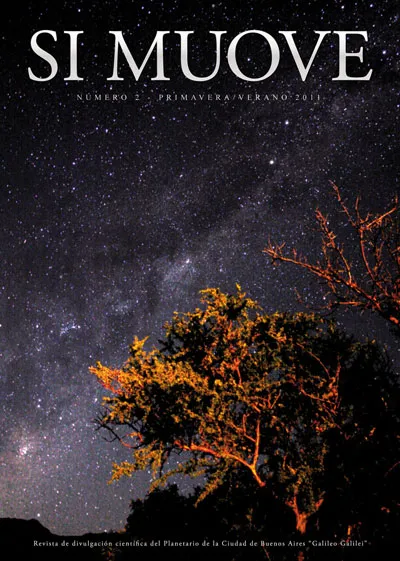
Although the hall has been closed since then, the Planetarium continues its activities, even though there are no courses, lectures, or screenings. But, on the other hand, weekend observations persist, the second issue of the new magazine is being prepared, and, when the stars and weather permit, some observation event with screens is held.
The completion of this new astronomical plaza will allow Planetarium visitors to have a better idea of positional astronomy, in addition to beautifying the place.
Sources and related links
- Planetario Galileo Galilei
- IGN: Materialización de Meridianos en el Planetario de la Ciudad de Buenos Aires "Galileo Galilei"
About the images
- Photos of time zone and terrestrial globe with Darío Khler, Director of the "Luis Perlotti" Museum, Creator of the sculpture. Credit: Planetario Galileo Galilei.