This year marks the 100th anniversary of the AAVSO, the American Association of Variable Star Observers. On this occasion, about variable star observation, light pollution and the future of the organization, I interviewed Dr. Jaime García, the current president.
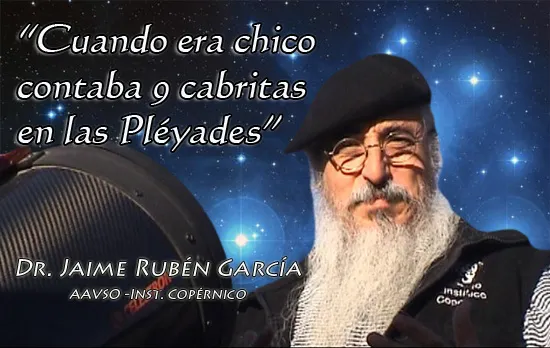
From 2009 to the present, the current President of AAVSO is none other than Dr. Jaime García, the same Argentine professor and astronomer who brings us El Mensajero de los astros, from the Instituto Copérnico of which he is the director.
In October, his two-year term ends and the next president will be the current 1st Vice President, Dr. Mario Motta (of Italian origin but who has been living in the United States since he was very young, until now president of the Massachusetts Medical Society, famous for building a 32" telescope).
Dr. García, with great kindness, dedicated a significant portion of his valuable time to talk about the organization he presides over and variable star observation. Here is a summary of our conversation.
-How is it that an Argentine, like you, presides over the American Association of Variable Star Observers (AAVSO)?
-The immediate answer is that in reality the name 'American' comes from when it was founded and for perhaps legal reasons that name was never changed, despite the fact that the contribution with observations, for example the AAVSO international database, is much greater from foreigners than from the Americans themselves. In fact, the observer with the most observations in the database is Albert Jones of New Zealand, to give you an idea. Even though the North Americans had a wonderful amateur astronomer and absolute record holder for many years who was Leslie Peltier (1) whose book I recommend because it is one of the most beautiful works written by an astronomy enthusiast.
Despite having Leslie Peltier, the top record holders are still Albert Jones, number 1, and I think second is Dannie Overbeek (2). And among the top there are two Argentines, with more than 50,000 observations, who are Sergio Domínguez (the one with the most observations) and then Mario Vattuone. That's so readers who are interested in what AAVSO is can get an idea, well AAVSO is international.
And the first time it doesn't have a person [in the presidency] from North America is me, but it has to do with my action in the entity and also with the fact that they wanted to have a centennial with a president who was not American. I mean North America because there was already a Canadian president, although English by birth, John Percy.
Within the Council and in a very important position there was a Mexican, many years ago at the time when AAVSO had that discussion about Donald Menzel's stance regarding variable stars not having the importance they had at the beginning of the 20th century and in that discussion (3) he intervened quite a bit because he was a friend of Shapley, Domingo Taboada Roldán who is the first Latin American member of the AAVSO Board of Directors.
I joined the Council in 2000 and was the first from South America. But from other parts of the world there have also been other councilors like Arto Oksanen of Finland, among others.
-Is visual observation still useful, considering technological advances like automated surveys and CCD cameras?
Visual observation is useful as long as it is not unique, in which case its usefulness would be more doubtful because the personal error equation is often poorly known, except for special cases like that of our compatriot Sebastián Otero (4), who is practically like a visual photometric with an impersonal device. But apart from his particular case, all other contributors of visual observations have an error that is often quite difficult to determine individually. But when you can compare it statistically with other people, then the error can be bounded.
-And for this, is it necessary to have expensive equipment or can observations be made with modest equipment, binoculars, even with the naked eye?
-Even without binoculars. In fact, Sebastián discovered two variables (delta Scorpii and delta Velorum) with the naked eye. Often even binoculars, for very bright stars, are counterproductive. Because if the star is very bright it takes me out of the field, the binoculars reduce my field of view and I can't have comparisons. For example, if I want to observe a star like Alpha Orionis (Betelgeuse) which is one of the 20 brightest stars in the sky, I'm going to compare it with other bright stars and close by (in terms of a binocular field) it doesn't have any.
-And photoelectric measurements?
-Well, photoelectric measurements are over a century old. It started with Joel Stebbins (5) who measured a very bright star like Algol and determined the light curve of this eclipsing binary with great precision, back at the beginning of the 20th century.
But actually, photoelectric photometry more strongly (systematically, with magnitudes at different wavelengths) developed in the 1950s and that's why some of the greatest photometrists in history are still alive. For example, Dr. Alejandro Feinstein (6), who, although retired, is an astronomer..., actually still active because he still works in his office at the La Plata Observatory. And I am fortunate to have been his disciple, I am also fortunate to share a seat at AAVSO with another of the great photometrists like Arlo Landolt. (7) And another of the top ten is Arne Henden. (8)
The most interesting thing is that they have seen the evolution. Because another great photometrist who retired many years ago and no longer dedicated himself to it, but became a militant for dark skies against light pollution is David Crawford (9), but he left. Unlike Arlo who continues working and publishing and he lived through that transition from photometer to CCD which is fundamental because with the CCD we can measure very faint stars with great precision, something that was impossible before. Today we can measure with very good precision up to magnitude 20 if we wanted. In fact, the latest survey that AAVSO is handling right now, which is APASS (10) is establishing standards up to magnitude 16.
-Even with surveys of this type, is visual observation necessary?
-Photometric standards are made so that people can have comparison stars for their observations. Because, what was happening, especially in the South? We had data, for example Tycho data, that is, from Hipparcos, as the most precise only up to magnitude 11 or 12.
THE BEGINNING OF AAVSO
There is no single date, although October 10 is preferred, stemming from historical literature indicating that the origins of the organization would be between October 4 and 29, 1911. (a)
The collaboration between amateurs and professionals arose from the very beginning of the organization, through the relationship between William Tyler Olcott (a lawyer who became interested in astronomy only at age 32 -in 1905-) who heard that the director of Harvard Observatory, Edward C. Pickering, would give a talk on variable stars. Starting in 1910, he began sending regular observations to Pickering. In Harvard College Circular 166, of June 1911, Pickering published a list of stars that needed to be observed and a roster of observers wishing to participate in the project. Leon Campbell wrote that "there one might say the embryo of the association was conceived." (b)
-New technologies not only brought CCD cameras, but also the development of the internet, collaborative programs and citizen science, like Citizen Sky.
-As a result of Citizen Sky, the citizen science project that AAVSO has, since it involved observing a very bright star like Epsilon Aurigae, whose eclipse lasts two years and needed to be observed well in the middle of the eclipse, that star caused many amateurs who have DSLR cameras, reflex, with a sensor that instead of being a CCD is a CMOS, a project was developed by those who collaborate in Citizen Sky to make these cameras usable for astronomy, but not only for taking beautiful photos that could be pure astrophotography, but to use them to do science. (11)
A very nice work has been achieved and any blog reader who has one of those cameras should know that they can do science, especially with bright stars that for the moment have very little coverage.
-We have already removed several obstacles: visual observation is still very important and it is possible for amateurs to do it even if they don't have very expensive equipment. But surely it takes a long time to visualize a brightness change...
-Well, if we think of a star like Mira which has a 332-day period, undoubtedly, we will need a few days to see it change. However, it changes because you have to think that it goes from magnitude 2 to 9. To cover 7 magnitudes in 332 days means it has varied some tenths per day, so I don't know if per day, but per week. Those who live in a humid climate, for example Buenos Aires, La Plata, Rosario, Montevideo, etc., the weather makes it impossible for us to follow it for the 332 days. So it's great for me that it has 332 days. But of course, you need the time, the desire, the possibilities. Suppose someone has only one night. Well, there are stars that vary a full magnitude in an hour and a half. For example, SX Phoenicis (12) which you have to observe with binoculars, it's practically magnitude 7 to 8, in 87 minutes, it goes and comes back. Therefore, before you finish looking, deciding what estimate I give the star, it has already varied. It is so fast that the temporal resolution of the detector must be spectacular. The eye is an excellent instrument of temporal resolution. So much so that an amateur from many years ago who used to observe that star with me many times, Pablo Testai (13), would do two to three complete periods of the star in one night.
-Aside from the possibility of contributing scientifically, observing variables is fun...
-I maintain that it must be. If one doesn't have fun doing a hobby, it stops being one. An amateur astronomer must have fun with what they are doing.
-What is the future of AAVSO?
-Without doing science fiction, because at AAVSO we have the custom for these anniversaries of circulating some papers among those present at the meetings, in which one writes what AAVSO will be like in 10, 20, 50 years. At the last anniversary, when it was 90 years, I put things like "more international" and the truth is it has never been more international than now. But also regarding other matters, like how many observations the database would have (I put 20 million, it turns out we have 21 million), etc. But, what can happen to AAVSO in the coming years? First of all, to be very austere in its financial matters, because we are in years where the return on investments is practically impossible to estimate. It's harder than estimating the brightness of a star. Our first issue and that's why I'm very zealous about it as a director, is to be very austere in our performance. This means we have to have a staff of very good people, but not numerous, very intelligent, that functions very well. For what? Well, here comes the thing that might interest the reader and not the specific member of AAVSO. What should we do? Try to make our network of robotic, automatic observatories spread more. Because many amateur astronomers who want to do variable stars, with the rate at which the sky is being ruined by light pollution and other pollution, will soon make it so we cannot see a star from Earth if we don't have a telescope. So we have to think of elements so that our members can continue observing. I am very afraid of this because I also experience it where I live, in a rural area, how I am losing magnitudes. It means that those who live in cities will soon not be able to observe even Sirius, unless we become aware.
-It's terrible, but real, even though many times we are not fully aware of this.
-Unfortunately that's the way it is and that we don't realize that we are losing a treasure for future generations. As I always say in my talks, it is the only witness of our history that has remained practically unchanged through so many millennia and tells us the story. Because those constellations that people named three, four thousand years ago are telling us the true story of human beings in an incredible way. And it is so beautiful to discover it through the sky. There is a very beautiful book, which I am passionate about, by an Argentine physicist who had to migrate, called "Cielito Lindo"(14) that tells the story of the constellations, which is our story and is up there. Already kids, when they come here, tell me "How does the Southern Cross have four stars, if I only see three?". To my great-uncle, who taught me to count, I argued that the Seven Little Goats, the Pleiades, were nine stars. That sky that I could see in Buenos Aires, Floresta neighborhood, where I was born, in which I could see so many stars, today kids cannot even see the Pleiades. And I'm not that old, I'm 57 years old, I'm talking about 54 years ago. If we have ruined it in fifty years to this point, the accelerated pace at which we are growing will surely ruin the sky much faster than we imagine.
-What is the future of Jaime García at AAVSO?
-I have been a member since 1972, therefore I will continue to be an extremely active member, as always. In October my term as president ends and I have one more year intended to pass on my experience to my successor and to the entire council.
It is a career: you are 2nd Vice President, then two years of 1st Vice President, two years as President and then one year as Past-President to transfer the experience.
I will always continue to be linked to astronomy because it is my profession and my passion.
The relationship between the United States and Argentina in Astronomy
The observation of variable stars, it must be said, did not begin last century, but dates back centuries, millennia ago. However, since the end of the 19th century this organization began to take shape which, without being the only one (LIADA and other organizations also exist), is the largest in the field.
The beginnings of variable observation in the U.S. are linked to our country. In fact, not only variable astronomy, but the establishment of the observatories. Benjamin Gould developed the famous Uranometría Argentina (1879) as a continuation of Argelander's Uranometría Nova. From Germany and Argentina, Gould took his interest in variables to the United States. See Before the AAVSO, Historia de la Uranometría Argentina, Paolantonio, S. and Minniti, E. (2001); "The measurement of starlight: two centuries of astronomical photometry", pp.37-39, J. B. Hearnshaw, Cambridge University Press, 1996.
One thing that separates us from the northern country is the language. Among the legacy of Dr. Jaime García at AAVSO is having more and more material in Spanish, such as the recent forum in our language. But it is also the wish of the current president to increase the content in Portuguese, since Brazil also has several observers and is, moreover, a land very dear to the astronomer who passed through the Instituto de Ciências Exatas, Universidade Federal de Minas Gerais.
Sources and related links
Editor's notes:
(1) Leslie Peltier on Wikipedia.
(2) AAVSO: 20 Million Observations (with the record holders)
(3) See The AAVSO Archives—Historical background and AAVSO Council members, 1911-2011
(4) Sebastián Otero
(5) Joel Stebbins and Fotometría fotoeléctrica.
(6) See Bulletin 285. December 11, 2009 FCAGLP/UNLP by Alejandra Sofía
Tribute to Dr. Alejandro Feinstein
(7) Arlo U.Landolt
(8) Arne Henden is the current Director of AAVSO.
(9) Astronomers without Borders: David Crawford
(10) APASS: The AAVSO Photometric All-Sky Survey
(11) DSLR Photometry Tutorial
(12) SX Phoenicis
(13) Pablo Testai
(14) Cielito Lindo, Elsa Rosenvasser Feher, Editorial Siglo XXI, Colección Ciencia que ladra, ISBN 987-1105-91-6, Buenos Aires, 2004.
(a) According to the essay by M.Saladyga, editor of the AAVSO Journal, Newsletter and archives "Note on a Determination of the Date of the Founding of the AAVSO"
in JAAVSO v34n2
(b) The emergence, founding, and growth of the AAVSO
About the images
- Photo of Dr. Jaime R. García from his Facebook profile (Credit: Dolores García), combined with Hubble photo of M45. Credit: NASA, ESA and AURA/Caltech