A collection of links to music, images and videos relating art and science. Today: A butterfly-shaped planetary nebula; Anticrepuscular rays; A region of Corona Australis. Music: Planoprojetivo/Postales del universo 3. Video: How is an astrophysicist like Indiana Jones?

Images of the decade
NGC 2346: A butterfly-shaped planetary nebula
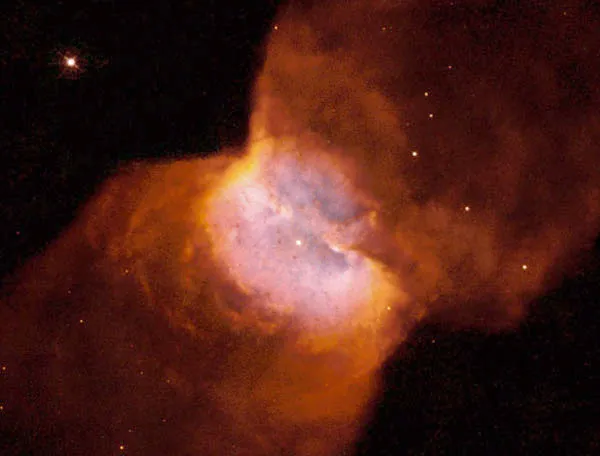
It may look like a simple butterfly, but it is larger than our Solar System.
At the heart of the bipolar planetary nebula NGC 2346 is a pair of stars very close to each other that orbit one another every 16 days.
The tale of how the butterfly bloomed probably began millions of years ago, when the stars were farther apart.
The more massive star expanded to engulf its binary companion, causing the two to spiral closer together and eject rings of gas.
Later, bubbles of hot gas emerged as the heart of the massive red giant star was being uncovered.
In billions of years, our Sun will become a red giant and emit a planetary nebula – but probably not in the shape of a butterfly, because the Sun does not have a binary star accompanying it.
Credit: Massimo Stiavelli (STScI), Inge Heyer (STScI) et al.,
& the Hubble Heritage Team (AURA/ STScI/ NASA)
It was the Astronomy Picture of the Day (APOD) October 28, 2001. And on Observatorio.
Anticrepuscular rays over Colorado
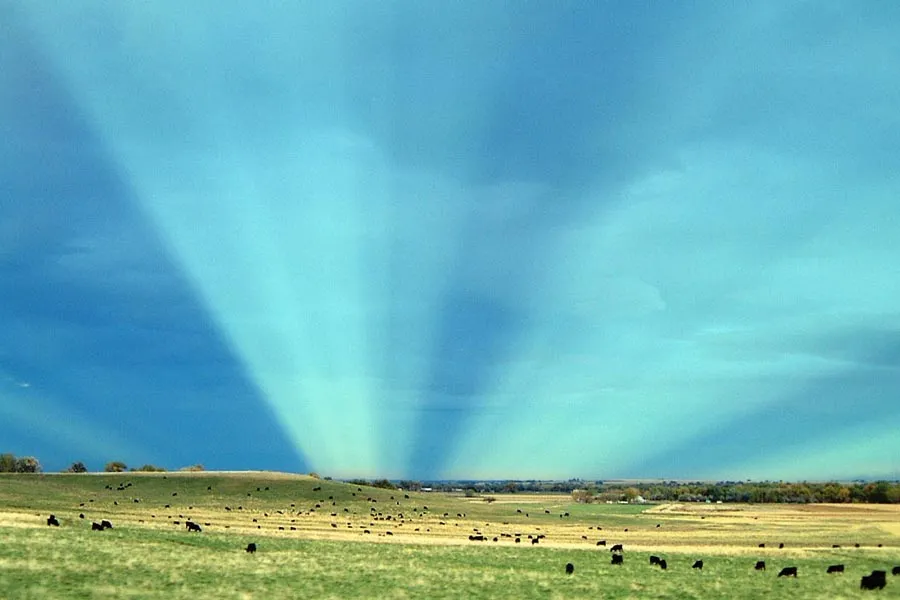
What is happening over the horizon?
Although the scene may seem at some point supernatural, nothing more normal is happening than a sunset and some well-placed clouds.
The image above shows anticrepuscular rays.
To understand them, start by imagining common crepuscular rays that are seen when sunbeams pass through broken clouds.
Now, although the Sun's rays travel in straight lines, their projections onto the celestial sphere are great circles.
Thus, the crepuscular rays from a setting (or rising) Sun will appear to re-converge on the other side of the sky.
At the opposite point in the sky, 180 degrees from the Sun, they are therefore called anticrepuscular rays.
The image that can be observed above was photographed earlier this same month -in 2001- from a moving car on the outskirts of Boulder, Colorado, USA.
Credit: John Britton
It was the Astronomy Picture of the Day (APOD) of October 30, 2001. (And it was again on 11-16-2008)
Also on Observatorio and on El Sofista (includes a panorama of crepuscular and anticrepuscular rays in which it is possible to follow the luminous arc between the Sun and the antisolar point).
Images of the week
A region of Corona Australis
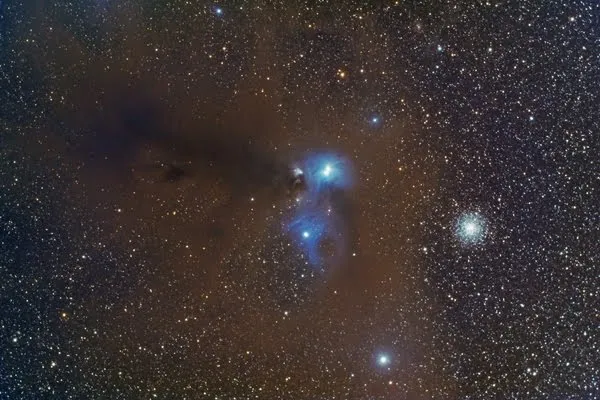
The reflection nebulae NGC 6726, 6727 and 6729 accompanied by the globular cluster NGC 6723. The nebulosities are located about 420 light-years from Earth, while the cluster is about 29,000 light-years from the Sun.
Image obtained with an AP130 EDF GT and a Canon 1000D from San Antonio de Areco, Province of Buenos Aires, Argentina, by astrophotographer Ignacio Diaz Bobillo, from http://www.pampaskies.com.
It was the Amateur Astronomy Picture of the Day (AAPOD) of October 27, 2011.
A detailed explanation, with maps, of this zone rich in Herbig-Haro objects can be found at Sur Astronómico: Jóvenes luces en las tinieblas.
Space Music
Planoprojetivo: Post cards of the Universe 3
In the past two editions I commented here on the work of Orlando Moreira, whom we can find on SoundCloud, with a trilogy dedicated to the stars: Postales del universo.
Here is the third part, although in later editions I will comment more on this artist since this trilogy seems to have a fourth part and extras, in addition to other works also related to astronomy.
Post cards of the Universe 3 by planoprojetivo
Science in motion
How is an astrophysicist like Indiana Jones?
Science on Bicycle conference with astrophysicist Jaime Forero, as part of the Noches Explora.
Jaime Forero-Romero, a Bogotá-born physicist educated in Argentina and France who works at the Institute of Astrophysics in Potsdam, near Berlin, says: "Indiana Jones and astronomers/astrophysicists are archaeologists". The Colombian researcher received the Gruber Fellowship this year.
The conference is aimed at the general public, adults and children, and the astrophysicist tries to create analogies between concepts to make them more accessible. For example, a young galaxy, for Forero, is a children's choir!
To access previous editions of this section, consult the Multimedia Selection Series.