A collection of links to music, images and videos relating art and science. Today, images of NGC 6782; A cat's paw and a lobster. Music by Tunguska EMS and a video of The night photographers.

Images of the decade
NGC 6782
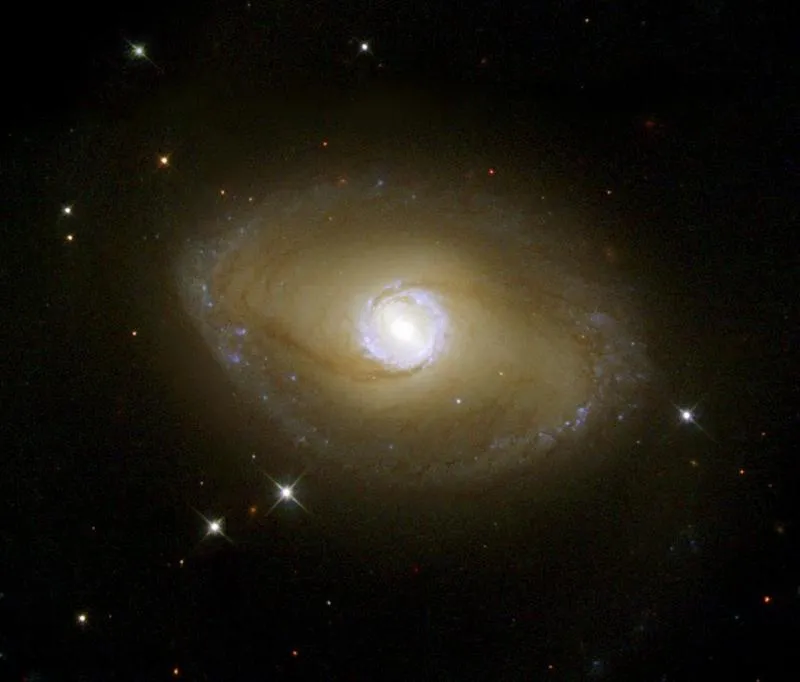
This spiral galaxy has two arms that make it look similar to others of its class, the "pinwheel" type, although it is actually somewhat different, as illustrated in this ultraviolet image.
Violet light has a shorter wavelength than visible light and is emitted by stars that are hotter than the Sun. At this wavelength (in blue in the photo), galaxy NGC 6782 shows a spectacular, nearly circular ring surrounding the nucleus that marks the presence of many newborn stars.
NGC 6782 is a relatively nearby galaxy, about 183 million light-years away. The image was taken in June 2000 as part of an ultraviolet study of 37 nearby galaxies.
On the Hubble Legacy site you can access supplementary material and the original images
We can also find a photo of the galaxy by H Wilson, on CDS Portal and on SimPlay.
On Wikisky: NGC 6782 with GALEX in ultraviolet and in optical with DSS2
The image was published by HubbleSite on November 1, 2001.
Credits: Credits: NASA and The Hubble Heritage Team (STScI/AURA)//R. Windhorst (ASU).
Images of the week
A cat's paw and a lobster
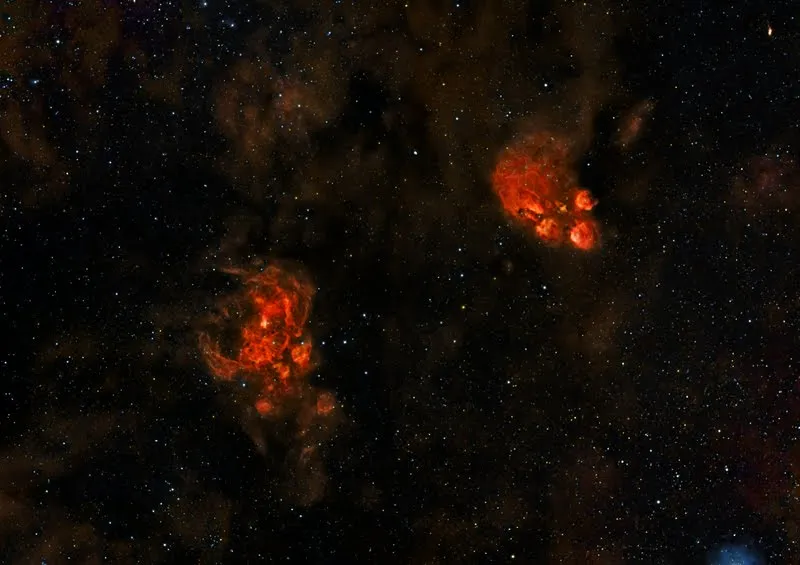
In this image you can see the Cat's Paw Nebula, NGC 6334, 5,500 light-years away, and the Lobster Nebula, NGC 6357 7,000 light-years away. The latter has also been nicknamed the War and Peace Nebula.
The image was taken by Nathaniel Custodio, an amateur from the Philippines, and was selected as the Amateur Astronomical Picture of the Day (AAPOD) for November 2, 2011.
We can see a similar image of both objects, made for the ATLASGAL survey in submillimeter and infrared wavelength from the Midcourse Space Experiment (MSX) at ESO: The NGC 6357 and NGC 6334 nebulae.
NGC 3657 was named the War and Peace Nebula by scientists from the Midcourse Space Experiment. Their idea was that in the infrared images, the bright eastern part resembled a dove, while the western part looked like a skull.
The story is told in the 2MASS gallery of its week number 25 images, which include both nebulae.
Space Music
I have already commented before on the work of the Russians Tunguska Electronic Music Society.
Last month they released a new work titled Phaeton Chronicles.
The translation would be "Chronicles of Phaeton". But what is Phaeton?
Although there are many meanings, I would be inclined to think it alludes to the hypothetical planet Phaeton.
Science in motion
ESOcast 19: Photographers of the night
The Sun sets behind Cerro Paranal in the Atacama Desert. As astronomers prepare to observe with ESO's Very Large Telescope, nature prepares for its own grand display. As night falls over the desert, the southern sky reveals its nocturnal beauty, leaving the viewer in silent awe. But some people don't just watch the show.
With great skill they record these unique moments so that everyone can see them. They are the photographers of the night.
The original episode can be seen on ESO: http://www.eso.org/public/videos/esocast19/
Video link to DotSub
To access previous editions of this section, consult the Multimedia Selection Series.