A collection of links to music, images and videos relating art and science. Today: Images of A Sun Pillar and NGC 6188. Music from Symphony of Science and a video by Mario Benedetti about the Large Hadron Collider.

Images of the decade
A sun pillar in red and violet
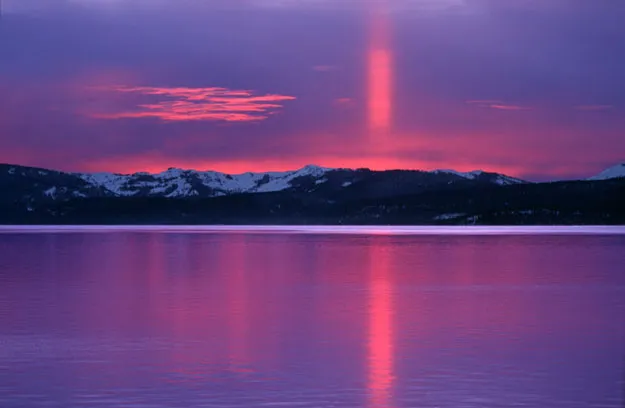
Sometimes the unknown is beautiful. In February of the year 2000, near Lake Tahoe, Nevada, two amateur photographers noticed an unusual column of red light, rising mysteriously from the location of the sunset.
During the following minutes, they were able to capture this pillar and a photogenic sunset.
The image above shows the red column over a serene and tranquil Lake Tahoe and with snowy mountains at its peak, which correspond to Nevada Park and Lake Tahoe.
The mysterious column, as they later learned, is a Sun Pillar, a phenomenon in which sunlight reflects off small ice crystals in the atmosphere.
Credit: Jim Kirkpatrick & brigitte Heiter-Kirkpatrick
It was the Astronomy Picture of the Day (APOD) of November 7, 2011. And at Observatorio
More sun pillars at El Sofista.
Images of the week
Zoom Nebula NGC 6188
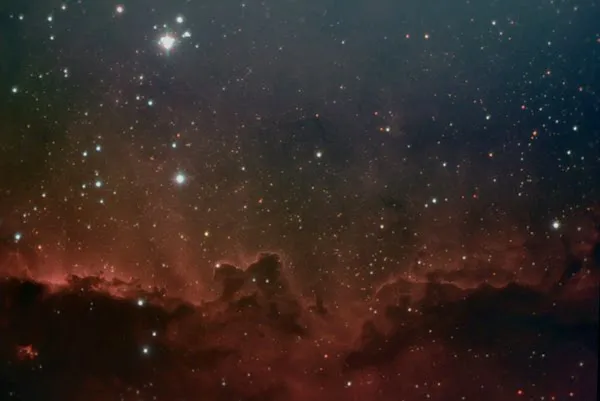
This emission nebula, 4,000 light-years from Earth, lies in the constellation Ara.
The photograph was chosen as the Amateur Astronomy Picture of the Day (AAPOD) of November 12, 2011 and was taken by Martin Menrath, from Buenos Aires.
Space Music
I have previously commented on Symphony of Science, the musical project of John D. Boswell, designed to bring scientific knowledge and philosophy in a musical form. It owes its existence, largely, to the Cosmos series by Carl Sagan, who was born on November 9, 1934.
The latest work of this project is "Onward to the Shore" which speaks of moving forward, progressing, taking steps through the generations with the goal of reaching the cosmic shore. We have, as humanity, gone from the surface of the Earth, into space. Then we advanced to the Moon. Now the planets will come. And this combination of music and phrases from different scientists speaks of Mercury, Saturn, countless worlds that put a new context to the meaning of this pale blue dot we inhabit. As if to know that there is so much place out there, so much to discover, to marvel at. So much to take care of here, too, right?
What follows is a list of videos, all translated into Spanish, except the last one.
http://www.youtube.com/playlist?list=PL199E2A1F2F3496F6
Although number 12 is not translated, yet, in the video, I leave here a draft of the translation:
[Neil deGrasse Tyson]
The act of going onward means passing the baton
One of them first left Earth
The next was going out to the Moon
What's next? The planets
Onward to the shore
We move onward to the shore
Here we are together
This small fragile world
[Brian Cox]
This is our Sun
Just another star in a sea of stars
The heart of the solar system
Just another star in a sea of stars
Mercury is the closest planet
This tortured piece of rock has been stripped bare
[Tyson]
The Moon has a sky
It has a horizon
It's another world
that has Earth in the sky
Just as we have the Moon in the sky
(chorus)
We are not the only world to think of worlds innumerable
We are not the only world to think think of worlds innumerable
[Carolyn Porco]
There is a great recognition that stirs within us when we see our little blue ocean planet in the skies of other worlds
The Saturn system offers a splendor without compare for its rings and many diverse moons
[Tyson]
No longer abstractions
These are worlds
Perhaps there is life there
They have changed how we think about Earth
[Cox]
A mote of dust suspended in a sunbeam the pale blue dot
(chorus)
The laws of nature create vast different worlds with the smallest of changes
[Tyson]
When I reach the shore of the universe
I do so knowing that along some paths of cosmic discovery there are times when, at least for now, one must be content to love the questions themselves.
Science in motion
Mario Benedetti - The origin of things
Argentine engineer, principal researcher at CONICET and scientific attaché at the European Center for Nuclear Research (CERN), where he participated in the development of the Large Hadron Collider (LHC), wrongly called "The God Machine". He directs the Instrumentation Laboratory of the Faculty of Engineering of the National University of Mar del Plata. That's what Benedetti talks about in this talk at TEDxBuenosAires 2011.
To access previous editions of this section, consult the Multimedia Selection Series.