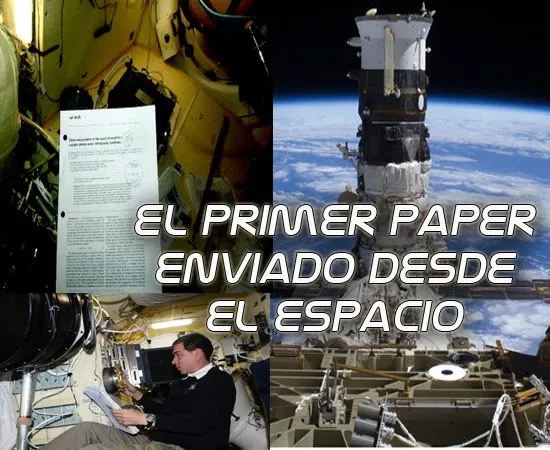
The journal Europhysics Letters received yesterday the first paper sent from space, from the International Space Station (ISS).
The article is based on the properties of plasma under microgravity conditions and represents the collaborative research of 29 missions conducted over the last ten years by Russian and German researchers aboard the ISS.
The detailed experiments in the work were developed on the ISS in July 2010 by Alexander Alexandrovich Skvortsov and were sent on October 27, 2011 by his colleague Sergey Alexandrovich Volkov, who is part of the ISS, Expedition 29.
The idea of sending a paper from the ISS arose in a video interview with Michael Schreiber, Editor of EPL. The interview was conducted by Matin Durrani, editor of Physics World, at a meeting to celebrate the 25th anniversary of EPL, in Munich.
Schreiber noted: "I hope to attract excellent future research from beyond the globe. Of course, it is not likely that we will receive manuscripts from or beyond the Moon in the near future. But perhaps the first mission to Mars will be in time to send a manuscript on the golden anniversary of EPL in 2036."
Published yesterday, November 11, the paper reports on measurements of the speed of sound in plasma. That measurement is an important tool for characterizing the structure, properties and behavior of a material, for example, it can provide information about its elasticity.
Under normal gravity conditions, here on Earth, only a thin layer of plasma can be examined, but three-dimensional investigations can be conducted under microgravity.
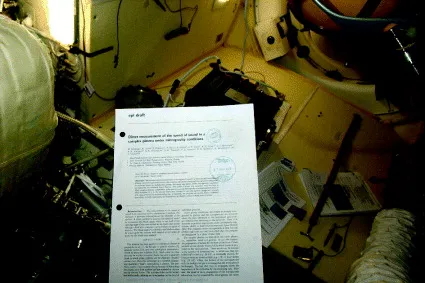
In the issue of EPL there is an editorial about this particular paper and the story behind it. It is indicated that EPL began in 1986 as a merger of two journals (Journal de Physique Lettres and Lettere al Nuovo Cimento). Since then Europhysics Letters became global. Although its name indicates otherwise (European). After renaming it as EPL in 2007, efforts increased to achieve a more international journal. And in the silver year, for its 25 years of existence, EPL reached space, notes Michael Schreiber in his editorial.
The article in question is signed by several authors from Russia and Germany, along with Volkov on the ISS.
The lead author is M. Schwabe who, like his colleagues Jiang, Zhdanov, Hagl, Huber, Ivlev and Morfill, is from the Max-Planck Institute.
Both articles, the editorial and the paper, can be obtained for free and are linked below.
The experiment
What is presented is an experiment conducted in the PK-3 Plus Laboratory of the ISS.
And it is related to the Mach number and the Mach cone. The Mach number, M, is a ratio between the local velocity of a flow and the speed of sound within the fluid: M=V/Vs, where V is the local velocity and Vs the speed of sound.
PK3-Plus is a block, a system with several components, connected to another data acquisition system or Telescience. More details on the Max-Planck page.
The heart of the laboratory is the plasma chamber, in the block, which consists of 6 cm diameter electrodes, separated by 3 cm each. There are dispensers that can inject particles into the plasma. When doing so, the particles form a cloud around the center of the chamber, with a central vacuum caused by an ion current. Generally there are some larger particles present from various origins: agglomerations, particles left over from some previous experiment, etc.
Plasma
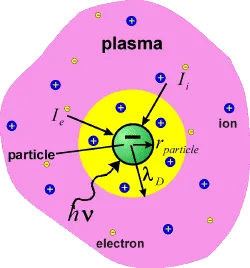
A plasma is an ionized gas consisting of electrons and ions and is the fourth state of matter. It exists mainly at high temperatures. The crystallization of a plasma can be achieved with an additional component: microparticles or "dust" of a size of several microns (1 µm = 1/1000 mm) are bombarded by electrons and ions, but since the ions are heavier and have lower mobility, the particles collide more with electrons and accumulate a negative charge. At a certain distance, this charge is attracted by the cloud of positive ions around the particle.
At a certain density, the particles begin to interact via the Coulomb force. Together with the surrounding plasma they form a "complex plasma" or "granular plasma".
See: Introduction to Granular Plasma Physics
Here you can see an experimental image in which the path of a probe particle in the microparticle cloud on the left is visible and in the vacuum it is also clearly visible as a thin line that then curves.
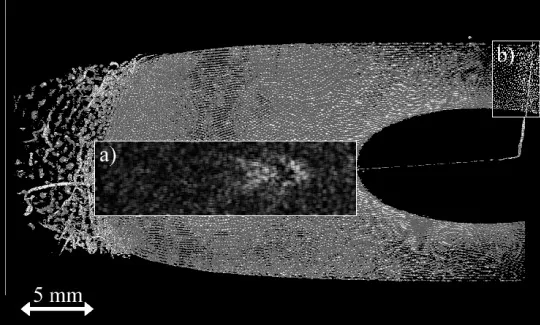
This is how the experiment was done with melamine-formaldehyde microparticles of 2.55 microns in diameter and accelerating a larger particle.
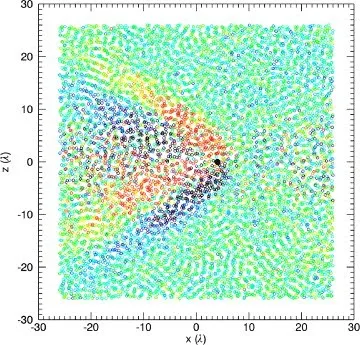
Additionally, a three-dimensional simulation was performed to compare with the experimental results and they found good agreement.
Here we see an image of a simulated Mach cone for an average interparticle distance of 165 µm and a probe particle velocity of 40 mm/s.
Sources and related links
- Journal receives its first paper from space
- Direct measurement of the speed of sound in a complex plasma under microgravity conditions
M. Schwabe et al 2011 EPL 96 55001
DOI:10.1209/0295-5075/96/55001
EPL Issue 5 (December 2011) - Is EPL a global journal? No, more!
Michael Schreiber Editor-in-Chief 2011 EPL 96 50000
DOI:10.1209/0295-5075/96/50000 - Max Planck: "Plasma Crystal" Scientific Background
- RSC Energia: Experiment Plazma Crystal
- Dusty and Liquid Plasma Crystals in Conditions of Microgravity (Plasma_Crystal)
About the images
- Combination of images from:
ISS028-E-009187 (22 June 2011) Sergei Volkov working with PK-3+ in the MRM2 of the ISS; ISS021-E-030653 (21 Nov. 2009) MRM2 Module; and manuscript of the paper. - Manuscript. Photograph by RSC-Energia.
- Plasma Graphic. Credit: Max-Plank "Plasma Crystal".
- Fig. 1 and 2. Credit: M. Schwabe et al (2011)