A nutritious pasta dish to swallow a Mars al dente. (Or how to give a recipe for noodles with tuco with an air of astronomy).
When Carlo Ferri proposed that this XXV edition of the Carnival of Physics -which celebrates its two years of existence- be focused on gastronomy, I only thought of noodles.
Is it perhaps the only food he knows? Well, almost. I'm not very handy nor do I like to spend a lot of time cooking only to swallow it in 30 seconds.
The simplest thing to make is noodles. I like spaghetti or fettuccine more than other kinds of noodles and I like them more with butter and cheese and not so much with red sauce, although bolognese is another thing, but it demands a bit more.
So I have to talk about noodles and physics. Where to find physics in noodles?
The first thing that came to mind was the famous issue of the breaking of Feynman's spaghetti, but I found that La Mula Francis already wrote for the Carnival an entry in which he says everything related to the topic.
That's why I'm going to focus on an ingredient in the preparation of noodles: salt.
In his book What Einstein Told His Cook, Robert Wolke asks [1]: Why do we have to put salt in the water before boiling the pasta? Does it make it cook faster?
The two questions are very good. Even better is to ask: what function does salt serve in the preparation of pasta?
Its only function is to enhance the flavor. However, some maintain that adding salt raises the boiling point, so that the water will boil when it is hotter and will cook the food faster.
Wolke points out that this increase does not make a big difference, unless you add such a large amount of salt as to make Salt with pasta!
And he adds: "Dissolving one tablespoon (20 grams) of salt in five liters of boiling water to cook half a kilo of pasta will raise the boiling point by about five hundredths of a degree Celsius. This would reduce the cooking time by half a second, more or less."
And why does adding salt increase the boiling point?
Well, first let's see what happens with just water.
We fill 4/5 of a pot with tap water at room temperature and place the pot on the lit burner. The fire heats the pot, which in turn transfers heat to the water. The movement of the water molecules increases (the average speed increases) and we call that temperature. The water temperature rises. After a few minutes the temperature stops rising upon reaching the boiling point at which all the molecules are ready to evaporate.
Physicist Dr. Alberto Rojo, in Física en la vida cotidiana [2], explains what follows:
"Upon receiving a bit of extra energy, instead of increasing their speed they 'prefer' to break the bonds that tie them to their neighbors and escape. Now then, where do they escape? One way is to try to go to the surface. But that can take them a long time. Another escape route are very small surfaces of air bubbles trapped in invisible interstices on the surface of the pot, which slipped into the water when filling the pot. Many of these bubbles are invisible at room temperature, but at boiling temperature the molecules escape through there, the bubbles greatly increase their size and float to the surface."
With the salted water, what happens is that the Na+ and Cl- (calcium and sodium) ions occupy the space between the water molecules. As the temperature increases, although the water molecules move faster, there are fewer molecules and therefore there are fewer collisions. Less water vapor is released and the pressure is lower compared to unsalted water at the same temperature. More energy is needed for the pressure of the salted water vapor to exceed the atmospheric pressure and begin to boil.
What determines the boiling temperature?
From the above it follows that the greater the attraction between the molecules, the more you have to heat the water to boil it. And that attraction depends on two things: on the characteristics of the molecules themselves (oil boils at a different temperature than water) and on the external pressure that tends to squeeze them and bring them closer together.
That is why the boiling temperature increases when the external pressure increases, for example it is difficult to cook at high altitude where water boils at relatively low temperatures, since at altitude the air pressure is lower.
Does it matter when to add the salt to the water?
Should we perhaps add the salt before the water boils?
Wolke says: "The fact is that once the pasta is boiling in salted water, it doesn't matter when the salt was introduced. It dissolves easily in hot or warm water. And even if it didn't, the motion of the boiling would dissolve it immediately. Once dissolved, the salt does not remember the moment or the temperature at which it entered the water, whether it was submerged at 100ºC or at 35ºC. Therefore, that cannot affect the pasta in any way.
There are also those who point out that adding salt helps prevent the pasta from becoming too soft.
Salt can be replaced by bouillon cubes (which already contain salt) for seasoning.
After removing the spaghetti or noodles (they call them angel hair) from the heat, they are drained and rinsed with cold water so they are "al dente".
Spaghetti "Canali di Marte"
So, a recipe for delicious noodles that I especially like is as follows:
Ingredients
250 g of spaghetti (half a package, for two people)
4 ripe tomatoes (can be tomato puree)
1/4 cup of olive oil
2 bay leaves
2 cloves of garlic
Salt and pepper to taste
Preparation
Peel the tomatoes and cut them into cubes. In a frying pan, heat the olive oil and put the crushed garlic cloves with the bay leaves. Cook for a little while. When they release their aroma, remove them.
Add the tomato and let it cook until it forms a sauce. Add salt and pepper to taste.
Meanwhile, cook the pasta:
In a pot with plenty of water and a handful of coarse salt, let the water boil. Add a teaspoon of oil and put in the noodles, using a spoon to help submerge them without breaking them. After about 7 minutes they will be ready to taste. That will be the right time to remove them when they are neither hard nor excessively soft. If when tasting they break easily when bitten, they are ready.
Pour the noodles into a colander, removing the hot water. Sprinkle a little cold water on them so they are "al dente" and serve on a plate which we then bathe with the red sauce.
The accompaniment of bread and a glass of wine is ideal. If classical music is playing, even better.
Astronomy and Gastronomy
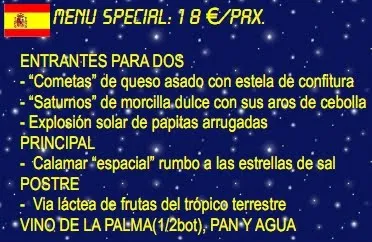
In some parts of the world, for example in certain areas of Chile and Spain, it has become increasingly popular to combine the admiration of astronomical objects with gastronomic tasting. See for example this report from 20minutos on Astronomy and Gastronomy.
There are restaurants that prepare meals that try to resemble planets or objects of the cosmos, for example, ice cream balls that look like comets and even, after dessert, there is observation through telescopes. As if the food enters through the eyes...twice!!
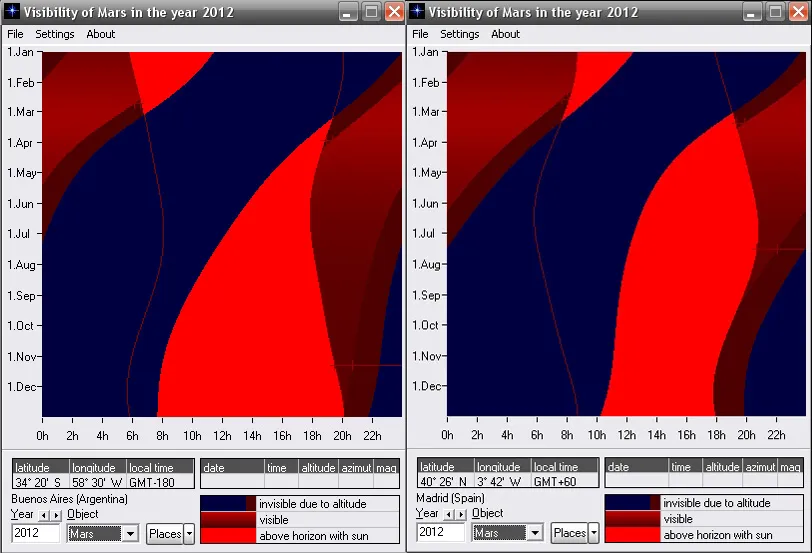
With a good plate of spaghetti with red sauce, wouldn't we be looking at a gastronomic image of the "Canals of Mars"? If the noodles preceded the observation of the red planet and we dined at 22:00, the time slot to observe the warrior wanderer is small. Here I show when Mars would be visible for Madrid and Buenos Aires during 2012, with Planetary, Lunar, and Stellar Visibility (PSLV):
By the way, NASA has found salt deposits on the red planet. A fact that could liven up a (G)astronomical evening with Spaghetti à la Canali di Marte.
Yes, I know, you have to use a lot of imagination with a plate of spaghetti with red sauce to think of Mars and its false "canals." But, doesn't observing Ursa Major, the great Dipper of space, the one in which we cook our pasta, also require a creative look?
Note: Will the reader know if Mars ever in the past or future will transit through the great culinary asterism or the Greater Bear of the cosmos?
Note written for the XXV Carnival of Physics, in this edition hosted by Gravedad Cero. To join and read the entries there is a social network on Ning.
Sources and related links
- [1]: What Einstein Told His Cook, Robert L. Wolke, Ma non troppo, Ediciones Robin Hood, 2003, Barcelona. ISBN: 84-96222-00-4 Quoted from chapter 2 The Salt of the Earth, Pasta and basta, pp. 50-51.
- [2]:Physics in Everyday Life, Alberto Rojo, Siglo XXI editores, collection Ciencia que ladra, 1st ed., 5th reprint, Buenos Aires, 2010. ISBN 978-987-1220-81-6.
- Seed: Why does salt lower the freezing point and raise the boiling point of water?
- The false "canals" of Mars
About the images
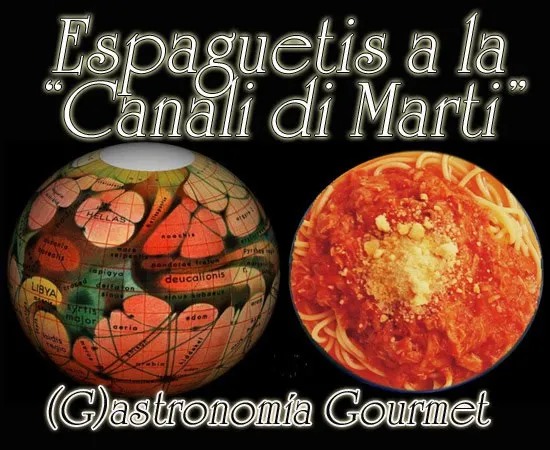
- Fig.1: Initial image: (Left) This 1894 map of Mars was drawn by Eugene Antoniadi and redesigned by Lowell Hess. (Right) Photo of pasta with IlTerra sauce. Credit: Tom Ruen, Eugene Antoniadi, Lowell Hess, Roy A. Gallant, HST, NASA. Source: Space.com
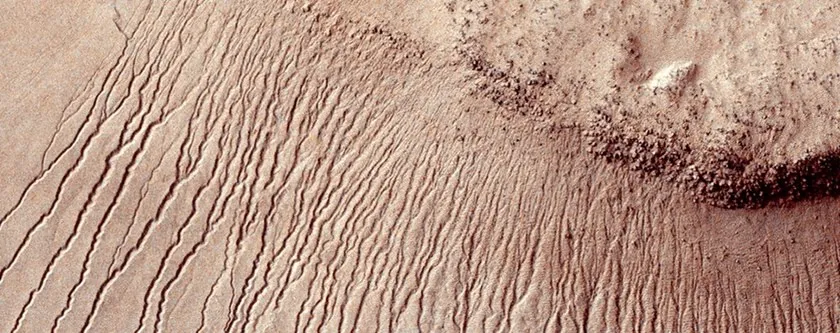
- Fig. 2: Real gullies on Mars. Credit: NASA/JPL/The University of Arizona. HiRISE.