Interview with Dr. in astrophysics Guillermo Barro Calvo, who earned his doctorate at the Complutense University of Madrid, is currently at the University of California Santa Cruz and is part of the CANDELS Survey.
Among the authors of the article accepted by ApJ, related to the previous article about the discovery of dwarf galaxies with high star formation, is Guillermo Barro Calvo. He holds a doctorate in astrophysics from the Complutense University of Madrid. His doctoral thesis was on "Properties of star-forming galaxies at different epochs of the universe" under the supervision of Pablo Pérez-González and Jesús Gallego.
He has created a database that allows for studies of scientific interest on the sampled areas, such as: Determination of the number of galaxies as a function of apparent magnitude, morphological classification,...etc.
He is currently at the University of California Santa Cruz, in the department of astronomy and astrophysics on a postdoctoral fellowship and is part of the CANDELS and DEEP studies.
I spoke with him yesterday about his participation in the study in question, the flood of data and his arrival in California.
As noted in the press release, Guillermo tells me the finding was fortuitous.
-To what extent is it "fortuitous" or "serendipitous", considering that you dedicate yourself to studying the properties of galaxies and their star formation?
-Fortuitous perhaps because we weren't looking for this type of very low-mass galaxies forming stars with such intensity. We realized it unintentionally when we saw that these galaxies showed unusual properties when observed with Hubble's cameras, particularly a new one...
-The WFC3.
-Right, and what was detected, using photometry in two of the filters this camera carries, was that the selected galaxies were unusually "blue". That is, they were much brighter in one filter than in the other. What we found in this work is that this brightness is linked to extreme emission lines and high star formation rates.
-And would that contradict previous hypotheses, for example, with studies of galaxies of the same mass today?
-I wouldn't say the data are contradictory. Usually, we expect certain relationships between a galaxy's mass and its star formation to hold, and for these small galaxies their star formation is much greater than expected. This poses a challenge, especially for theoretical simulations that try to explain how galaxies formed based on the properties we are discovering.
-What is the current importance of computing in astrophysics? Astronomers/astrophysicists no longer put their eye to the eyepiece, but rather dedicate themselves to manipulating a flood of binary data on computers, right?
-Yes, it's no longer the astronomy that previous astronomers or my professors did of looking through the eyepiece or examining photographic plates with a magnifying glass. If you're lucky, at the large observatories, it's possible to access the dome and see the instrument cooling mechanisms or the control rooms. Observing with Hubble involves money and so an international collaboration is necessary to ensure the scientific value of what is going to be observed and to be able to handle the dataset that will be generated.
-And there's some data mining, some SQL searches "enriched" so to speak, it's not just a simple data search...
-Given the amount of data currently produced, it's necessary to have specific systems. Each institution creates its software and then there are interfaces through which data is accessed with simpler searches.
But everything must be properly cataloged and stored so it can be accessed, something similar to what librarians would do.
A modern initiative in this sense are virtual observatories, which try to put as much information as possible on the web so it can be accessible to researchers, with certain common standards.
-And, extrapolating these ideas, will it be possible in the future, with automatic routines, to produce "discoveries" exclusively through computing?
-Well, some of that already happens with automatic supernova surveys, for example, which compare the brightness of two moments of the same place in the sky.
However, as in the case of this study, the human capacity for pattern recognition is still needed.
And besides, we know things that we don't know, but then we encounter things that we didn't know we didn't know...
-The famous phrase by Donald Rumsfeld...
-Right, it's a play on words, but that's how it is, we encounter the unexpected and that's not something that can be solved with automatic systems.
-Projects like Galaxy Zoo are in some way a demonstration of that too, the need, which still exists, to use the human brain to find something that machines cannot.
-It's a bit of everything. Computers are necessary to perform tasks that would take people a huge amount of time, but the knowledge and skills of the human being are also needed.
-And how does a Spaniard end up in California? How did the interest in astrophysics arise?
-Well, I always liked astronomy and in Spain there aren't many places to study it professionally. Madrid and the Canary Islands are two places and due to personal preferences I chose Madrid. And there I met researchers who told us what they did, and I started liking it and so I did my undergraduate degree and my doctorate. Then this postdoctoral fellowship opportunity came to me. A year ago I wouldn't have imagined I'd be here.
-I've seen a photo where you appear with an ESO logo behind you.
-Ah, that was a summer course at ESO Germany. It was very good to see that, as well as the Max Planck Institute in Germany.
-And now?
-For now, here. Later I don't know if I'll return or continue here. You miss home, but it's also true that top-level science is done here and I feel very comfortable.
-What importance do you think scientific outreach has?
-I think it's important, for example at the university level, so that more young people become interested. That they approach astronomy to discover the skies that are seen less and less in cities. Observing the texture of the Milky Way is amazing. It's something that still amazes me.
-But it's also something "deceptive", in the sense that interest can arise from the visual impact, but then, when continuing professionally with the career, you'll have to do intense mathematics, computing and English...
-Which doesn't mean the rest is lost. Even if we don't look through the eyepiece, we don't stop marveling at using a computer.
-There is another type of beauty, besides the visual, of observation, which is that of solving problems, which is ultimately a large part of a researcher's challenges.
-Here it's very common to talk about 'puzzles', as challenges to solve, yes.
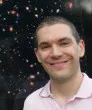
From California, he remains in contact with his professors and colleagues in Madrid and, as he pointed out to me, he also reads some blogs, like Amazings and Fogonazos.
Yesterday was the anniversary of Carl Sagan's birth. Along with other astronomers like Neil deGrasse Tyson or physicists like Michio Kaku, they are highly popular for their participation in foreign television series and in a different language.
Well, Guillermo Barro Calvo is also a professional astrophysicist, who speaks Spanish, whom we can feel as more 'close' and who is also collaborating to add pieces that allow solving one of the thousands of enigmas of the cosmos.
Sources and related links
- Guillermo Barro Calvo's page at the Complutense University of Madrid: http://guaix.fis.ucm.es/~gbc/Home.html
- UCM Active Star-Forming Galaxies Group
- Profile at UCO
- CANDELS Survey
- Paper in ApJ: Extreme Emission Line Galaxies in CANDELS: Broad-Band Selected, Star-Bursting Dwarf Galaxies at z>1
arXiv:1107.5256v1 [astro-ph.CO]
About the images
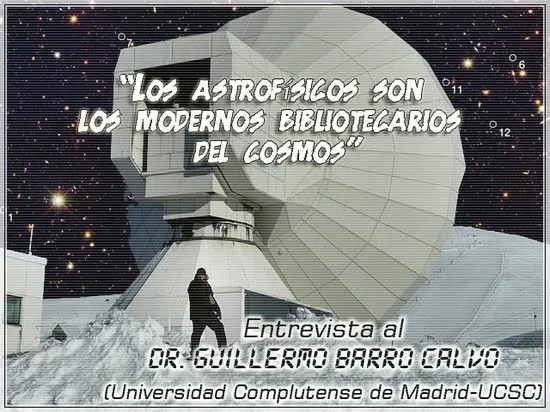
- The initial image is a combination of a photograph of Dr. Guillermo Barro Calvo behind the antenna of the IRAM Pico Veleta Observatory with a Hubble image of recently discovered dwarf galaxies. Credit for the Hubble image: NASA, ESA, A. van der Wel (Max Planck Institute for Astronomy), H. Ferguson and A. Koekemoer (Space Telescope Science Institute), and the CANDELS team.
- Photograph of Dr. G. Barro at UCSC.