Researchers from Johns Hopkins University made a new proposal to modify the calendar. It would have 12 months divided into 4 quarters of 91 days. All dates would fall on the same day of the week permanently. And an extra week would be added every five or six years.
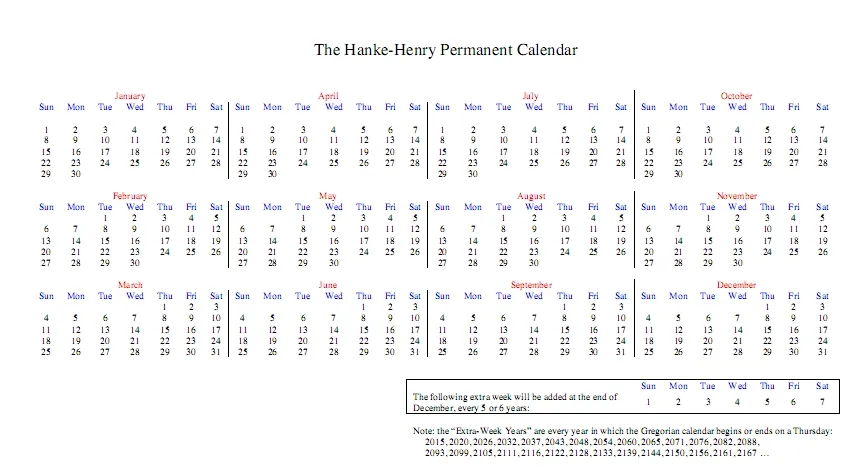
Using software and mathematics, Richard Conn Henry -an astrophysicist from the Krieger School- and Steve H. Hanke -an economist at the Whiting School of Engineering, propose a new calendar in which the 12 months are kept. The big difference is the similarity, if you'll allow me the apparent contradiction. It's that in our Gregorian calendar the months of one year are somewhat different from the same month in other years. For example, Christmas 2012 will fall on a Sunday. But the next year's won't.
In the proposed new calendar, on the other hand, all dates would keep their days.
The Hanke-Henry Permanent Calendar would have four months of 31 days: September, March, June, and December.
"Our plan is to offer a stable calendar that is absolutely identical from year to year and that would allow for rational planning of annual activities," said Henry. And he continued: "Think of the amount of time and effort needed to redesign the calendar of every organization in the world and it becomes obvious that our calendar would make our lives easier and simpler."
Not only would there be benefits in organizational matters. Also from an economic point of view. "Our calendar would simplify financial calculations" in which days have to be counted, for which different conventions have been established. For example, the calculation of interest accrued between February 28 and March 1.
The HH calendar would have in each quarter two months of 30 days and one of 31. Therefore, each year would have four quarters of 91 days. That is, 364 days!!
It's not the first proposal to modify the Gregorian calendar. According to the researchers, previous attempts "failed because the most important ones included breaking the 7-day week cycle."
The Gregorian calendar has been used since 1582 when Pope Gregory altered the previous calendar instituted in 46 by Julius Caesar. The idea was for the new format to be in sync with the seasons, for which 11 days were removed from the calendar in October at one stroke, so from the 4th they went to the 15th (meaning no one "was born" on October 5. See calendar of 1582).
On a web page created by the "reformers," they point out that their format respects the Protestant fourth commandment: Remember the Sabbath day, to keep it holy (The Sabbath, Shabbat or Saturday).
Now, reforms of the Gregorian calendar must deal with a small cumulative problem: the year has a duration of 365.2422 days (of the Tropical year). What accumulates is what is behind the decimal point: 0.2422. If we multiply it by four it gives 0.9688, almost 1. That's why currently every four years there is a leap year, with an added day.
The HH calendar, on the other hand, proposes adding an extra week every five or six years. Thus the years that would have a MiniMonth, called Xtr for Extra, would be: 2015, 2020, 2026, 2032, 2037, 2043, 2048...
How is this possible?
You might think: until now a single day was added every four years. But this proposal includes a whole week of 7 days every five or six years. Isn't that a big difference? It is noticeable and is explained because our current calendar has 365 days and the HH has 364.
As I said before, we must consider a duration of 365.2422. Before it was only 0.2422, but in this idea it would be 1.2422. For that "lost time" to be recovered all together in one week, how much time must pass? Easy: 7/1.2422=5.635.
And what about the hour?
This duo's proposal is to internationalize Universal Time and remove time zones. An agreement on this already exists and it is possible to use UT today, but countries still maintain their local time.
Implications
One can quickly think about what changes this calendar would generate. If you were born on August 25, starting January 1, 2017, which is when they propose this new calendar be instituted worldwide, your birthday will fall that year, 2017, on Friday. And the next year, too. It will always fall on Friday!!
It will be much easier to know what day of the week a given date will fall on.
A characteristic of the HH calendar is that if we put one month below another in increasing time order and in two columns, then we will have January in one column and next to it, July. February with August, March with September, April with October, May with November, June with December. And these pairs are identical! That is, if I know that January 1 is Sunday, then July 1 is too. The same for any day of both months and valid for all years going forward!
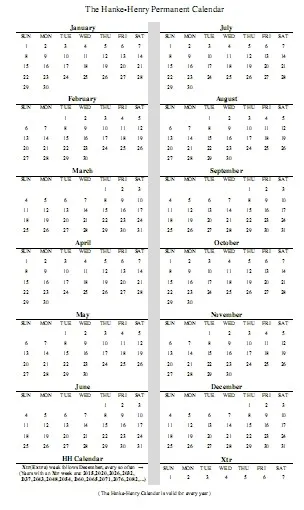
Furthermore, in an orderly fashion, the months begin on Sundays, Tuesdays, or Thursdays. January, Sunday. February, Tuesday. March, Thursday. April, Sunday. May, Tuesday. June, Thursday. The remaining ones similarly.
If until now to remember which months had 30 or 31 days you used your knuckles, well with the HH calendar you can "count" Sunday, Tuesday, Thursday, Sunday, Tuesday, Thursday, to know what day of the week a month falls on. With that, knowing the day another day of the same month will fall on is very simple.
Doesn't everything become more monotonous without changes?
Well, there will be changes, with the "MiniMonth." But yes, it's somewhat more "boring" and perhaps more useful. And the calendar is not entertainment. The same with the hour.
Are daylight saving times lost?
No, because using UT doesn't alter anything: in summer, if anything, we will change our work schedule by one hour, without touching the clocks.
The "unborn"
Those born on January 31, May 31, July 31, August 31, and October 31 will no longer have a day in the HH calendar, since those months in HH are 30 days long. One possibility is to think they were born on the last day of those months, which before was the 31st and in HH will be the 30th, and celebrate their birthday on the 30th.
Background
This HH proposal is an adaptation of the one made in 1996 by Bob McClenon. Henry had already made a proposal of this type in 2004 with the idea of adopting it in 2006.
The HH is also very similar to Irv Bromberg's Symmetry Calendar.
It also has similarities with Elisabeth Achelis's World Calendar.
The HH Calendar site also mentions other credits.
How do you know today what day of the week a past or future date was or will be?
With our current calendar it's a problem that can be solved with mathematics and algorithms.
With a bit of "brute force" you can do it like this: Choose a starting date, for example Monday 1/1/1900. Now to find out what day of the week a date fell on or will fall on, take the date and count the days that passed between the two dates, considering leap years. Divide the result by 7 and look at the remainder (mod or modulo operation). If it's 0, it's the same day of the week as the starting date. If it's 1, the next day. And so on.
In fact, you could use this method to find out what day of the week 1/1/4713 BC would have fallen on, the date from which the Julian calendar begins to be counted. For example, this Sunday was Julian day 2455922. Is it a multiple of 7? Does the fact that the Julian year began at 0 influence anything?
It's not the only way. In fact, it's probably not the most efficient. Check out the site Enjoy Mathematics and you'll see an online application to do this. If you look at the source code you'll see the algorithm used.
Another way to know the day of the week a date will fall on is by considering key dates, as explained by Dr. Adrián Paenza in Permanent Almanac.
Dates and pseudo-science
This year it was pointed out that it was "special" because of the symmetry in the way of writing the date linked to November 11. The stupid idea also circulated on the internet that if we add our age to our birth year, the result would be, incredibly, 111. Just by thinking about it for two seconds we realize that if we add the years we have to the year we were born, that is, the years that have passed since then until NOW, then the result can only be the current year, 2011. If it gives 111 it's because -with malicious intent- only the last two digits of the birth year are added. Thus, 1900 years are removed in one fell swoop. For example, if someone was born in 1973 and is 38 years old, the sum would be 73+38=111. But the person wasn't born in the year 73, but in 1973. Writing 73 implies subtracting 1900. And the result is the same, 2011, minus 1900, or 111. And it's logical, then, that this happens to all of us, it's not magic nor indicative of anything special.
But it was said that a "change of era" or consciousness would occur. For whom? For all humanity. Well, it turns out that not everyone uses the same organization. There are several calendars. Ergo, it's not 2011 for everyone, nor do all human beings manage ourselves with calendars with equal names and durations for the months, for example. Why would a change of era affect the Ethiopians who live in their year 2004 and not in 2011?
Numerological pseudo-science
Pseudo-scientific and cultural presumptions about the days of the week already exist: Tuesday or Friday the 13th, conflictive Mondays, boring Sundays.
With this new organization, a new pseudo-scientific idea will surely appear that places greater emphasis on something that already exists: personality according to the day of birth (day of the week).
With this reform, that would worsen, I think, because from the implementation of HH onwards, all those born on a specific date (day-month) will fall on the same day of the week, regardless of the year, something that doesn't happen today.
There is nothing "extra-human" about the days of the week. There are differences between some days and others for cultural reasons: working days and non-working days, for example. And for those differences, perhaps, there is nothing better than the similarity proposed by HH to organize ourselves better.
You, what do you think. What negative consequences could this HH calendar have after its implementation? Ah. Know that it's a proposal, for now, nothing changes. And yet, everything changes.
Sources and related links
- Hanke-Henry Permanent Calendar
- Changing Times
- PI in the calendar
- Gregorian PI Day
- JHU: Time for a Change? Johns Hopkins Scholars Say Calendar Needs Serious Overhaul
About the images
- Credit: Hanke-Henry.
DOI