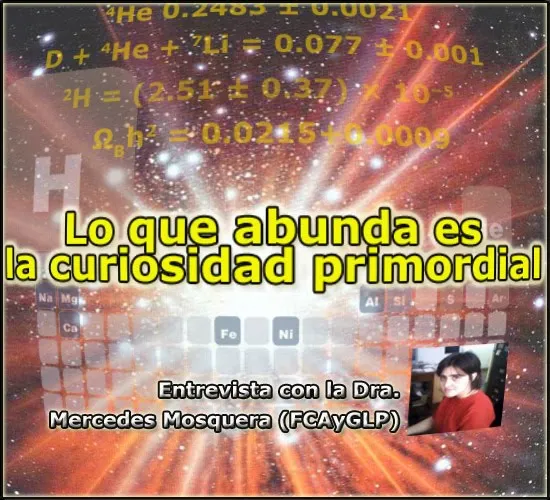
What is it like to work in cosmology and from Argentina? What kind of tasks does a 'researcher of the universe' perform? Interview with Dr. Mercedes Mosquera (Faculty of Astronomical and Geophysical Sciences, UNLP).
-After high school, how did you take the step to La Plata and to Astronomy?
-I started in high school. The Colegio Nacional de Buenos Aires has an observatory and advanced students can take astronomy courses, and since I liked physics and astronomy, one of my activities was to take courses there. I loved the subject and decided to study that career in La Plata.
-Any influence from your parents?
-No, my parents are professionals, they let me choose what I wanted.
-And were you into observing or more into the theoretical side?
-No, I like the theoretical part more.
-Obviously you didn't have much trouble with mathematics, or did you?
-No, luckily I get along well with mathematics.
-Is someone who finds mathematics difficult condemned to do something else?
-No, not at all. Everything can be achieved with effort. Studying a university career is 99% sitting down to study and practice a lot.
-And why did you study the two careers, astronomy and physics, almost in parallel?
-I don't have a specific reason why. I really liked physics and chemistry since school, I started to get interested in everything related to the exact sciences. I also wanted to dedicate myself not only to the astronomy part, but to other phenomena in physics.
-The topics of your theses are in astronomy, but also related to the physics of the universe, how did they arise? From personal interest or from your advisor's suggestion?
- In astronomy, in recent years we have elective subjects where one guides oneself towards what one wants to do: celestial mechanics, stellar atmospheres, stellar interiors, stellar dynamics, and all the other branches. And I leaned more towards cosmology because according to the basic subjects from previous years, those were the topics that had interested me the most. And there I worked with Héctor Vucetich with whom we studied variations of constants in the early universe and then when doing the physics degree, with Osvaldo Civitarese the possibility of working in physics and cosmology arose.
-In cosmology there are also different branches. For example, at IAFE they study interactions between galaxies and such.
-That is already the slightly later universe.
-And your work is more primordial: big bang nucleosynthesis and temporal variation of constants. But, if they are constants, why do they vary? [1]
-The same question always arises. They are called fundamental constants, they are supposed to be constants that cannot be determined by theory, but observationally. They are thought to be constant, but with the development of new theories, like superstrings, branes and such, it is deduced that these constants may not be constant, but may vary in time and space.
-It's not that they vary every five seconds.
-No, on cosmological scales. That's why we study the early universe, to have a large time scale and not something more recent because we won't detect it. Although there are, for example, very precise measurements from atomic clocks that set bounds for variations of the fine-structure constant.
-The fine-structure constant is related to the electromagnetic force.
-Yes. There are several coupling constants, for example the weak coupling constant, Fermi's G, the fine-structure constant which you may have seen as alpha, the vacuum expectation value of the Higgs boson, those are some of the constants. They are assumed to be constant, but they could have a different value over time. It is interesting to obtain that temporal variation to be able to say 'these theories agree with observations and these do not agree'.
-And do you reach that type of conclusions -to confirm or rule out- or do the results rather restrict the theoretical models?
-They can be restricted. We can say that certain models agree according to the theory, but it is quite complicated to obtain temporal variation of the different constants. Nothing is so definitive.
-Well, in fact that's science. What is measured to infer these temporal variations, what is compared against what?
-I compare theoretical results with observations. The theoretical values are obtained by modifying a numerical code called the Kawano code [2] which is a numerical code that solves the differential equations that allow us to determine the abundances of the primordial elements.
-Is it an algorithm?
-Yes, it's a program in Fortran.
-Aside from the computer archaeology that implies talking about Fortran or Cobol, they are still stable and useful languages.
-Yes, we still write in Fortran and for what I do it is very powerful.
-Can you do your work with pencil and paper?
-Yes, there is a lot of pencil and paper and then there comes a point where you have to program.
-You try to know what the universe was like 13,700 million years ago with pencil and paper?
-That's right. And a computer next to it.
-And a head full of mathematics. I say to break with the romantic image I just stated: with pencil and paper you don't write poetry, you do calculations.
-Yes, I am applying nuclear physics, particle physics, a lot of mathematics and physics.
-So we have the code that we borrow from Kawano and it yields a result, linked to primordial abundances of hydrogen...
-Deuterium, tritium, helium-3, helium-4, lithium-6, lithium-7 and many more. Up to oxygen. We take observations made by other scientists in the world, published in peer-reviewed journals, where they observe and analyze spectra of quasars, clouds, etc. and from there they extract information about the abundance and with an extrapolation they arrive at the primordial abundance of the studied element.
-You have worked with neutrinos, a trendy topic these days. Massive and sterile neutrinos.
-That's right. What I did was incorporate massive and sterile neutrinos in the early universe.
-Neutrinos are fundamental particles predicted theoretically and supposedly massless. When observed...
-Actually it was found that there was a discrepancy between theory and observation. So it was proposed to resolve the discrepancy by thinking that the neutrino has mass and thus could oscillate between different types (muon, electron and tau). And there are measurements that give mass limits and mixing parameters.
-And are sterile ones theoretical or are there observations?
-There are limits. There are many groups studying the topic. It's a very new topic, even though it seems like many years, there are many phenomena to observe and many people studying the topic.
-Sometimes science is evaluated as something dogmatic. For example, why not think about scenarios different from the 'standard' one, like proposing that energy can be created? [3]
-Energy comes from somewhere. I can put massive neutrinos, sterile neutrinos, and other things that are supported by another branch of science. One relies on observations and the work of other scientists or it's possible to take elements from other areas. For example, the data from neutrinoless double beta decay [4] to study primordial nucleosynthesis. This is measured nowadays and is another branch of physics that I am using to study in cosmology and set limits on the mass of the neutrinos that I am measuring in primordial nucleosynthesis. You can't say, for me neutrinos weigh...5 kilos.
-That is to say, the hypotheses are not 'whimsical' but arise from somewhere and in particular from models that don't close.
-Of course, and from other experiments. There is always a problem to solve. In the case of primordial nucleosynthesis, there are observational data on lithium that do not agree with the WMAP observations. [5]
-At one point the problem was deuterium.
-Deuterium is one of the ones that works best with the WMAP results. Helium-4 is now working well, some nuclear values were improved and there are new observations, but in the case of lithium-7 there is a big difference between the observed and theoretical value.
-Throughout these years, do you feel that you are advancing, putting together a puzzle, or is it an idea outside of science?
-Yes, I feel that I started with one topic and kept advancing and then I came across another. One is always studying and reading publications and although I study the early universe, I don't stay in a single line.
-So what others do influences you.
-Yes, because one doesn't live in a little bubble and one must be attentive to what colleagues are doing and also you work in a team and there ideas and discussions arise about how to proceed.
-Furthermore, you practice teaching.
-Yes, I teach electromagnetism to 2nd-year students at the Faculty of Engineering of the Universidad de La Plata. I like not only teaching the subject but also inquiring into the why of things. I had that curiosity when I was studying and I enjoyed it immensely.
-Can that be transmitted?
-Yes, it's difficult, but it's possible. Maybe not in that subject, if a student doesn't like that subject, but it is possible to awaken the little bug of curiosity, the eagerness to know.
-And that doesn't imply that by having greater knowledge emotions are canceled, one doesn't stop being human.
-No, not at all, I'll give a personal example. In Capital and in La Plata we can't see much of the sky. Once I traveled to Jujuy on vacation and I remember lying in a park, at night, looking at the sky and I was truly marveled at what I saw. And I knew what I was seeing, but I was amazed by that sky, by how different and majestic it looks in a place with much less light pollution and pollution than in the cities.
Profile
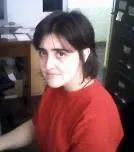
Mercedes Elisa Mosquera finished her secondary school at the Colegio Nacional de Buenos Aires in 1997. The following year she entered the UNLP and five years later she obtained her degree in Astronomy. Simultaneously she pursued the degree in physics, which she achieved in 2005.
In neither of the two undergraduate degrees did she record any failures.
She began her doctorate in astronomy in 2004 and finished it four years later. Her thesis topic was Primordial Nucleosynthesis beyond the Standard Model.
She also completed a doctorate in exact sciences, physics area, whose thesis topic was Massive neutrinos in cosmological observables of interest.
In 2009 she entered CONICET as an assistant researcher and has published in specialized journals such as Astrophysical Journal, Physical Review C, A&A, etc.
Recently the Academia Nacional de Ciencias Exactas y Naturales awarded her the Ramón Enrique Gaviola Prize in Astronomy.
Note written for the XXVII Carnival of Physics, in this edition hosted by El Tao de la Física. To join and read the entries there is a social network on Ning.
Sources and related links
- Notes: [1]: See Primordial nucleosynthesis on Wikipedia and The problem of fundamental constants in nature on Migui.com
- [2]: Let's go: Early universe. 2. Primordial nucleosynthesis: The Computer way.
Lawrence Kawano, (Caltech, Kellogg Lab) . FERMILAB-PUB-92-004-A, Jan 1992. 58pp - [3] Some of that was raised between the 1950s/1960s in the Steady State Theory
- [4] Double beta decay rates with variable fundamental constants.
Civitarese, O., Landau, S. and Mosquera, M. E.
Int. J. Mod. Phys. E 17, 493 (2008).
DOI : 10.1142/S0218301308009847 - [5] WMAP: Wilkinson Microwave Anisotropy Probe
About the images
- The initial composition contains images from Chandra, The Periodic Table for Astronomy. Credit: Chandra/NASA. and image from Que Ciencia.