A galaxy with five nuclei? No, cosmic mirage: it's an "Einstein Cross".
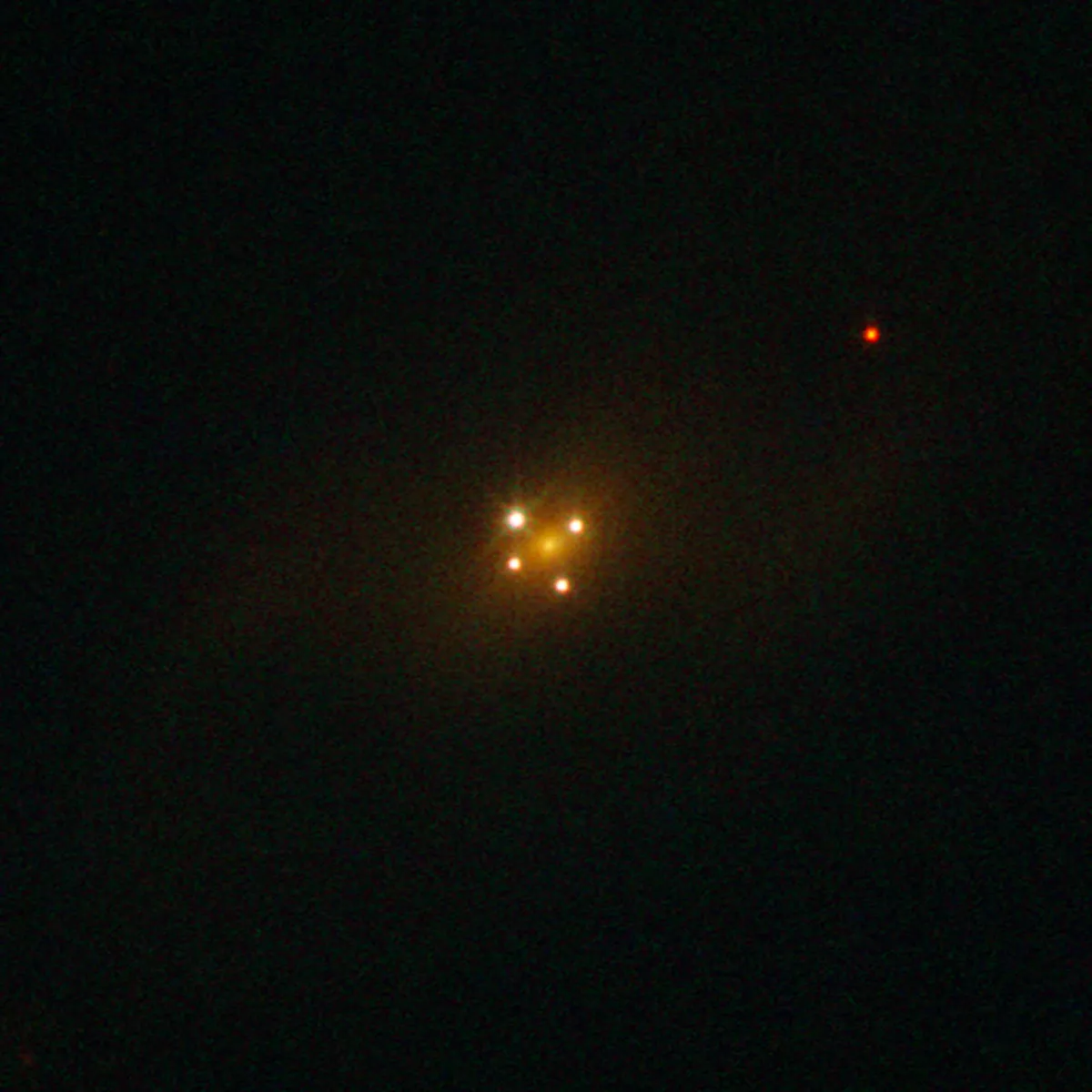
This image from the Hubble Space Telescope might trick you into thinking that the galaxy in the photo -known as UZC J224030.2+032131- has five nuclei, instead of one. In fact, the heart of the galaxy is only the faint and diffuse object seen at the center of the cross-shaped structure formed by four other points that are images of a distant quasar located behind the galaxy.
The image shows a famous cosmic mirage known as the Einstein Cross and is a visual confirmation of the General Theory of Relativity. It is one of the best examples of the phenomenon known as gravitational lenses by which light is bent by gravity, as predicted by the German scientist. In this case, the powerful gravity of the galaxy acts as a lens that bends and amplifies the light from the more distant quasar, producing four images of the object.
The redshift of the quasar is nearly z=1.7, while the magnitude 15 galaxy has a z=0.04 (see in Aladin), that is, the QSO is located about 8 billion light-years away and the galaxy at 400 million light-years, in the constellation of Pegasus [1]. The alignment of the two objects is remarkable (0.05 arcseconds).
The image is one of the sharpest Einstein Crosses ever obtained, achieved with the Wide Field and Planetary Camera 2 (WFPC 2) with a field of view of 26 square arcseconds.
This object is also called QSO 2237+0305 (as well as QSO J2240+0321). QSO means Quasi-Stellar Object, that is, a quasar. The difference in the numbers is given by the object's coordinates (as there are several coordinate systems -J2000/J1950- the number changes, but it's the same object). It also appears in other records such as the Principal Galaxies Catalogue (PGC 69457).
Its discovery is attributed to astronomer John Huchra (who passed away last year) which is why the object is also known as Huchra's Lens.
An image taken with the WIYN telescope on October 4, 1999 by NOAO astronomers shows us the object like this:
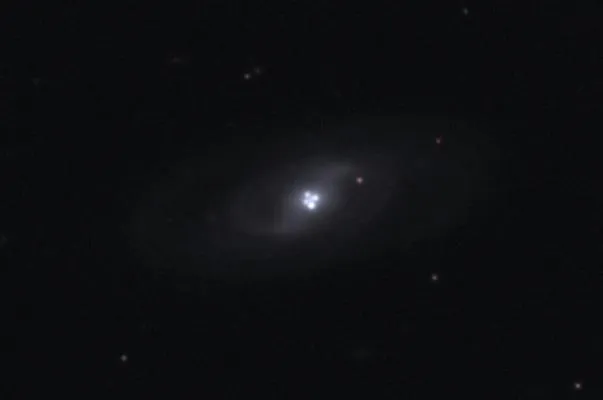
The object is also part of the UZC catalogue (hence the first name).
Other "Einstein Crosses"
There would be about a dozen of these objects recorded, although I don't have a list of all of them. But some others can be easily tracked, such as: HST14176+5226, HST12531-2914 [2], J1011+0143 [3].
Ah. And there are also Einstein rings and double Einstein rings, as well as other "figures" generated by this optical effect of gravitational lenses.
Sources and related links
- ESA/NASA Space Telescope: Seeing Quadruple
- The Einstein Cross gravitational lens 2237+030
- [1]: First ESA Faint Object Camera Science Images the Gravitational Lens G2237 + 0305
- Integral Discovers An Emission Arc In The "Einstein Cross"
- Observing the Einstein Cross (English)
- [2]: New "Einstein Cross" Gravitational Lens Candidates in HST WFPC2 Survey Images
Kavan U. Ratnatunga et al (1995)
arXiv:astro-ph/9508131v1 - [3]: A New Einstein Cross: A Highly Magnified, Intrinsically Faint Ly Emitter at z = 2.7
Bolton et al (2006)
ApJ 646 L45 DOI:10.1086/506446 (Free) - A brief history of gravitational lensing
About the images
- Initial image: Credit: ESA/Hubble & NASA
- NOAO image: J.Rhoads, S.Malhotra, I.Dell'Antonio (NOAO)/WIYN/NOAO/NSF