A collection of links to music, images and videos relating art and science. Today: Images of NGC 6397, Saturn and the Moon playing hide-and-seek, the Rosette Nebula, and Eta Carinae. Music by Nebulosas by Loomeer. And an animated short about space altruism.

Images of the decade
A pulsar in NGC 6397
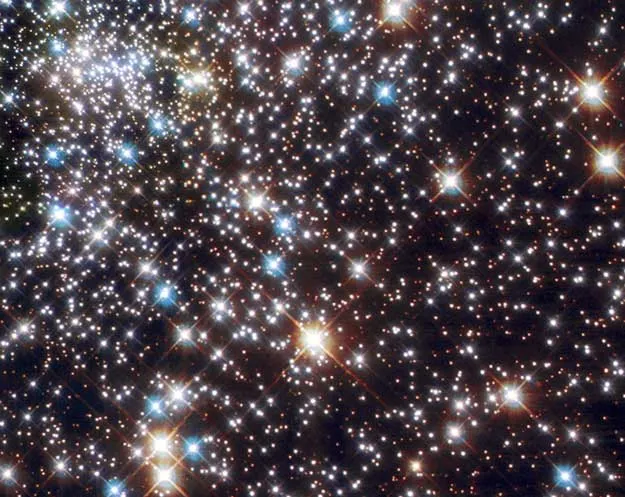
One of these stars is blinking. This star, a member of the globular cluster NGC 6397, is noteworthy not only because it "blinks", but because it blinks very fast and its companion is too atypical.
Speculations are considered that suggest it is a neutron star spinning at a speed of 274 rotations every second due to the bloated red star it orbits.
The matter gravitationally expelled from the inflated star that the millisecond pulsar (PSR J1740-5340) likely orbits, causes it to spin faster when the matter crashes onto its surface.
The strange system could have formed when the neutron star captured a normal star after a close collision near the dense center of the globular cluster.
Other collisions near the center of NGC 6397, 8,200 light-years away, may have produced other oddities, such as blue straggler stars.
The Hubble Space Telescope took this image of the colorful globular cluster and it was NASA's Astronomy Picture of the Day (APOD) for February 20, 2002. Also on Observatorio.
The image is part of a research released by ESA on 02/13/2002.
Credits: Francesco Ferraro (Bologna Observatory), ESA, NASA
Saturn plays hide-and-seek with the Moon
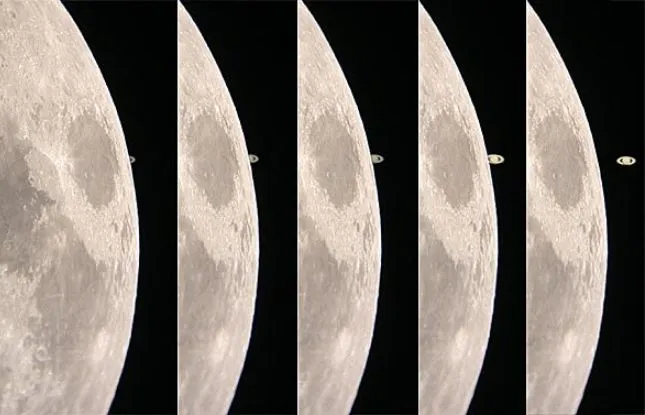
A crescent moon was hiding the ringed planet on February 20, 2002. In this image sequence from the Powell Observatory in Kansas, USA, Saturn is reappearing from behind the lunar limb. The gas giant emerges above the dark and smooth Mare Crisium ("Sea of Crises").
Credits & Copyright: Tom Martinez (Astronomical Society of Kansas City)
It was NASA's Image of the Day (APOD) for February 22, 2002. And on Observatorio.
Images of the week
Multicolor image of the Rosette Nebula
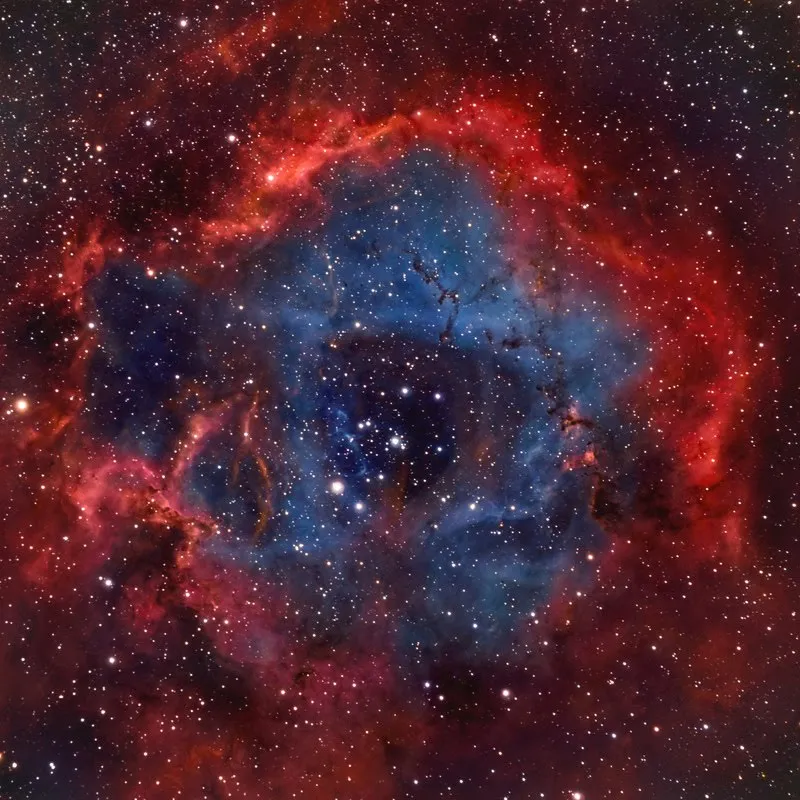
NGC 2237 is an HII region in Monoceros, about 5,200 light-years away. The image was obtained with an apochromatic refractor tube TS-APO 90/600 (a beautiful triplet weighing only 3.5 kg) mounted on CGE and with an Artemis Art-4021 CCD, later processed with PixInsight and PS.
The image was taken by Velimir Popov from the Rozhen Observatory in Bulgaria.
It was the Amateur Astronomy Picture of the Day (AAPOD) for February 21, 2012.
Preview of an upcoming supernova
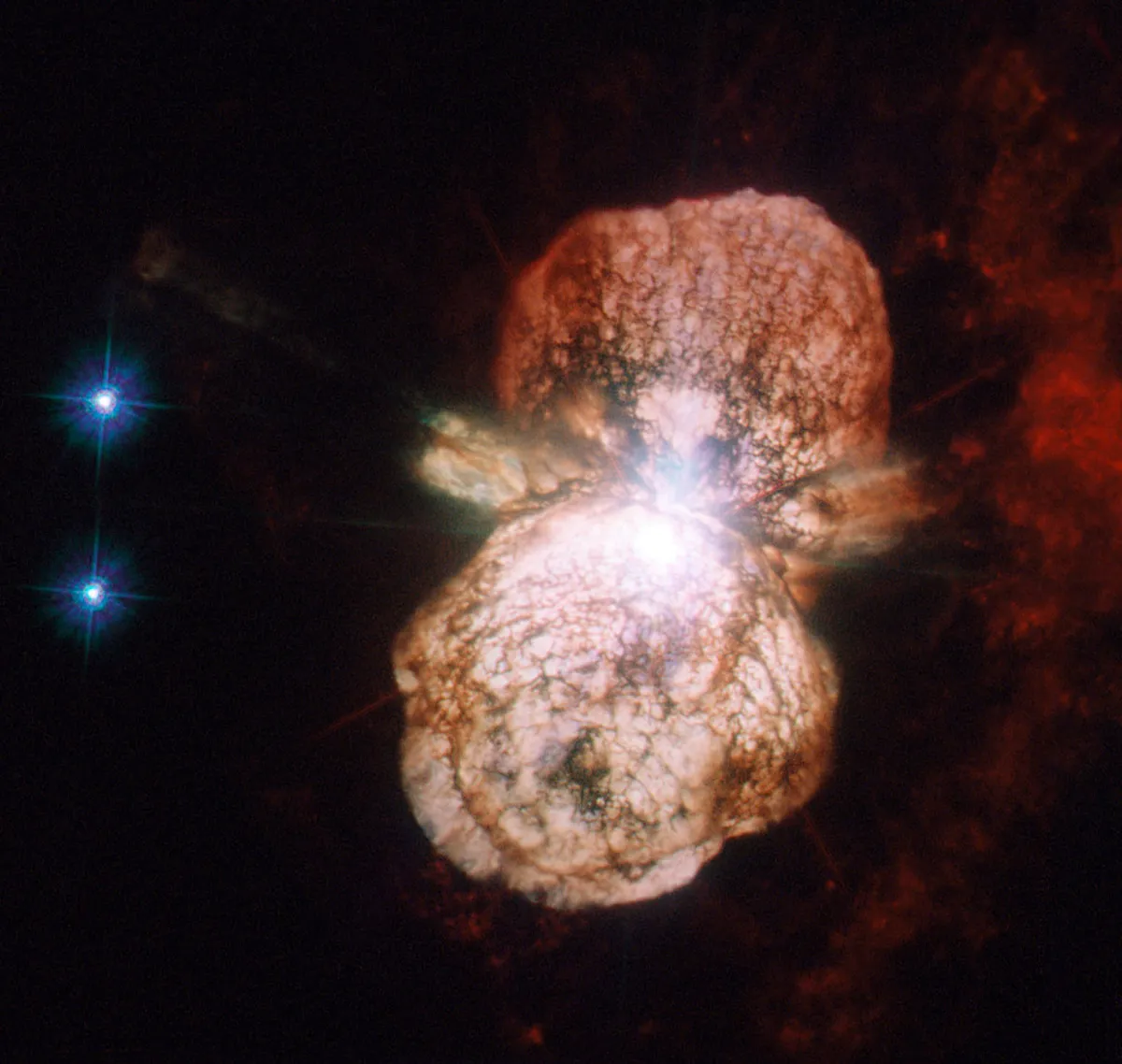
At the beginning of the 19th century, the binary system Eta Carinae was faint and ordinary. In the first decades of the century it became brighter and brighter until in April 1843 it was the second brightest star in the sky, outshone only by Sirius (which is almost a thousand times closer to Earth). In the following years it gradually dimmed again and by the 20th century it was completely invisible to the naked eye.
The star has continued with its brightness variation since then and while it is again visible to the naked eye on a dark night it never again approached its 1843 peak.
The larger of the two stars in Eta Carinae is a huge, unstable star nearing the end of its life. The event observed in the 19th century was a "false supernova".
Although the powerful instruments that exist today did not exist back then, it is now possible to study the effects of that event. The giant clouds of matter expelled a century and a half ago, known as the Homunculus Nebula, have been a target for Hubble since 1990. This image, taken with the Advanced Camera for Surveys, is the most detailed and shows how the star's material was not expelled uniformly.
Eta Carinae is not only interesting for its past, but also for its future. It is one of the stars closest to Earth that is likely to explode in a supernova in the "relatively near future". It must be considered that on astronomical timescales, the "near future" could be millions of years.
Eta Carinae is located in NGC 3372, in the Constellation Carina, about 7,500 light-years away.
It was the Hubble Space Telescope Image of the Week.
Credit: NASA/ESA Hubble.
Space Music
Carina (NGC 3372) by Loomeer
Loomeer is a musician from the Czech Republic who last year released the album Nebulas on Jamendo. Throughout its 9 tracks, it transports us through HII regions, planetary nebulae, reflection nebulae and supernova remnants recorded in the Messier and NGC catalogs. From that work, I highlight today the seventh track Carina (NGC 3372).
Animated Science
Stuck on Zook
In this animated short by Andrew Wheat, with music by Phil Tepley, an adventure on the distant planet Zook is narrated in just over four minutes, in which a strange creature holds the key to unlocking a stuck situation.
The plot is very easy to understand and does not require translation. But in case someone doesn't notice, the message is linked to altruism.
To access previous editions of this section, consult the Multimedia Selection Series. The series attempts to show that the immensity of the universe can be perceived in different ways, by choosing some images from a decade ago -so they are not forgotten- and from the current week that ends, as well as sounds, music and videos that are artistic forms of expression with content related to astronomy and related sciences.