A collection of links to music, images and videos relating art and science. Today: Images of NGC 4622, M78, M31. Music by Manuel Sigillo: Andromeda. And a chapter of Once Upon a Time...Space.

Images of the decade
A galaxy that goes "backwards"
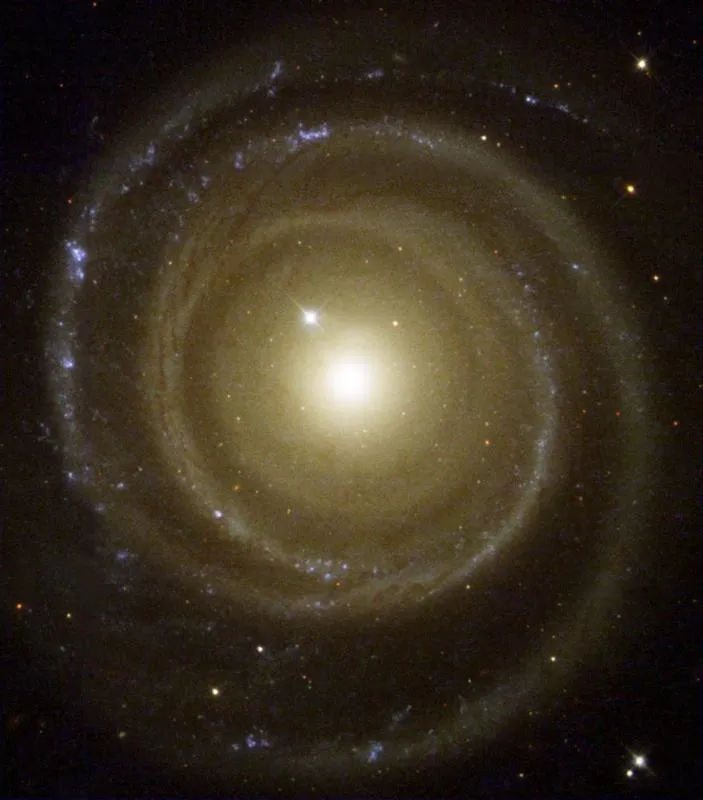
The galaxy NGC 4622 appears to be rotating in a direction opposite to that expected by astronomers. Images from Hubble helped professionals determine that the galaxy would rotate clockwise.
Most spiral galaxies (like the Milky Way) have arms composed of gas and stars that are dragged along by the galaxy's spin. But this galaxy appears to have two outer arms that point in the direction of the galaxy's counterclockwise rotation. Those two spiral arms have been called outer "leading" arms. Adding to the confusion is the fact that NGC 4622 also has an inner "trailing" arm that wraps around the center of the galaxy in the opposite direction to its rotation. Based on galaxy simulations, a team of astronomers had calculated that the galaxy rotated counterclockwise.
Here is a diagram on the galaxy image showing the rotation direction of the three arms:
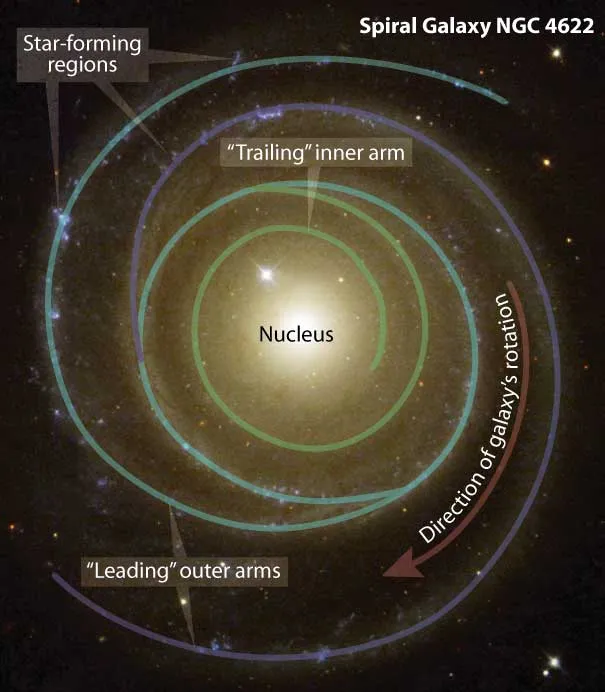
This could be explained by a possible interaction of NGC 4622 with another galaxy.
As if that weren't enough, in these same observations it was believed that a possible supernova was discovered located 91.9 arcseconds a little east of north of the nucleus (RA(J2000) = 12h 42m 40.04s, DEC(J2000) = -40º 43' 12.54").
This was pointed out by the three astronomers in charge of the research, from the University of Alabama, R. Buta and G. Byrd and T. Freeman from Bevill State. The supernova is known as SN 2001jx.
The galaxy is located 111 million light-years from Earth, in Centaurus. The images were taken in May 2001 and presented to the public on HubbleSite on February 7, 2002.
Credits: NASA and The Hubble Heritage Team (STScI/AURA)
Acknowledgment: Dr. Ron Buta (U. Alabama), Dr. Gene Byrd (U. Alabama) and Tarsh Freeman (Bevill State Community College)
Illustration: Z. Levay (STScI)
The nebula M78
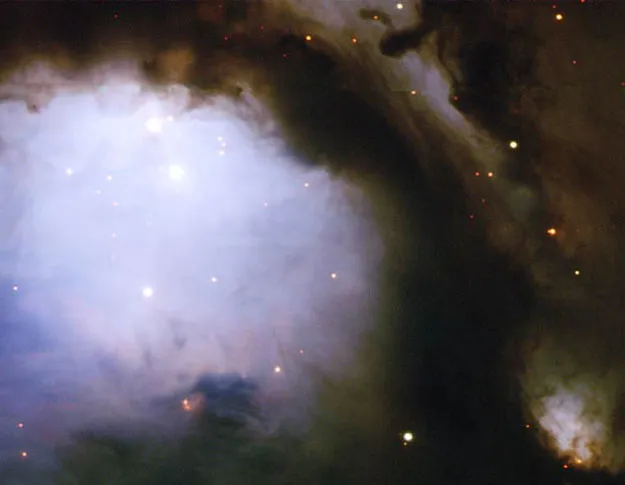
A strange bluish glow and dark dust columns stand out in M78, one of the brightest reflection nebulae in the sky, visible with a small telescope pointing towards Orion. The dust not only absorbs light, but also reflects light from several blue stars that recently formed in the nebula. The object is about 5 light-years in diameter and lies 1600 light-years away. M78 belongs to the Orion Molecular Cloud Complex that contains the Great Nebula and the Horsehead Nebula.
Credit and copyright: S. Lee, C. Tinney, & D. Malin, AAO
It was NASA's Astronomy Picture of the Day (APOD) for February 11, 2002. In Spanish at Observatorio.
Images of the week
Andromeda from the Southern Hemisphere
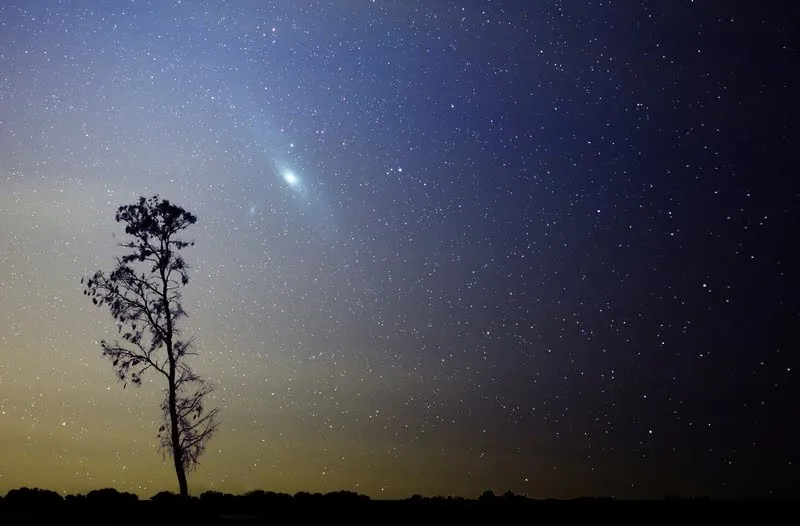
The Andromeda galaxy (M31) is an almost Northern Hemisphere object because at 35 degrees South latitude it is difficult to see, as it rises little above the horizon. As if that weren't enough, light pollution must be added.
That's why this photo has great value, as it was achieved by Luis Argerich from the Mercedes Observatory in the Province of Buenos Aires on December 24, 2010 with a Canon 5DII.
Luis says he was surprised that a short exposure could capture both Andromeda and its satellite galaxies M110 and M32.
It was the Amateur Astronomy Picture of the Day (AAPOD) for February 9, 2012.
From the Northern Hemisphere, on the other hand, the previous Image of the Day was that of Alfonso Albendea from Pinar de araceli (Granada) of the same object. With other equipment and from another place, also at another time (08-25-2011) what Alfonso achieved is incredible.
Space Music
Manuel Sigillo - Andromeda
There are many songs titled Andromeda or M31. Among them, I choose today a composition by the Italian artist Manuel Sigillo, born in Naples in 1987.
Another allusion to M31 is the English band Andromeda, led by John Du Cann and short-lived since two years after its formation in 1968, Du Cann left for Atomic Rooster.
Then his music returned to the ring during the 1990s with a series of remasters and compilations (The Definitive Collection).
Careful, there is another band, Swedish, progressive metal, with the same name.
On the only studio album, whose title was homonymous to the group, appears the track "Return to Sanity" which opens with a guitar passage similar to Mars from The Planets by Gustav Holst.
Here I leave you a video with the track in question.
Animated science
Once Upon a Time... Space: In the Andromeda Sector
Once Upon a Time... Space was an animated TV series of 26 episodes created by Albert Barillé at Procidis studios and broadcast by the France 3 network in the 1980s. Several European countries participated in the production of the series.
Here I leave the first part of the fourth episode: "In the Andromeda Sector". The remaining parts can be seen in the right sidebar of YouTube or among the videos of the user who uploaded them, indurdawn, whom we thank for sharing this fabulous material.
To access previous editions of this section, consult the Multimedia Selection Series. The series attempts to show that the immensity of the universe can be perceived in different ways, by choosing some images from a decade ago -so they don't fall into oblivion- and from the current week that ends, as well as sounds, music and videos that are artistic forms of expression and with content related to astronomy and related sciences.