By observing the Moon with the European Southern Observatory's Very Large Telescope (VLT), astronomers have found evidence of life in the Universe...on Earth.
Finding life on our planet may seem like a trivial observation, but the new approach of an international team could lead to future discoveries of life elsewhere in the Universe. The work is described in a paper to appear in the March 1, 2012 issue of the journal Nature.
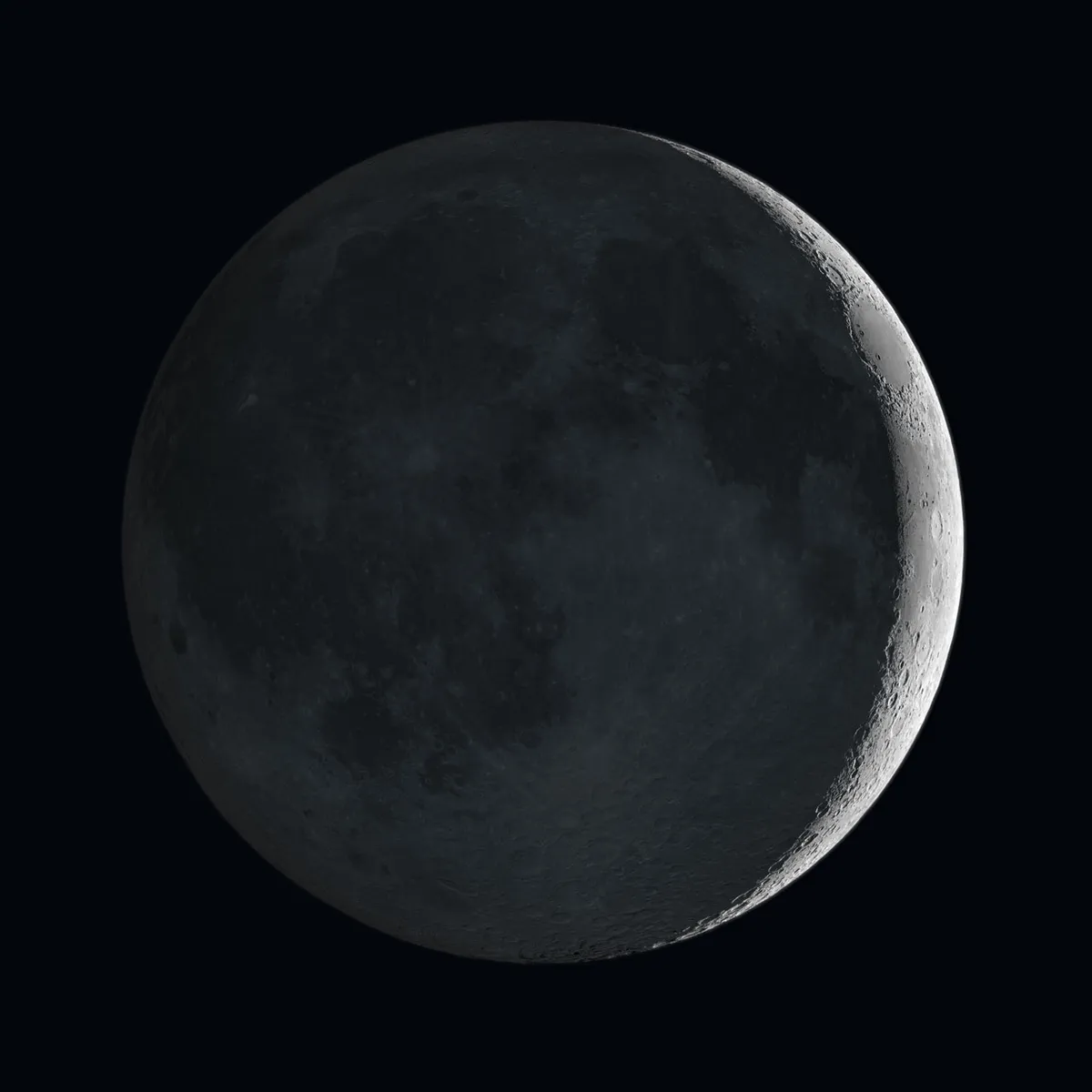
"We used a trick called observing earthshine to look at the Earth as if it were an exoplanet," says Michael Sterzik (ESO), lead author of the paper [1]. "The Sun shines on the Earth and that light is reflected back onto the surface of the Moon. The lunar surface acts as a huge mirror and reflects the Earth's light back to us — and that is what we have observed with the VLT."
Astronomers analyze the faint light reflected by Earth looking for indicators, such as certain combinations of gases in Earth's atmosphere [2], the telltales of the presence of organic life. This method makes Earth a benchmark for the future search for life on planets beyond the Solar System.
The fingerprints of life, or biomarkers, are hard to find with conventional methods, but the team has pioneered applying a new, more sensitive approach. Instead of just observing how bright the reflected light is at different colors, they also observe the polarization of the light [3], a technique called spectropolarimetry. By applying this technique to the earthshine observed with the VLT, the biomarkers in the light reflected from Earth can be clearly seen.
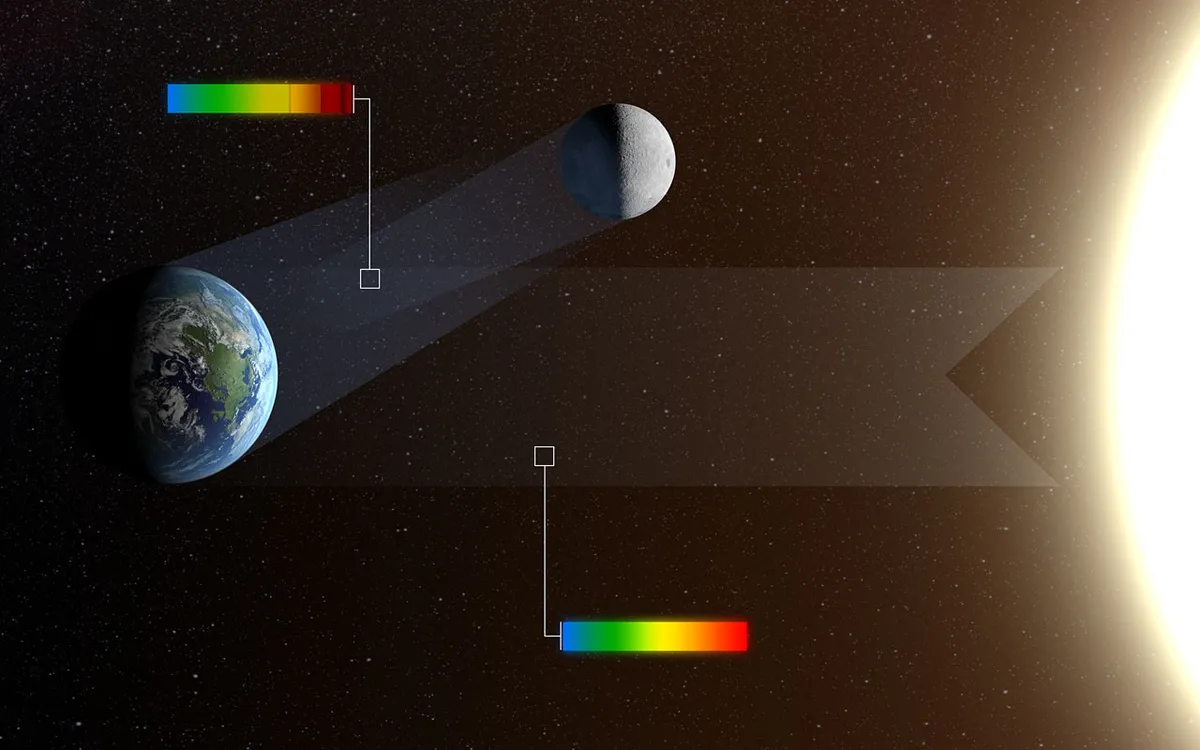
Stefano Bagnulo (Armagh Observatory, Northern Ireland, United Kingdom), co-author of this study, explains the advantages: "The light from a distant exoplanet is hard to see due to the brightness of the host star, so it is very difficult to analyze — almost as complicated as trying to study a grain of dust next to a powerful light bulb. But the light reflected by a planet is polarized, while that of the star is not. So polarimetric techniques help us capture the faint reflected light of an exoplanet from its dazzling star."
The team studied both the color and the degree of polarization of Earth's light after being reflected by the Moon, as if the light came from an exoplanet. They managed to deduce that Earth's atmosphere is partly cloudy, that part of its surface is covered by oceans, and that — and this is crucial — there is vegetation. They could even detect changes in cloud cover and in the amount of vegetation at different times, since the light reflected by the Moon came from different parts of Earth.
"Finding life outside the Solar System depends on two things: first, that such life exists and, second, that we have sufficient technical capability to detect it," adds co-author Enric Palle (Instituto de Astrofísica de Canarias, Tenerife, Spain). "This work is a step forward on the path to achieving those capabilities."
"Spectropolarimetry can, ultimately, tell us if the simplest plant life — based on photosynthesis processes — has emerged elsewhere in the Universe," concludes Sterzik. "But, of course, we are not looking for little green beings or evidence of intelligent life."
The next generation of telescopes, such as the E-ELT (European Extremely Large Telescope), could be capable of giving us the extraordinary news that Earth is not alone as a bearer of life in the vast Universe.
F.A.Q
On a website of the astronomer in charge of this research, Michael Sterzik, the scientist includes an animation titled Earth in time: A month on the Moon. It is a simulation running from January 20, 2012 to February 19 of this year. The video can be downloaded from M. Sterzik's site and I have hosted it on YouTube.
There the researcher adds a sort of "Frequently Asked Questions" on the topic which I translate here because it can help understand the topic.
1. Why was this research done? Was it done to obtain something to use in the study of exoplanets?
He notes that the motivation for the work is to establish a viable technique to study and analyze the atmospheres and surfaces of exoplanets and, in particular, biomarkers. However, we are convinced that using Earth as the only example of a planet that hosts life is essential to be used as a reference for Earth-like exoplanets.
2. Why do they use spectropolarimetry?
Most astronomical observations measure the brightness (or intensity) of the light coming from stars and other objects, usually spreading the light into the familiar rainbow of colors which gives us information about the nature of the emitting bodies, such as their temperature and chemical composition. For example, stars that appear predominantly white or blue tend to be hotter than those that appear red or yellow, like the Sun. This new work exploits a different property of light, called polarization, which tells us not only how bright an object appears, but also the direction of oscillation of the electromagnetic waves. This can sometimes reveal more about the source and the materials through which the light passed on its journey to Earth.
There are many examples of polarization around us. Occasionally, we need to orient the television antenna to receive a signal from a particular transmitter. By doing so, we are aligning the antenna to better pick up the vertically or horizontally polarized signal. Light reflected by certain surfaces like a wet road, a lake, is polarized and some people will have noticed that polarized lenses suppress some of the reflected light. In the case of reflected light called Earthshine, it can tell us about properties of the Earth's atmosphere and surface.
3. What is the difference in the spectrum of light that has bounced to Earth from the Moon and the light that Earth reflects? Why does this matter for studying exoplanets?
We use the Moon as a giant mirror. It is the only way to see the Earth as it looks from space but observing from right here! Unfortunately, the Moon is not an ideal mirror and the signal we are interested in (the polarized reflected light) is modified when bouncing from the Moon. The lunar surface dampens the signal we are interested in by a factor of 3 and this must be taken into account when our results are used as a benchmark for studying exoplanets.
4. What are biomarkers?
We do not expect to see intelligent life forms with our telescopes, but we hope to detect features associated with life, for example gases like oxygen, ozone, methane and carbon dioxide. While these gases could occur without the presence of life, their simultaneous presence with abundances far from chemical equilibrium are only compatible with the existence of life. If we disappeared suddenly, these gases would react quickly with each other and those "biomarkers" would too.
5. How would a scientist use this technique to study an exoplanet? Does it need continuous observation? How detailed would the image this could give us of an exoplanet's atmosphere and its biosphere power be?
A rough characterization of the atmospheres of exoplanet giants is within reach with current instruments and telescopes. For a more refined characterization we need to wait for the next generation of extremely large telescopes. The detection of spectroscopic features (like oxygen, ozone, water or an equivalent of the Normalized Difference Vegetation Index or NDVI) that allows inferring biosignals on planets like Earth would be more challenging.
6. Why are these spectro-polarimetry techniques in particular good for studies from the surface of exoplanets?
While the precision of the (normal) intensity spectrum is affected by Earth's atmosphere when observing with ground-based telescopes, spectro-polarimetry signals are less affected by atmospheric disturbances due to their intrinsic differential measurement. Thus, spectro-polarimetry with very large telescopes could be an interesting alternative to space missions for the characterization of exoplanets.
7. What follow-up work has been planned?
We will continue observing Earth as a benchmark of a planet with life. We plan to obtain better phase coverage (for example, observe Earth under many different conditions) and in particular follow the polarized brightness that the Sun reflects on the ocean. Our immediate goal is to compare the observed spectrum with theoretical models of Earth's atmosphere and surface, as well as improve the models and finally apply them to exoplanet observations.
Notes
[1] Earthshine or earthshine, can be easily seen with the naked eye and is spectacular through binoculars. It can be seen best when the Moon is in its thin crescent phase, about three days before or after the New Moon. Like its bright crescent phase, the rest of the lunar disk is visible, subtly illuminated by Earth's brightness in the lunar sky. A related concept is that of albedo.
[2] In Earth's atmosphere, the main biological gases produced are oxygen, ozone, methane and carbon dioxide. But these gases can be produced naturally in a planet's atmosphere without the presence of life. What constitutes a biomarker is the simultaneous presence of these gases in quantities that are only compatible with the presence of life. If life suddenly disappeared and the creation of these gases ceased, they would react and recombine. Some would disappear quickly and the characteristic biomarkers would disappear with them.
[3] When light is polarized, its magnetic and electric fields have a specific orientation. In unpolarized light the orientation of the fields is random and has no determined direction. The trick used in some 3D cinemas involves the use of polarized light: the glasses filter the polarized light sent to our left and right eyes, receiving separate images made with different polarized light. The team measured polarization using a special mode of the FORS2 instrument on the VLT.
Sources and related links
- This research was presented in a paper, "Biosignatures as revealed by spectropolarimetry of Earthshine", by M. Sterzik et al. and will appear in the journal Nature on March 1, 2012. The paper can be accessed from the ESO science release (see below).
- ESO: VLT Rediscovers Life on Earth
In the ESO press release there are more additional materials. We thank ESO for its outreach work. - Spectropolarimetry of the Earthshine, by M. Sterzik.
About the images
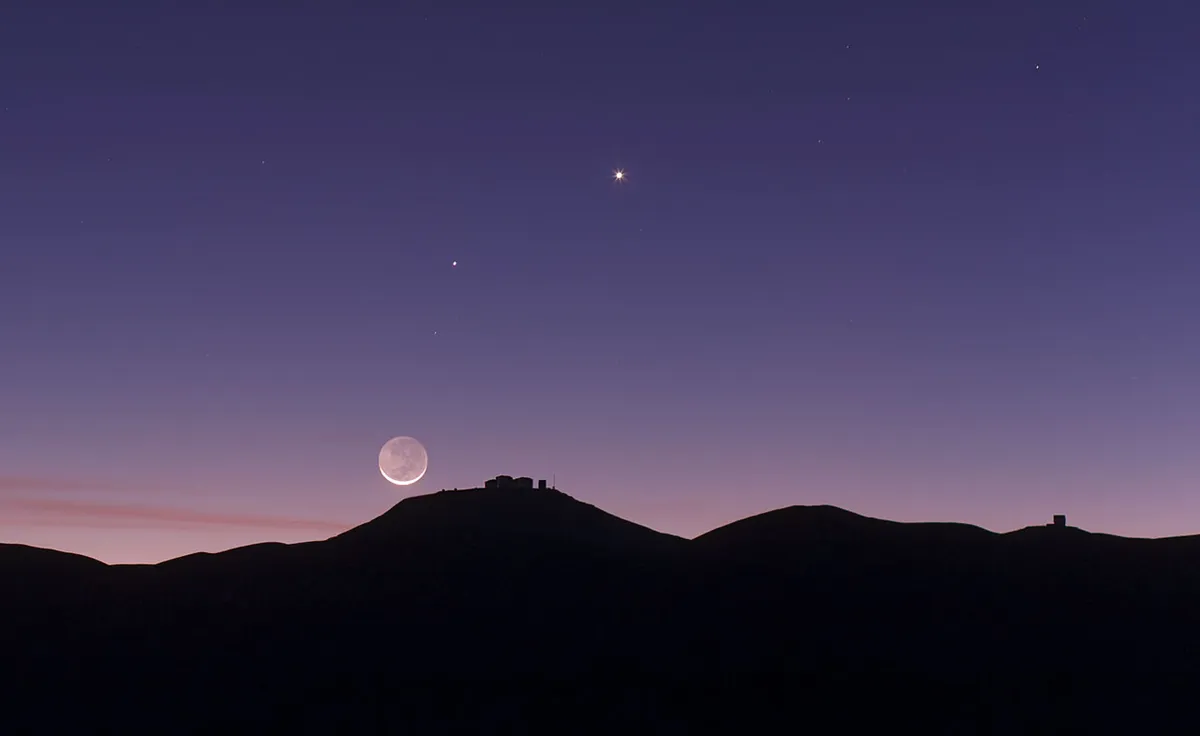
- Fig. 1: View of the crescent Moon over the Paranal Observatory in Chile taken on October 27, 2011. The planets Mercury and Venus also appear in the image.
Credits: ESO/B. Tafreshi/TWAN (twanight.org). - Fig. 2: Credit: ESO/L. Calçada.
- Fig. 3: Credit: ESO/NASA/M. Kornmesser.