A collection of links to music, images and videos relating art and science. Today: Images of Cygnus in radio, the Bullet Cluster, the heart of the Milky Way, and Lovejoy. Sound: Valencian Cosmos. Video: Flyby.

Images of the decade
Cygnus, in radio
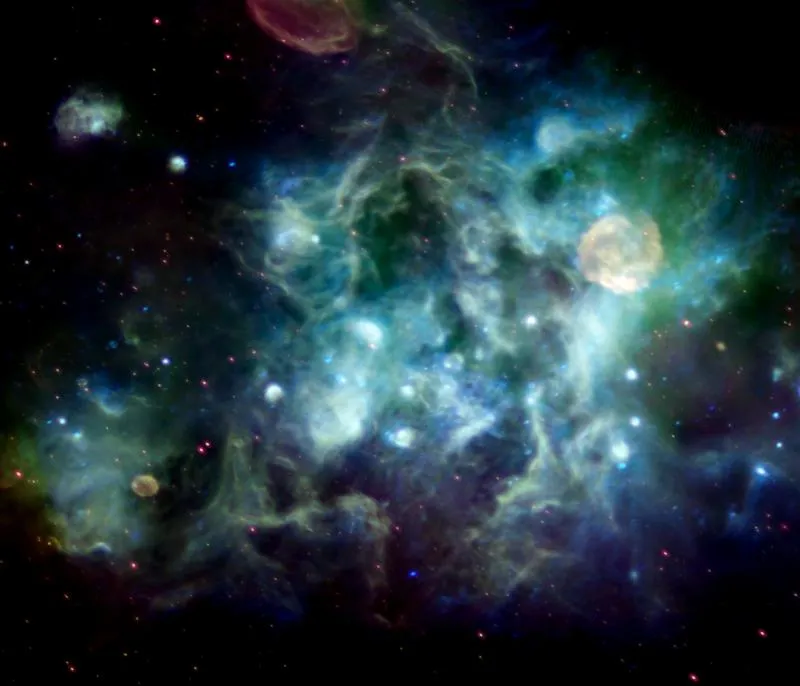
Cocoons enveloping nascent stars, shells of past supernovae and spots of distant quasars stand out in this view toward the constellation of Cygnus. This image covers about 10 degrees in diameter in the sky, but it is only a small portion of the Canadian Galactic Plane Survey (CGPS) in radio light. Bands of diffuse ionized gas flow through a star-forming region located 600 light-years from Earth. Two visible supernova shells include the brown globule at left and bottom (G84.2-0.8) and the white sphere at top right (G78.2+2.1 or Gamma Cygni remnant). To the left of the brown globule is the North America Nebula. Prominent stellar cocoons are noted throughout the image as bright white dots. Some of those stars will likely generate supernova events in the future. Far away and visible here as red dots shine quasars.
The colors of the image represent the data according to their wavelength: Pink for 74 cm and green for 21 cm, in radio; turquoise for 60 microns and blue for 25 microns, in infrared.
The bright extragalactic source Cygnus A lies in the top right part of the image. However that very bright object has been purposely obscured so that its light does not create undesirable optical effects ("artifacts") in that region of the image.
A larger image can be downloaded and more details obtained (in English) at:
Vista of the Cygnus Region of the Milky Way Galaxy
Credit & Copyright: Jayanne English (U. Manitoba) et al., CGPS, CNRC.
It was NASA's Astronomy Picture of the Day (APOD) for February 18, 2002. In Spanish at Observatorio.
1E 0657-56, the Bullet Cluster
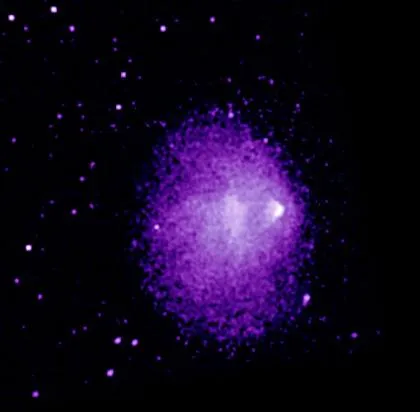
This cluster consists of two galaxy clusters in collision. This image taken by the Chandra Observatory in 2002 reveals a bow-shaped shock wave toward the right part of the cluster. This feature, which is thought to be the result of a merger of a small galaxy cluster with 1E 0657-56, has allowed astronomers a rare opportunity to study how these groupings of galaxies grow.
The shock wave appears to have formed when the 70 million degrees Celsius gas from the small cluster passed through the 100 million degrees gas in the main cluster at a speed of nearly 10 million km/h. That movement would have created a wind that stripped the cooler gas from the sub-cluster, similar to leaves blown from a tree by a storm. Due to the speed, appearance and shape of the subcluster, this event would have occurred 150 million years ago.
The Bullet Cluster is one of the hottest known and lies 3.8 million light-years from Earth. Some years later, also with Chandra Observations, astronomers believed they found evidence of dark matter there.
Credit & Copyright: NASA/SAO/CXC/M.Markevitch et al.
The image was released on February 20, 2002 on the Chandra site.
Images of the week
The heart of the Milky Way

There is much to love about astronomy and, in Valentine's times, photographer Julien Girard offers a loving example in this image. The pink heart-shaped silhouette seems to float ethereally against the night sky over ESO's Paranal Observatory in northern Chile. Girard drew the heart in the air by illuminating with a small flashlight toward the camera during a 25-second tripod exposure.
The central region of the Milky Way appears in the middle of the heart, while the plane of the galaxy extends along the image. The stars in the constellation of Corona Australis form a bright arc of jewels at the top of the left lobe of the heart. The diffuse glow to the left of the lowest part of the heart is zodiacal light, caused by the scattering of sunlight by dust particles in the Solar System.
In the image it is also possible to see the ESO VLT telescopes and a car going down the hill (on the right). And just below the center of the Galaxy, a "kiwi" (see Kiwi flies in night sky).
Credit: © Julien Girard 2011 www.djulik.com.
On Flickr Girard's photo has some annotations.
It was the ESO Picture of the Week.
Lovejoy from the Southern skies
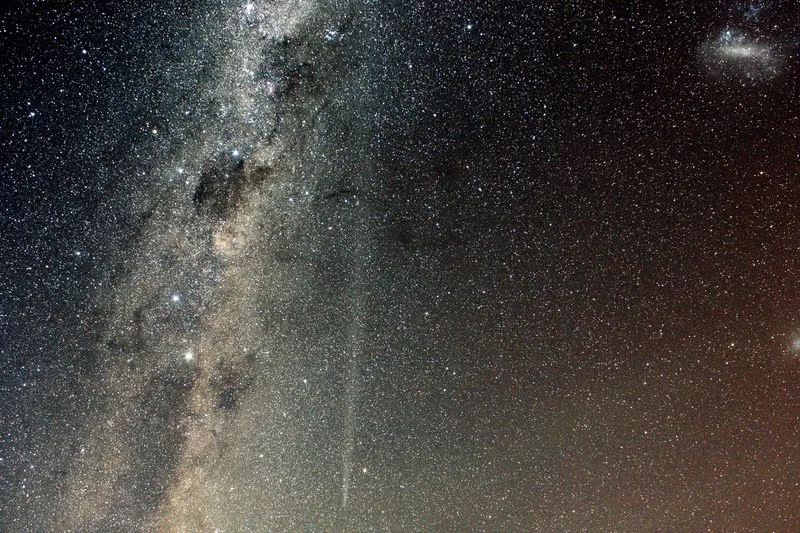
Comet Lovejoy (C/2011 W3) visited the southern skies in December and January. This record was made on January 2, with a Canon 450d, 600s exposure, ISO 800, F 5.6 mounted on a Skywatcher EQ5 from Del Carril, Province of Buenos Aires by astrophotographer Diego Gentili.
It was chosen as the Amateur Astronomy Picture of the Day (AAPOD) for February 13, 2012.
Space Music
Valencian Cosmos, by Jack Jeffrey
Jack Jeffery, from Virginia, United States, creates ambient and progressive music influenced by Floyd, Parsons, Eno, Beatles, EL&P and Kraftwerk.
His latest work is called "The Constant That Remains", which followed his first production "Passage to Agadir".
In this case of "The Constant That Remains", I chose to share here the track Valencian Cosmos, but the entire work is worthy of being heard. It can be appreciated and downloaded on Soundcloud and it is also possible to purchase it on Cdbaby, iTunes and Amazon.
Animated Science
Flyby by Cristofo Romani
Cristofo Romani is making this animated short for his final in 3D Digital Design. From Duluth, Minnesota, Romani can let his imagination take him to Saturn, with some knowledge of astronomy and design and a lot of effort. The music is by Beethoven, 7th Symphony, 2nd Movement.
To access previous editions of this section, consult the Multimedia Selection Series. The series attempts to show that the immensity of the universe can be perceived in different ways, by choosing some images from a decade ago -so they don't fall into oblivion- and from the current week that ends, as well as sounds, music and videos that are artistic forms of expression with content related to astronomy and related sciences.