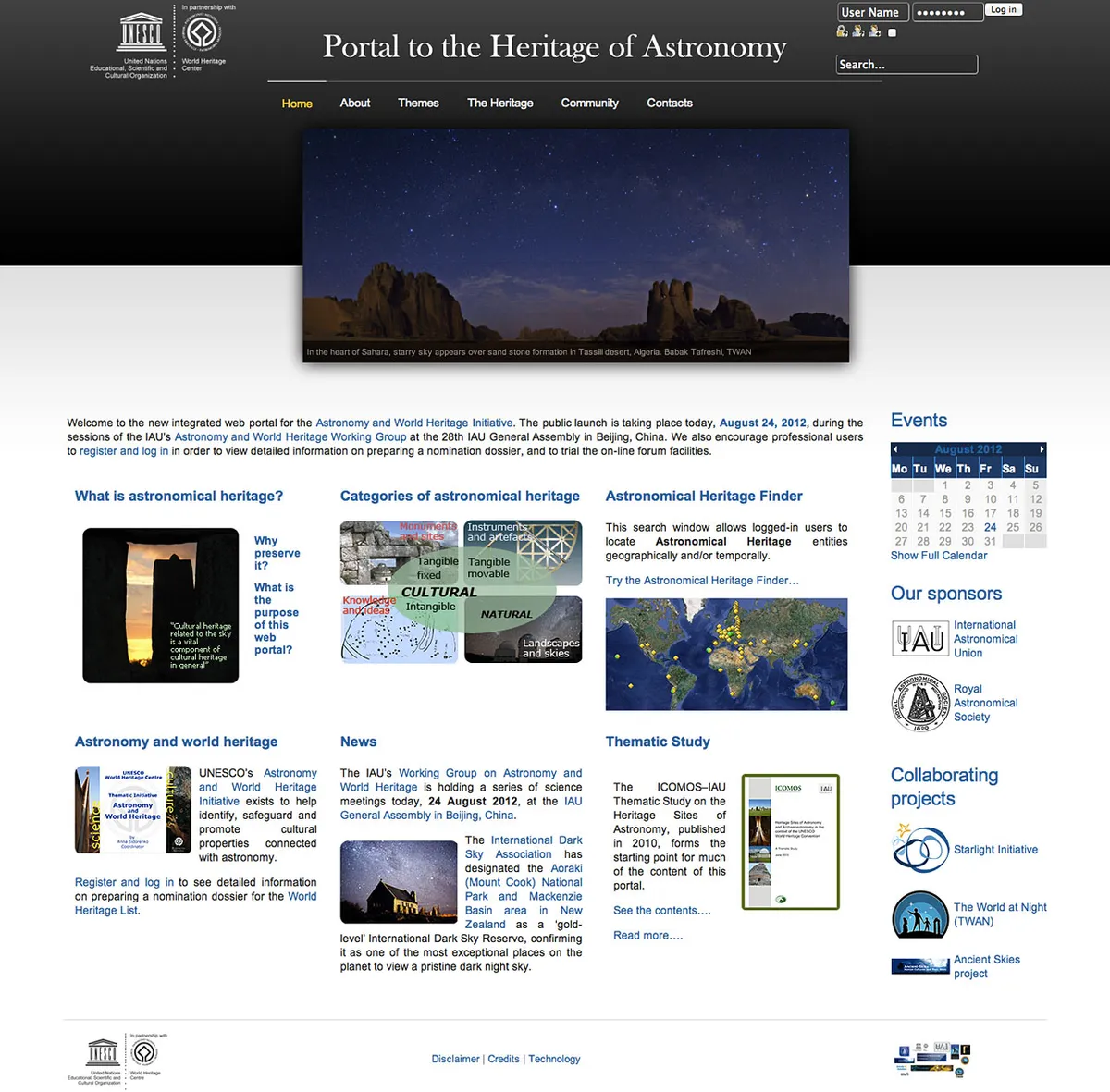
A new UNESCO-IAU portal on Astronomical Heritage was launched at the 28th General Assembly of the IAU in Beijing. The site is a database, forum, and documentary repository on astronomical heritage sites around the world.
Buildings and monuments related to astronomy through the ages are a tribute to the diverse ways in which we humans have rationalized the cosmos and framed our actions according to our understanding of it at those times. The importance of the sky in human heritage was recognized by UNESCO when it established its Astronomy and World Heritage Initiative in 2003 and in 2008 by signing the Memorandum of Understanding with the IAU. Since then, the two organizations have worked together to promote astronomical sites of potential "Outstanding Universal Value".
The web portal, whose address is www.astronomicalheritage.net, is the latest of these joint actions and is the result of collaboration between the IAU Working Group on Astronomical Heritage (AWHWG) and the Ancient Skies project that began during the International Year of Astronomy.
"Much of our most precious astronomical heritage—both ancient and modern—is at risk. In the coming months and years, this web portal will be 'The' vehicle to actively support and sustain political and public interest in promoting and protecting astronomical heritage sites, both cultural and natural," said Professor of Archaeoastronomy Clive Ruggles of the University of Leicester, Chairman of the AWHWG.
The AWHWG produced in 2010 a Thematic Study on the subject between the IAU and UNESCO's ICOMOS. That material has also been incorporated into the new portal.
The site includes information on what astronomical heritage is, what categories exist, a site search engine, news, case studies.
In particular, the site aims to encourage States to identify potential astronomical heritage sites and support those nominations to become part of the World Heritage List with documentation. Among the key issues is being able to recognize where something of "value" is located. The aforementioned thematic study identified two key interrelated issues in recognizing Outstanding Universal Value (OUV) in astronomy:
First, there is a dichotomy between "traditional" perceptions of what is valuable in terms of heritage, based mainly on its architectural or artistic value, and the view applied to scientific heritage, where alteration over time is inevitable.
Second, under the World Heritage Convention, tangible heritage is recognized, while the value of scientific heritage is highly dependent on the fixed and movable relationships and intangible aspects of heritage forms. Two examples are space heritage, linked to technology and its applications, for example satellites.
But dark skies are also a heritage. One we are losing in large cities at an accelerated pace. When evaluating the tangible, material heritage of astronomy, it does not seem possible to include celestial objects. However, we cannot dissociate astronomical sites from the objects studied from those places. That is why it is important to recognize and preserve the link between both: the natural heritage of geographical places is linked to the cultural heritage generated in them.
Sources and related links
- Launch of UNESCO–IAU Astronomical Heritage Web Portal
- IAU
- UNESCO's World Heritage Centre
About the images
- The image is a screenshot from http://www2.astronomicalheritage.net. Credit: IAU/UNESCO.