Since childhood, the Moon and its phases fascinate us, although sometimes it is difficult to understand why they occur. What is the relationship between the time and the phases of the Moon? Are there times when the Moon does not rise, does not set, or does not transit?
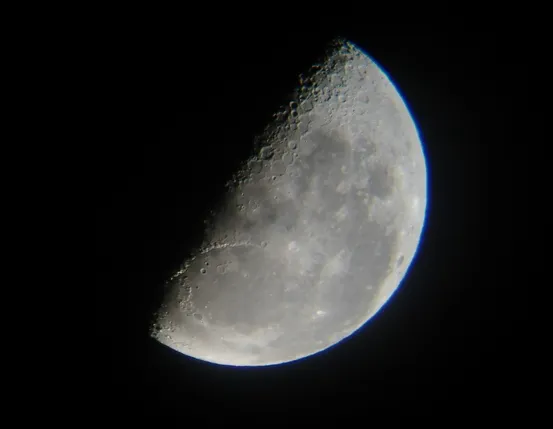
Recently, at an observational outing I attended that gathered people who, for the most part, had just completed an introductory course on astronomical observation, a woman asked me a question. She told me that in the course they had pointed out that the Moon does not rise at any hour and that, depending on the phase our natural satellite is in, it rose and set at a certain time of day.
And she asked me what the underlying logic was.
I must say that on that occasion I did not want to answer her. No, not out of ignorance or malice, but because her teacher was there and I did not want to invade another's intellectual territory. But I kept the idea, since then, of making a post about it.
If one already understands why the moon appears to us in phases, the rest follows logically and easily, but for various reasons, it is possible not to understand the time relationship between the Moon's rising and its phases.
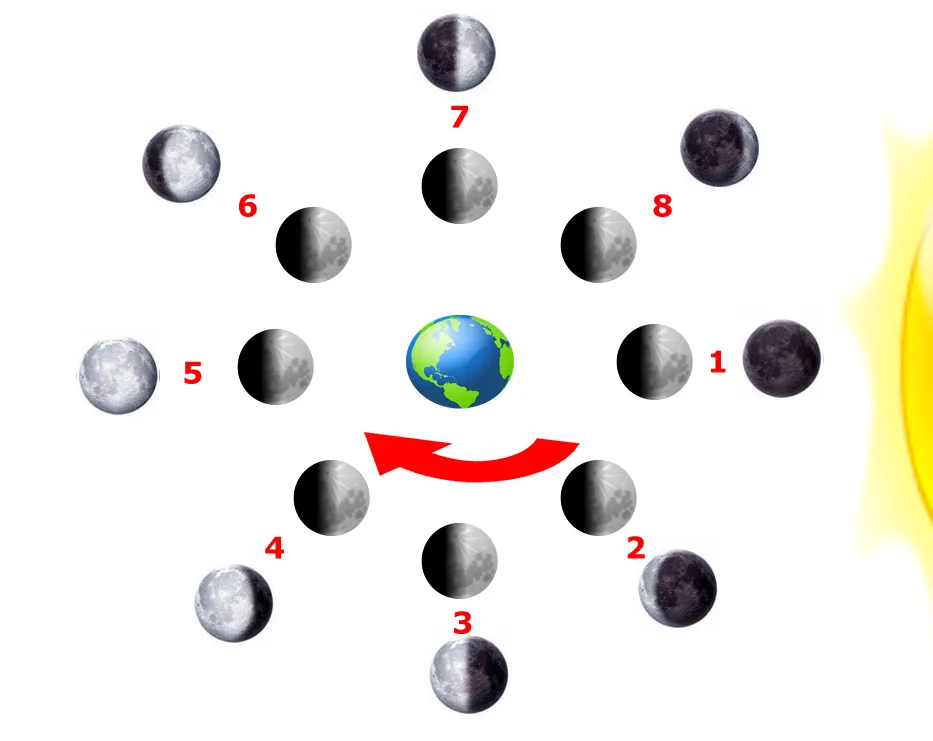
The phases are the product of the relative position of the Earth, the Moon, and the Sun throughout the month. The cycle of phases repeats every 29.5 days (synodic month) and is composed of the following stages:
1-New Moon
2-Waxing Crescent
3-First Quarter
4-Waxing Gibbous
5-Full Moon
6-Waning Gibbous
7-Last Quarter
8-Waning Crescent
The phases, certainly, are ways of classifying the illuminated and visible region of the Moon from our planet. For that, it is feasible to divide that appearance into parts and give them names, but the illuminated and visible region of the Moon from Earth will change day by day, gradually.
What is the relationship between the phases and the time of the Moon's rising and setting?
We must initially consider some approximate ideas: The Moon and the Sun are visible, above the horizon, for about 12 hours each day. The remaining 12 hours they will be below the horizon and will not be visible. Of course, they will be visible to those who live in the hemisphere opposite to ours.
This fact, that those two objects are above the horizon for about 12 hours is, I insist, an average fact, it is not always like that, but it will not be very different either, and this simplification is convenient for understanding the topic. But it is a simplification.
Another consideration: we divide, for human convenience, the visible sky, above the horizon, into two "parts" marked by an abstract line called the "Meridian". It is an imaginary line that joins North with South.
Celestial bodies rise in the East (because the Earth rotates in the opposite direction) and ascend across the sky for about 6 hours, until reaching a maximum, in the North. Upon crossing that imaginary line (it is said to "Transit") they will begin to descend until they set.
For example: the Sun, in Argentina, usually rises between 5 and 7 in the morning. Let's say, to keep it simple, that it rises at 6. It ascends for 6 hours, until noon, the moment when it reaches its highest point. Throughout the year, the height it reaches at its maximum changes, but that is another matter. After noon, the Sun begins to descend, until it sets at 18 hours (approx).
What happened at noon is that the Sun "transited," crossed the Meridian.
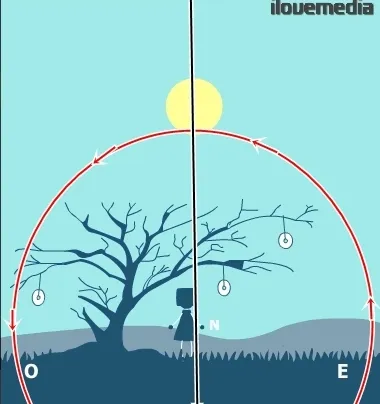
If that entire apparent journey takes 12 hours, and the meridian is in the middle, then, half the journey is 6 hours. Simple.
Well then, let's do the following exercise: let's think of the Moon already risen, high above the horizon, that is, about to transit, to cross the meridian. We don't know what time it rose, when it will set, or what time it is at the moment of observation.
Let's do this with 4 of the phases.
NEW MOON
In New Moon, the lunar hemisphere facing Earth is not visible. That implies that it is the other hemisphere of the Moon that is illuminated by the Sun. Where is the Sun? We said we imagine this when the Moon is high above the horizon.
Something like this:
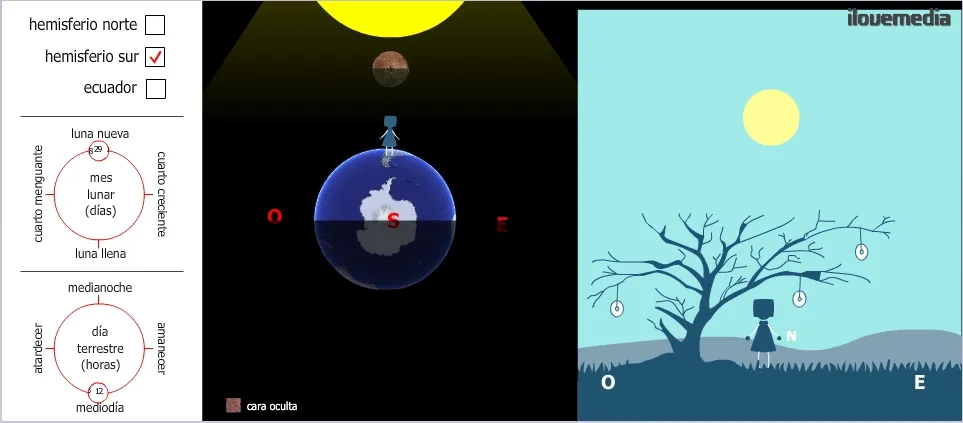
The Sun must be on the side of the illuminated lunar hemisphere, that is, on the opposite side to the hemisphere we from Earth could see. In astronomy, it is said that the Moon will be in Conjunction.
The phase angle or angle of the Earth-Sun and Earth-Moon directions is 0º.
Therefore, the Sun is also high on the horizon: It is noon. Both the Sun and the Moon will be more or less in the same place in the sky. Both will have risen 6 hours before and will set 6 hours later. I insist: it is an approximate calculation.
This month of May, for Argentina, there was a new moon on May 20. The Moon rose at 7:22 and set at 17:44.
It's worth noting that we are saying, at the same time, that the Moon rose in the East and set in the West. This is also another way to simplify, because that day the Moon rose at 65º and set at 295º Azimuth.
FIRST QUARTER
Let's do the same with the first quarter. The moon is in that phase, high on the horizon. To deduce what time it is, and -because of the six-hour rule- know approximately when it rose and when it will set, we must think: where is the Sun?
In the First Quarter, in the Southern Hemisphere, the illuminated part of the visible face looks like the letter "C". If that part is illuminated, where is the Sun?
Let's see:
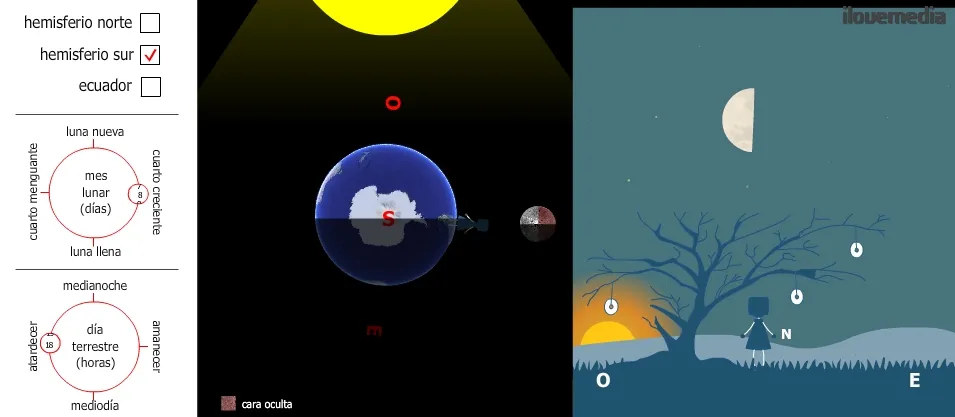
If half of the visible moon is illuminated and that part faces West and the Moon is high above the horizon, then the Sun will be in the West, setting. It is, approximately, 18 hours (in Argentina). The Moon will have risen about 6 hours earlier (noon) and will set 6 hours later (at midnight).
The Earth-Moon and Earth-Sun angle is 90°: the Moon is at quadrature.
Let's verify with real data from this month:
This month of May we will be at First Quarter on the 28th. The Moon will rise at 13 and set at 00:04. As we see, it's quite close to our calculation.
FULL MOON
Then the Moon will continue to illuminate more and more until the Full Moon or Plenilunio. Let's imagine that Moon high on the horizon. Where is the Sun?
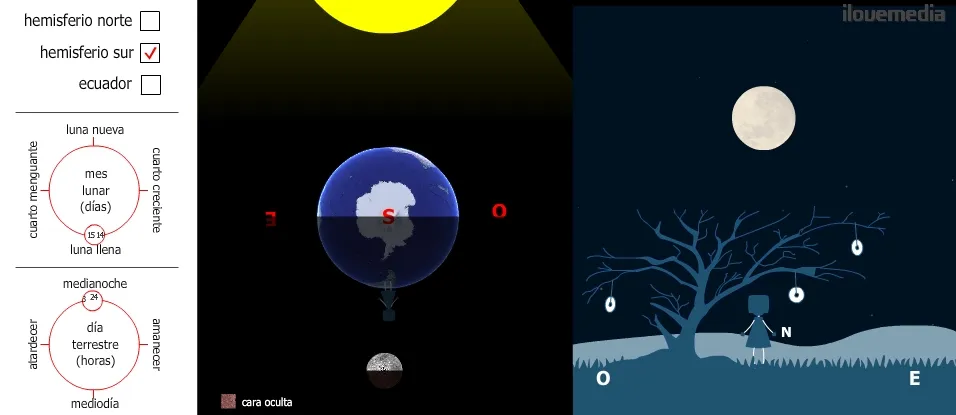
The Sun will be "on the other side". In astronomy, they are said to be in Opposition. The Earth-Moon and Earth-Sun angle is now 180º. The celestial body will be at the Nadir (point opposite the Zenith) and if it is at the midpoint, it will have set 6 hours ago and will rise 6 hours later. It is midnight. The Moon will have risen at 18 hours and will set at 6:00, approximately.
Let's see with real data. On May 6 there was a Full Moon. Our satellite rose at 18:34 and set at 8:01.
LAST QUARTER
From the Plenilunio, the illuminated and visible region of the Moon will wane. In Last Quarter, from the Southern Hemisphere, the illuminated area appears as a letter "D", towards the East. If the Moon is high above the horizon and its illuminated part faces East, where is the Sun?
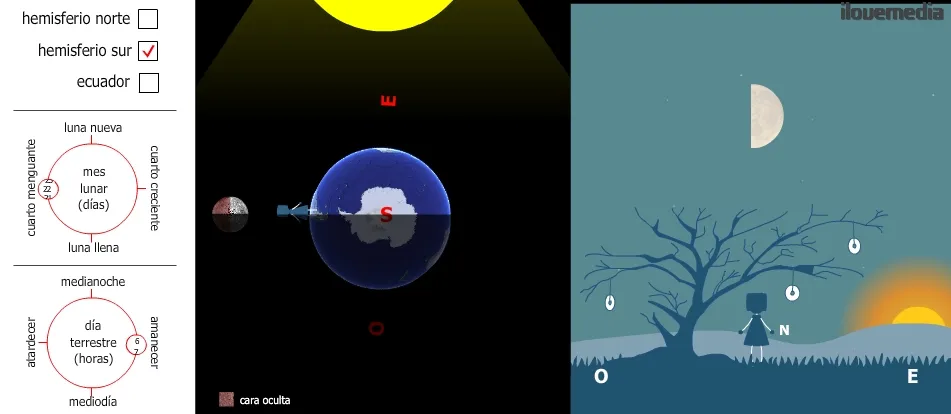
The Sun will be rising, in the East, when the Moon in Last Quarter is high. It will be dawn at that moment, around 6:00 h. The Moon will have risen six hours earlier, at midnight, and will set six hours later, at noon.
The Earth-Sun and Earth-Moon angle will be 270º.
Will it be so? Let's see with data from this month of May: Oops, there's a problem, call Houston!
The phases of the Moon on Ilovemedia
Ilovemedia is the site of Raquel G. Cabañas with several very didactic applications, among which is one about the phases of the Moon. From that application and with her permission and generosity, I have taken screenshots for this post. I recommend seeing the application, simple, beautiful and instructive.
Thanks Raquel!
When the Moon does not rise
There are days when the Moon does not rise. Yes, believe me. And days when it does not set. And it's not a joke. And days when it does not "transit", and it's not a joke.
But there's no need to take my word for it (Nullius in verba), let's see the reasons:
On May 11, 2012 the Moon, almost in last quarter, rose at 23:51. And set at 12:42. This coincides, approximately, with what was indicated in the previous paragraph.
But let's think about what happened the next day. The Moon rose on May 11 at 23:51. The "next day" will be only nine minutes later!! That is, nine minutes AFTER the Moon rises, it will be the 12th. So on the 12th the Moon did not rise. But, you might think, maybe it rose before the end of the 12th. And no, it rose again at 00:52 on the 13th.
This is not strange in itself. It's only due to human conventions of when the civil day begins and ends. But nothing strange happened with the Moon or the Earth or the Sun.
And this happens every month, near the Last Quarter.
And the same happens with the setting (near the first quarter) and the transit (near the full moon). Let's see:
In May 2012 the First Quarter will be on the 28th. On the 26th the Moon will set at 23:03. On the 27th the Moon will rise at 12:29 but will set at 00:04 (on the 28th). So on the 27th the Moon will not set.
Note: this does not mean there are no sunrises and sunsets!
And the same happens with transits, near the Full Moon. In May 2012 the Full Moon was on the 4th. The Moon rose at 16:55, the transit was at 23:50 and it set at 06:49 (already the next day).
On May 5, the Moon rose at 17:42, but it transited at 00:50 (already on the 6th). On May 5 there was no lunar transit.
This same thing can be verified month by month. Among the tools available to verify these situations we can use: Gsky Digest, the Argentine Naval Hydrography Service site, and Wunderground. On this last site, when entering, we will be asked to indicate our location (our city). And by default it will give us the data for that date. But if we scroll down the page, we will see at the bottom the option History and Almanac, from which it is possible to change to any past or future day. For example, if I indicate May 27 there (for Buenos Aires) I will have the astronomical data, among which it says that "there will be no moonset".
Notes: The two photos used in this post were taken by me. The one that begins this entry was taken half an hour after midnight on February 14. At what time did the Moon rise that day? You can consult the Argentine Naval Hydrography Service, in the "Services" section and check the Moon rise and set times for February 2012.
(As a bonus: do you dare to think through what type of telescope the image was taken with, captured by a compact digital camera?).
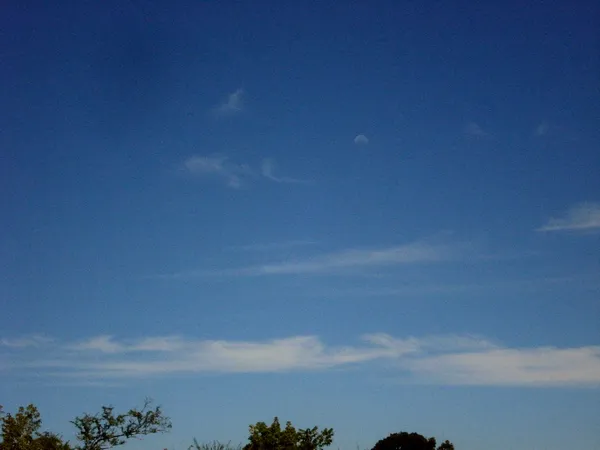
The second photo was taken hours earlier, on February 13. The camera was pointing West. Is it possible to have an approximate idea of what time the photograph was taken? Can the reader determine if the Moon was in First Quarter or Last Quarter? Keep in mind that the photo was taken in Argentina, in the Tigre Delta.
Note written for the XXXI Carnival of Physics, in this edition hosted by Imperio de la Ciencia. To join and read the entries visit Gravedad Cero.
Sources and related links
About the images
- Graphic 1: Credits: Image combined by me from elements obtained at OpenClipArt.
- Graphics 2-6: Thanks to Raquel G. Cabañas from Ilovemedia.