Using the Hubble telescope, astronomers produced a very detailed image of a pair of overlapping galaxies, called NGC 3314. A first glance would lead one to think they are colliding, but it is a perspective illusion: both appear in the same direction from our point of view.
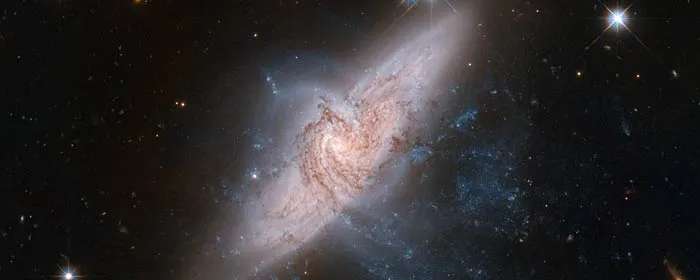
NGC 3314a and NGC 3314b are not colliding, as one might think from the image captured by astronomers with the NASA and ESA Hubble Space Telescope. How do they know? A first clue is the shape of the galaxies. The enormous gravitational force involved should deform the galaxies even before they collide. On the other hand, that would also generate new episodes of star formation.
In the case of NGC 3314, deformations are seen in the galaxy that is closer (3314a), but they would be the product of a previous interaction with another galaxy. That deformation can be noted below and to the right of the nucleus.
Studies on the motion of the two galaxies indicate they have not been perturbed and are moving independently.
And, this alignment affects the way they are observed from Earth. NGC 3314b has dust lanes, for example, that appear much lighter than those of its neighbor. But that difference is not because the galaxy lacks dust, but because those lanes are illuminated by the bright light of the stars in the background. NGC 3314a, in contrast, is backlit by the stars of NGC 3314b, and thus the dust lanes are perceived as silhouettes against the illuminated background.
The photo is striking, but it also provides scientifically interesting data, aside from the curiosity. The alignment is useful for studying the phenomenon called gravitational microlensing. This is an event that occurs when stars in one galaxy generate small perturbations in the light coming from a more distant island universe. In fact, the observations of NGC 3314 that led to this image were to investigate that phenomenon.
Hubble's mosaic covers a large field of view. Thanks to the long exposure of more than an hour in total time for each frame, the image shows not only this duo of galaxies, but also other more distant ones in the background. The image is a composite produced by exposures in blue and red.
These images are already part of the Hubble's Hidden Treasures Competition by participants Andre vd Hoeven and nmoushon.
Is this image new?
Already in 2000 Hubble gave us a similar view in May of that year on HubbleSite, also available on the Hubble Heritage site with more details. In the image from then and in the current one, the credit is given to astronomer W. Keel of the University of Alabama. The image published about a dozen years ago had been obtained with data recorded in 1999 and 2000.
This "new" image was generated with observations from 2002-2004.
NGC 3314a is located 117 million light-years away. NGC 3314b is about 140 million light-years away, both in Hydra. On the NASA and ESA Hubble sites there are videos and other images of these objects.
Sources and related links
About the images
- Image credits: NASA, ESA, the Hubble Heritage (STScI/AURA)-ESA/Hubble Collaboration, and W. Keel (University of Alabama)