Using the Very Large Telescope of ESO, an international team of astronomers has detected "dark" galaxies, gas-rich objects with very few stars, by observing their glow when illuminated by the light of a quasar.
"Dark" galaxies are small gas-rich galaxies from the early universe, very inefficient at forming stars. (See the box about the term "dark").
Their existence was predicted in theories dealing with galaxy formation and they are believed to be the basic building blocks of today's bright, star-filled galaxies. Astronomers believe these objects fed larger galaxies with much of the gas that later formed the stars that exist today.
Because they are almost devoid of stars, these dark galaxies do not emit much light, which makes them very difficult to detect. For years, astronomers have tried to develop new techniques in order to confirm the existence of these galaxies. Small variations in the spectrum of background light sources have given away their existence. Still, this new study is the first to manage to see these objects directly.
"The solution to the problem of detecting a dark galaxy was, simply, to shed a little light on it," explains Simon Lilly (ETH Zurich, Switzerland), co-author of the paper. "We were looking for the fluorescent glow of the gas in the dark galaxies as they were illuminated by the ultraviolet light from a nearby, very bright quasar. The quasar's light causes the dark galaxy to light up in a process similar to how white clothing lights up under ultraviolet light in a nightclub."
Fluorescence is the emission of light by a substance that, in turn, is illuminated by a light source. In most cases, the emitted light has a longer wavelength than the source light. For example, fluorescent lamps transform ultraviolet radiation—invisible to us—into visible light.
The team used the large collecting area and precision of the Very Large Telescope (VLT), along with a series of very long exposures, to detect the faint fluorescent glow of the dark galaxies. They used the FORS2 instrument to probe a region of the sky around the bright quasar HE 0109-3518, searching for the ultraviolet light emitted by hydrogen when it is subjected to strong radiation. Due to the expansion of the universe, when the light reaches the VLT, it is redshifted, of violet color.
This emission from hydrogen is known as Lyman-alpha emission, and it occurs when electrons in hydrogen atoms jump from the second sublevel to the lowest energy level. It is a type of ultraviolet light. Due to the expansion of the universe, the wavelength of light coming from these objects shifts on its way to us. The greater the distance, the more the wavelength shifts. Since red is the longest wavelength visible to our eyes, this process is literally a shift of the wavelength toward the red end of the spectrum—hence the name 'redshift'. The quasar HE 0109-3518 has a redshift of z = 2.4, and the ultraviolet light from the dark galaxies shifts into the visible spectrum. A specific narrow-band filter was designed to isolate a particular wavelength of light to which the fluorescent emission had shifted. The filter was centered at 414.5 nanometers in order to capture the Lyman-alpha emission shifted to z=2.4 (this corresponds to a shade of violet) and has a bandwidth of only 4 nanometers.
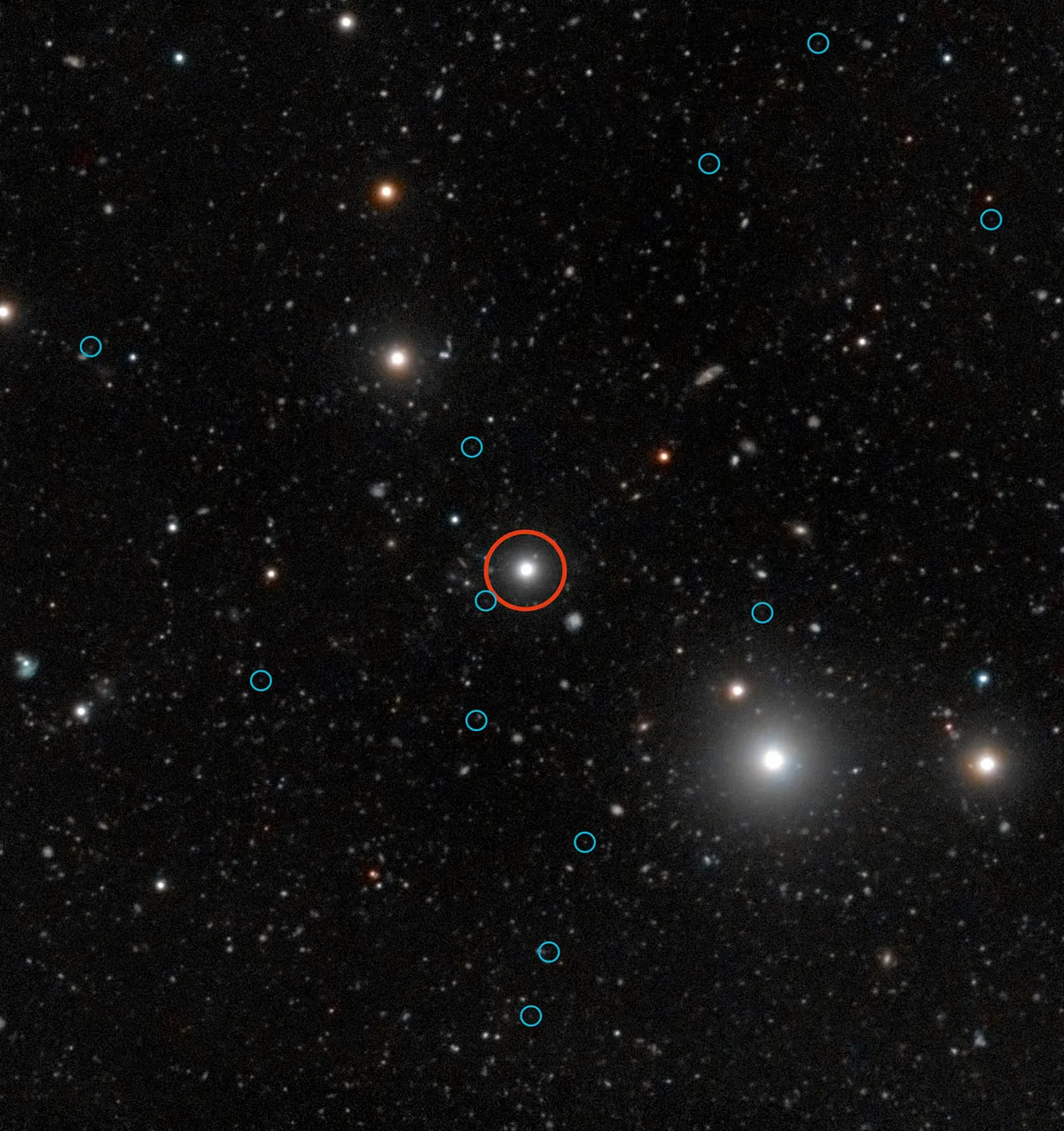
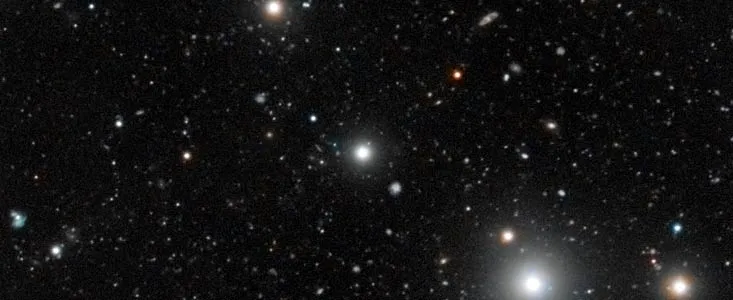
Image 2: This deep image shows the region of the sky surrounding the quasar HE0109-3518. The quasar is marked with a red circle, near the center of the image. The energetic radiation from the quasar causes the dark galaxies to glow, helping astronomers understand the dark initial phases of galaxy formation. The faint glow of twelve dark galaxies is marked with blue circles. Dark galaxies have no stars, so they emit no light that can be captured by telescopes. This makes it virtually impossible to observe them unless they are illuminated by an external light source, such as a quasar located behind them. This image combines observations from the Very Large Telescope (set up to detect the fluorescent emissions produced by the quasar illuminating the dark galaxies) with color information from the Digitized Sky Survey 2.
"After several years trying to detect the fluorescent emission from dark galaxies, the results demonstrate the potential of our method to discover and study these fascinating objects, previously hidden from our eyes," says Sebastiano Cantalupo (University of California, Santa Cruz, USA), lead author of this study.
The team detected nearly 100 gaseous objects located a few million light-years from the quasar. After careful analysis (designed to exclude objects in which the emission could be boosted by star formation inside the galaxy, rather than by the quasar's light), they finally narrowed the sample to 12 objects. This is the most convincing identification of dark galaxies in the early universe carried out to date.
The astronomers were also able to determine some properties of the dark galaxies. They estimated that the mass of the gas they contain is around one billion times the mass of the Sun, typical of low-mass, gas-rich galaxies in the early universe. They were also able to calculate that the star formation efficiency is reduced by a factor of more than 100 compared to typical star-forming galaxies found at a similar stage of cosmic history.
"Our observations with the VLT have provided us with evidence for the existence of compact, isolated dark clouds. With this study, we have taken a crucial step towards revealing and understanding both the dark initial phases of star formation and the process by which they acquire their gas," concludes Sebastiano Cantalupo.
The MUSE integral field spectrograph, which will begin its commissioning phase on the VLT in 2013, will be an extremely powerful tool for studying these objects.
This research was presented in the article titled "Detection of dark galaxies and circum-galactic filaments fluorescently illuminated by a quasar at z=2.4 (Detection of dark galaxies and circum-galactic filaments fluorescently illuminated by a quasar at z=2.4)", by Cantalupo et al., which will appear in the journal Monthly Notices of the Royal Astronomical Society. arXiv:1204.5753v2 [astro-ph.CO]
The team is composed of Sebastiano Cantalupo (University of California, Santa Cruz, USA), Simon J. Lilly (ETH Zurich, Switzerland) and Martin G. Haehnelt (Kavli Institute for Cosmology, Cambridge, United Kingdom).
Dark galaxies vs protogalaxies
Astrophysicist Robert Minchin, at the Arecibo Observatory, will surely choke today when reading this news. He was one of the first, in 2005, to point out a "dark galaxy": VIRGOHI21. Since then, a Spanish astronomer has collaborated in that research: Diego García-Appadoo, from Palma de Mallorca, who has worked at ESO since 2007, specifically at ALMA. He earned his doctorate in Cardiff and did a postdoc in Bonn.
However, this is not a contradiction between those investigations (which indicated the detection of the first "dark galaxy") and these others announced today. It's that the term "dark" is used with different meanings.
In the work indicated in today's note, it is about galaxies with few stars, hence "dark" implies "low-luminosity objects." Whereas in the works of Minchin and others, the term refers to "dark matter." VIRGOHI21 would be a dark matter halo in the Virgo Cluster. However, in both cases, they are objects with few stars. The mass of both types of objects, on the contrary, is quite different. While in this new announcement it is indicated that the mass of these galaxies is one billion solar masses (109), in the case of VIRGOHI21 it would be ten billion (1010) times the mass of the Sun, although only a small part would be gas (the rest is inferred by velocity).
According to the Oxford-Complutense dictionary of astronomy by Ian Ridpath, first edition 1999, the term "Galaxy" means: System of stars, often with interstellar gas and dust, bound together by gravity.
Perhaps, in the case of this news, the most appropriate term would be "protogalaxies" in the transition between the Interstellar Medium and the Intergalactic Medium.
Sources and related links
- ESO: First detection of dark galaxies in the early universe at eso1228es.
- The daily Galaxy: The "Dark Galaxies" Orbiting the Milky Way
- NewScientist: 'Dark galaxy' continues to puzzle astronomers
- Carnegie: New population of faint protogalaxies discovered
About the images
- Images 1 and 2. Credit: ESO, Digitized Sky Survey 2 and S. Cantalupo (UCSC)