A collection of links to music, images and videos relating art and science. Today: Images of G54.1+0.3; Messier 1; DDO 82. Music: Stars, by O.Z.O.N. Video: Tribute to Blade Runner.

Images of the decade
G54.1+0.3
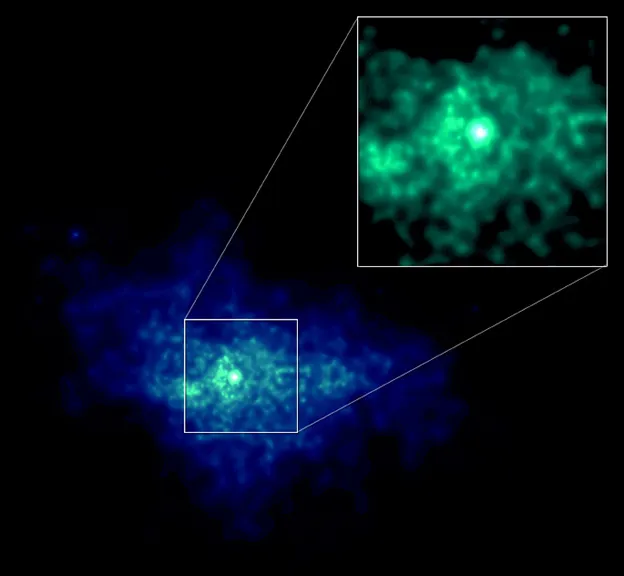
Observations made with the Chandra X-ray Observatory of the supernova remnant G54.1+0.3 reveal a bright ring of high-energy particles with a source that appears point-like. This observation allowed scientists to use the Arecibo Radio Telescope to search for and locate the pulsar or neutron star that generates that ring. The ring of particles and two jet-shaped structures appear to be due to the energetic flow of radiation from a rapidly rotating neutron star: 7 times per second.
During the supernova event the core of a massive star collapses and forms a highly magnetized neutron star and creates an enormous electric field as it rotates. The field accelerates particles near the neutron star and produces jets of matter from the poles, as well as a disk of matter and antimatter that flows from the equator at high speeds. That equatorial flow collides with the surrounding particles and magnetic field and a shock wave forms that accelerates the particles to high energies so they glow in X-rays and the bright ring is produced. In the image the core with a bright ring is seen in the enlarged inset.
This is what is observed in SNR G54.1+0.3, which is similar to other nebulae generated by pulsar winds, like the Crab Nebula and the Vela supernova remnant.
The scientists who carried out these investigations were F. J. Lu (University of Massachusetts) and colleagues 2002 ApJ 568 L49 doi:10.1086/340137; and F. Camilo (Columbia University) et al. 2002 ApJ 574 L71 doi:10.1086/342351
The object in question is located 20,000 light-years away, in Sagitta.
The information was published on the Chandra site, on June 25, 2002.
Credits: NASA/CXC/U.Mass/F.Lu et al.
Images of the week
Messier 1
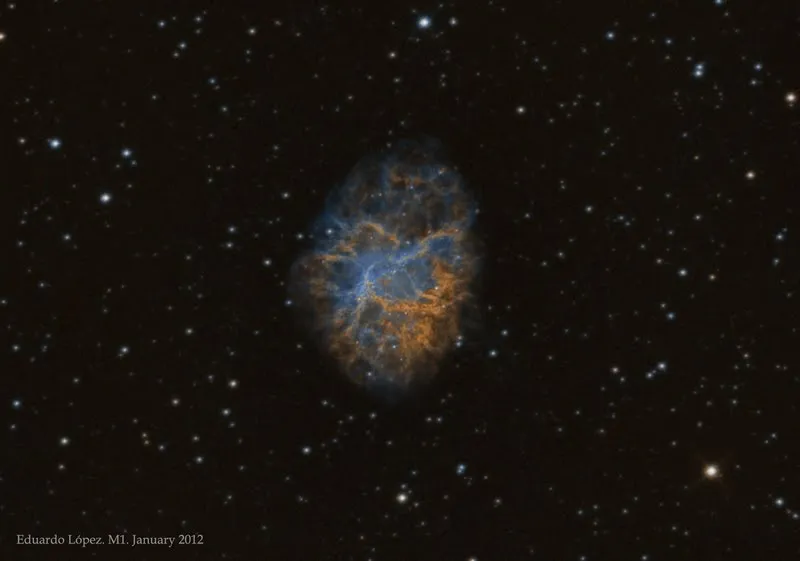
The Crab Nebula is the first item in the Messier catalog, that is M1. It is also known as NGC 1952. It is a supernova remnant in Taurus, the result of an event recorded by Eastern observers in 1054. At the center of the object lies a pulsar (PSR0531+121), that is, a rapidly rotating neutron star (30 times per second), only 30 km in diameter.
The photographic record is by Eduardo López, from Alcalá de Guadaira, on February 4, 2012, made with 500 shots of 60s with an Atik 314L camera on a TS 250mm mounted on EQ6 + filters and later retouching.
It was the Amateur Astronomical Image of June 30, 2012.
Wispy stars
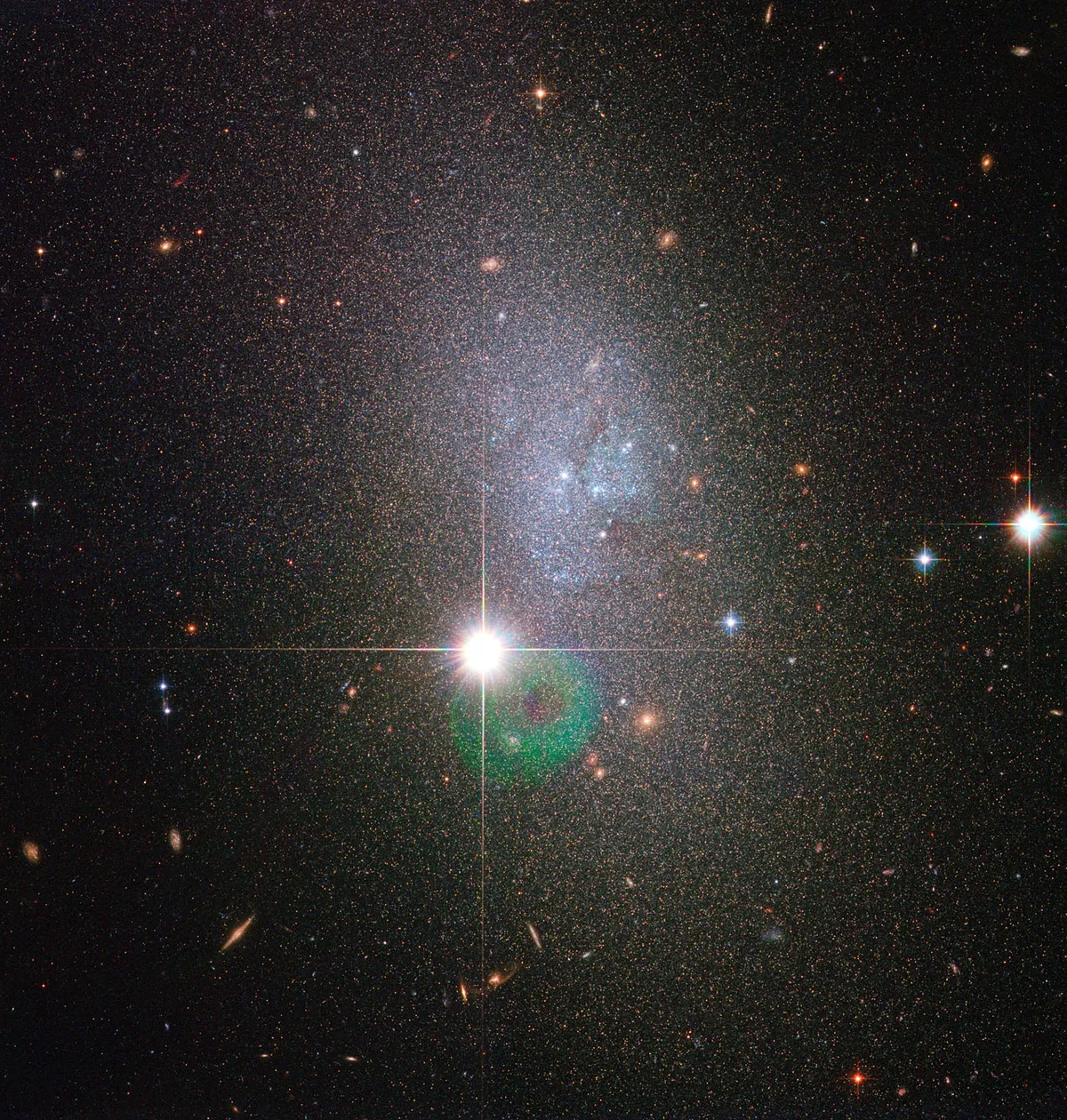
Relatively few galaxies possess luminous spiral arms or a bright center like our Milky Way. In fact, most galaxies are small, amorphous wispy clouds. One of them is DDO 82, captured here with the Hubble Space Telescope. Although smaller in size than our galactic home, it still contains several billion stars.
DDO 82, also known as UGC 5692, however is classified by astronomers as an Sm galaxy or Magellanic-type spiral galaxy, like the Large Cloud that orbits our Milky Way. DDO 82 has a spiral arm.
This type of galaxy was not part of the Hubble Classification, that tuning fork type. In other cases the object is mentioned as an irregular dwarf.
DDO 82 is located in Ursa Major about 13 million light-years away. The object's name comes from its inclusion in the David Dunlap Observatory catalog that lists dwarf galaxies, published in 1959 by Sidney van den Bergh.
Credit: ESA/NASA Hubble.
It was the Space Telescope Image of the Week.
It should be noted that this image was recorded by a proposal made by professor Julianne Dalcanton (University of Washington). Her Hubble observation proposal carried the number HST Proposal 10915 and gave rise to the ACS Nearby Galaxy Survey.
On the Hubble legacy site it is possible to find the three original exposures and their combination (those that say ACS/WFC). Also found are the DDO 82 files on the ACSNGS site.
Space Music
Today: Stars, by O.Z.O.N
O.Z.O.N is an artist from Ukraine who published an album titled "Stars" on Jamendo that contains, besides the title, other tracks with reference to space, and tracks like "Nexus".
Animated Science
Blade Runner
On June 25, 1982, 30 years ago, the famous film directed by Ridley Scott premiered in the United States. In Argentina the feature film was seen on July 15 of that year.
There are those who claim that science fiction films, or novels, foretell the future. Thus, today it is possible to ask, which predictions came true from the future promises in Blade Runner?
However, these stories have another kind of value. They use the technological advances that are supposed to be achieved in the future -like the futuristic Nexus 6 androids- to present human conflicts, seen in another context. They also generate new aesthetics. Note how it is possible to replicate the atmosphere of that classic film in this tribute.
What follows is a short film made by the creators of the special effects for series like 24, the Stargate studios. More data and a "behind the scenes" at Alt1040.
The short film has some dialogue, in English, but I think it's easy to understand anyway. Remember that Blade Runner is a film based on the novel "Do Androids Dream of Electric Sheep?" by Philip Dick. Perhaps robots dream of galaxies...
XXIT - Demo from Stargate Studios on Vimeo.
To access previous editions of this section, consult the Multimedia Selection Series. The series attempts to show that the immensity of the universe can be perceived in different ways. I choose some of the images from a decade ago -so they don't fall into oblivion- and from the current week that ends, as well as sounds/music and videos that are artistic forms of expression with content related to astronomy and related sciences.