A collection of links to music, images and videos relating art and science. Today: Images of the Whirlpool Galaxy in X-rays; Cassiopeia A; NGC 6188 and NGC 2070 from Argentina. Music: Listening to the Whirlpool and dancing with the Tarantula. Video: Alpha.

Images of the decade
NGC 5194: high-energy activity heats the whirlpool
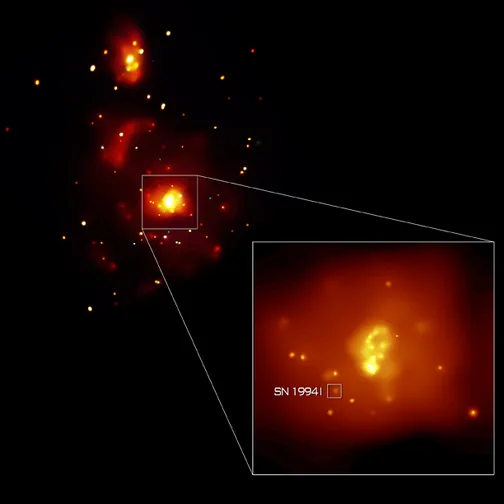
X-rays from a rare type of supernova were observed in the Whirlpool Galaxy with the Chandra Observatory. The research team also detected a large number of point X-ray sources due to black holes and neutron stars in binary systems.
The image obtained with Chandra highlights the central regions of two interacting galaxies: NGC 5194 (center) and its small companion NGC 5195 (top left), also called M51. If they are two different objects, they should have different names, but since at the same time it is possible to think of both galaxies as a "system" there are those who call both M51 (M51A for NGC 5194 and M51B for NGC 5195) and the term Whirlpool Galaxy is used not only for the larger one, but for the whole.
The inset in the image contains an enlargement of the central region of the larger galaxy. Extending from top to bottom of the bright nucleus are clouds of very hot gas, with diameters of about 1,500 and 500 light-years, respectively. The similarity of these features to those observed at radio wavelengths suggests to scientists that the gas is heated by high-speed jets of matter produced near a supermassive black hole in the galaxy's nucleus.
Below and to the left of the inset is a faint source identified with a supernova discovered in 1994 by amateur astronomers and later determined to be an unusual Type Ic supernova. The massive stars responsible for these supernovae lost their outer layers of hydrogen and helium long before the explosion, either through evaporation or transfer to a companion.
In the millennia before a star explodes as a supernova, it loses mass. X-ray observations provide a method of probing that process. The data obtained with Chandra of SN 1994I and its surrounding area indicate that the progenitor star evaporated material into a cloud around the star. The cloud would have a diameter of at least 0.2 light-years.
Andrew Wilson of the University of Maryland was the principal investigator of the Chandra observations of Messier 51. Other scientists involved in the research were Yuichi Terashima, from the same University, and Stefan Immler (University of Massachusetts).
M51 A and B lie in the Hunting Dogs (Canes Venatici), about 30 million light-years from Earth.
The image was released on Chandra on July 2, 2002.
Credits: NASA/CXC/U.Md/A.Wilson et al.
The colors of Cas A
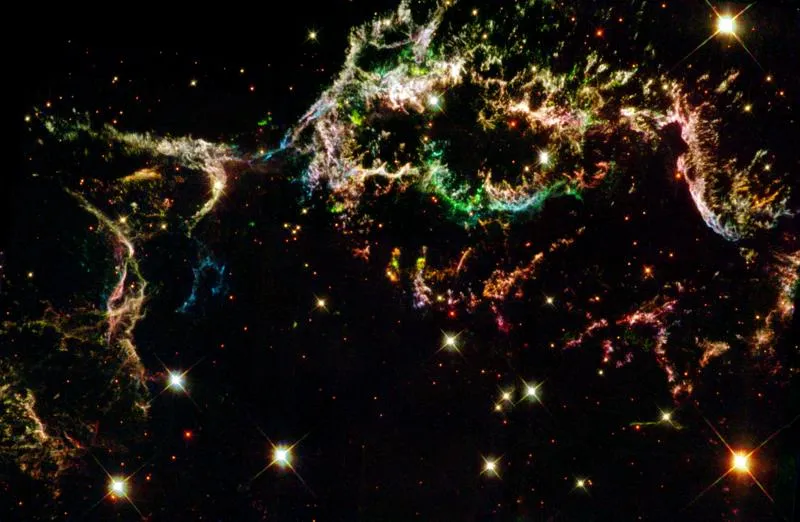
The top image was taken with the Hubble Telescope a decade ago and in the accompanying text an analogy was drawn between the "fireworks" of the sky and the usual ones in the celebrations of American independence (which is celebrated on July 4).
Incidentally, the light captured by Hubble's instruments was seen here on Earth for the first time 3 centuries ago, but it originated 10,000 years ago. What the image portrays are the remains, the remnant of a supernova. It is known as Cassiopeia A or "Cas A", a young remnant in the Milky Way that lies 10,000 light-years away in the direction of the constellation that gives it its name.
The image shows the upper edge of the expanding shell of the remnant. Near the top of the photo are dozens of "small" clumps of matter, which were fragments of the star that exploded. Each one is tens of times larger than the diameter of the solar system!
That's because the original star of the supernova was between 15 and 25 times more massive than our Sun.
The colors in the image of these cosmic debris come from chemical elements. The blue areas are rich in oxygen, the red ones in sulfur. The white, pink and orange refer to mixtures of oxygen and sulfur.
Credits: NASA and The Hubble Heritage Team (STScI/AURA)//R. Fesen (Dartmouth) and J. Morse (Univ. of Colorado)
The image was published on HubbleSite on July 3, 2002.
Images of the week
NGC 6188 from Baires
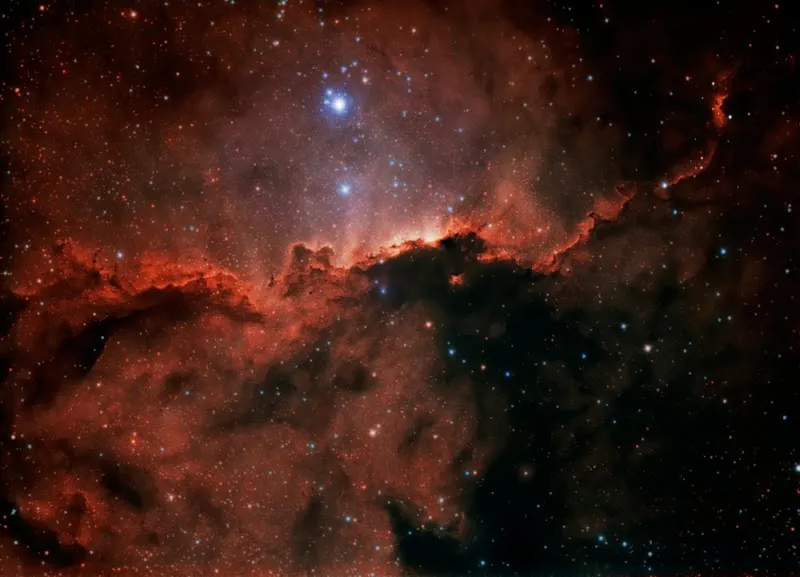
This cosmic landscape is located 4,000 light-years away, in Ara. It corresponds to the emission nebula NGC 6188. The cluster NGC 6193, nucleus of the Ara OB1 stellar association, is responsible for the emission of NGC 6188. In particular, the hottest stars in the cluster, two O-type giants: HD 150135 and HD 150136.
In 2005, two professionals of Argentine astronomy dedicated themselves to the study of the closest O3-type star, a component of the HD 150136 system (2005MNRAS.356..974N)
The recording was achieved with a Nexstar 11" GPS with Hyperstar. It is a Schmidt-Cassegrain type equipment with an aperture of 11 inches, that is 2800 mm (28 cm), and with a focal length of 2800 mm, from the Celestron brand. The term Hyperstar refers to a corrector unit that replaces the secondary mirror in a telescope of this type, reduces the focal ratio (in this case from f/10 to f/2) and, therefore, is faster for imaging.
In addition, a camera, Atik 314I+, was used and exposures were made with filters (Ha and OIII) for a total of 2h 15min. And then the author performed software processing.
Such work belongs to Martin Matias Menrath (martinm3), from Buenos Aires. The recording is from May of this year but it was chosen as the Amateur Astronomical Picture of the Day (AAPOD) on July 6, 2012.
The Tarantula in the Large Cloud
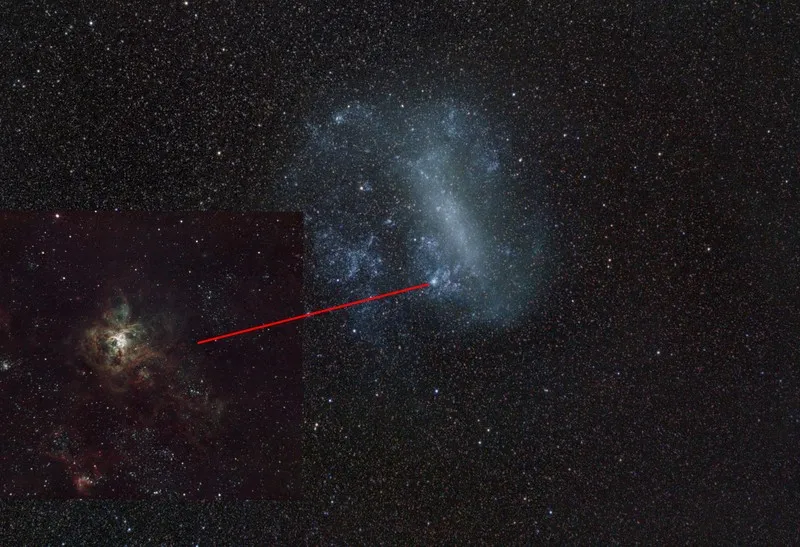
In a dark sky, one of the classic targets of the sky is the Tarantula Nebula, also known as NGC 2070 or 30 Doradus. It is an H II region in the Large Magellanic Cloud (LMC). Although it is 170,000 light-years away, the nebula has an apparent magnitude of 8.
The image above shows our neighboring dwarf galaxy, categorized as SB(s)m by its morphology, that is: a barred spiral without a regular ring structure (s) and without a bulge (m).
At the bottom of the LMC (or LMC for its acronym in English) a very luminous source is perceived. Within the image there is a box, indicated with a red arrow, showing an enlarged detail of the Tarantula Nebula.
The photograph was achieved by Carlos Di Nallo from San Antonio de Areco, Argentina on October 30, 2011.
It was the Amateur Astronomical Picture of the Day (AAPOD) on July 2, 2012.
Space Music
NGC 5194@SpaceProbe + oPrimi - Dancing with NGC 2070
I present to you Space Probe Project with the sounds of NGC 5194.
There are sites on the web, I have already commented on some here, that transmit natural sounds in VLF. Is that what this is about? I contacted the people at Space Probe Project and they told me they are a private company that sends probes into space to "capture sounds and find other civilizations". The project, they tell me, is "confidential" and, to top it off with suspense, they told me about their sounds: "one day everyone will understand them".
But I also present oPRIMI and his "Dancing with NGC 2070".
Animated Science
Alpha
Alpha is a "3d" animated short in black and white, the first half, and in color, the second (to denote the passage of time), made by three animation students: Nicolai Slothuus, Matthías Æ. Bjarnasson and Christian Munk Sørensen. It is a parody of Planet of the Apes. More at Votregraphic.
A space agency, in the 1960s, captures and trains a chimpanzee. The animal learns, through conditioning, and is sent into space in a spacecraft. Outside Earth's atmosphere, the monkey can see Earth, as well as the Sun and Moon in eclipse. The spacecraft returns to Earth and lands in a jungle. Other chimpanzees, curious, approach, and encounter the "intelligent" monkey-astronaut. What will happen?
Also on Vimeo.
To access previous editions of this section, consult the Multimedia Selection Series. The series attempts to show that the immensity of the universe can be perceived in different ways. I choose some images from a decade ago -so they don't fall into oblivion- and from the current week that ends, as well as sounds/music and videos that are artistic forms of expression with content related to astronomy and related sciences.