CERN experiments observe a particle compatible with the long-sought Higgs boson.
In a seminar held yesterday at the headquarters of the European Laboratory for Particle Physics (CERN) in Geneva (Switzerland), the ATLAS and CMS experiments of the Large Hadron Collider (LHC) presented their latest preliminary results in the search for the Higgs particle. Both experiments observe a new particle in the mass range around 125-126 GeV (gigaelectronvolts, about 134 times the mass of a proton).
"We observe in our data clear signs of a new particle, with a statistical confidence level of 5 sigma, in the mass region around 126 GeV. The exceptional performance of the LHC and ATLAS, and the enormous efforts of many people, have brought us to this exciting stage," said ATLAS experiment spokesperson Fabiola Gianotti, "but a little more time is needed to prepare these results for publication."
"Last year we said that in 2012 we could either find a new particle like the Higgs boson or exclude the existence of the Higgs boson predicted by the Standard Model. With all the necessary caution, I think we are at a turning point: the observation of this new particle indicates the path for the future towards a more detailed understanding of what we are seeing in the data," said CERN's Director for Research, Sergio Bertolucci.
Brief review: What is the Higgs boson?
The Higgs boson is a type of elementary particle, belonging to the boson family and predicted by the English physicist Peter Higgs, believed to play a fundamental role in the mechanism by which mass originates in the Universe. The confirmation or refutation of its existence is one of the objectives of the Large Hadron Collider (LHC), the world's largest and most powerful particle accelerator operated by the European Laboratory for Particle Physics (CERN) on the Franco-Swiss border, near Geneva.
There are several elementary particles. From school we know of the existence of protons, neutrons and electrons, but there are many more and they are classified into families or groups. All these particles have their place in a model, a way to simply explain how these particles interact. This Higgs boson is particularly important because it is the only particle predicted by the Standard Model of Particle Physics that has not yet been discovered. In that model, the particle and the associated field (Higgs Field) would explain the origin of mass in the cosmos. Without mass, the Universe would be a very different place. If the electron had no mass there would be no atoms, so matter as we know it would not exist, therefore there would be no chemistry, no biology, and we ourselves would not exist.
And what is mass?
Mass and weight are not the same, although we often use both terms interchangeably. Imagine a person living at the North Pole stepping on a scale like the ones we see in pharmacies. Their weight will indicate, for example, 60 kg. Now think that this same person could very quickly go to the Equator. Imagine they don't eat or drink or lose fluid on the trip, in fact, imagine they arrive at the Equator immediately. If the amount of matter that makes up that person is the same, will they weigh the same? No. Because weight is a measure related to gravity. Since the acceleration of gravity at the Equator is less than at the North Pole, we will weigh more at the North. The same person, without having lost any matter, weighs differently in each place in relation to gravity. That's why it's possible to imagine and calculate how much we would weigh on other planets.
But on a two-pan balance things change. So what we call mass is related to the amount of matter that bodies possess (although things get complicated when we consider speeds close to the speed of light).
But how does the mass of bodies arise? Why does the electron have the mass it has?
To explain it, Higgs formulated the idea of a Field (now named in his honor). We are all familiar, even if we don't fully understand it, with the idea of a field in relation to electromagnetism. The component, the particle, of that field is the photon, the particle of light. The Higgs boson is the particle of the Higgs Field. These bosons form that field that bathes all of space. The other particles interact with this field in different ways. It is often spoken of as a kind of "friction" between the particles and that field. Since that interaction is different, the mass of the particles is too.
The boson plays hide and seek
Elementary particles can be difficult to detect. Some have an extremely short "lifetime" because they very quickly "convert" or transform into other particles. It's not a matter of magic: when two cars collide, the result is no longer two cars, but a pile of parts, different from a car. The example is somewhat crude, but it aims to give a simplified account of what physicists call "disintegration" or "decay."
To detect these particles, there are accelerators that make protons collide at high speeds. The greater the energy of the protons upon collision, the greater the mass of the resulting particles.
Collisions release energy and all the data produced is recorded for analysis. A great many collisions are required for a good experiment. And the analysis is statistical.
Let's give an example: you toss a coin in the air and see which side it lands on. Is it possible for it to come up heads five times in a row? It is possible. And twenty times in a row? Or a hundred? It is also possible, but the probability decreases. If it comes up heads a hundred times in a row, it is very likely that the coin is rigged. But this is not possible to say the same with just five tosses. That's why it's necessary to have a lot of data. And the result will be explained in statistical terms. Among those types of analyses are those of average, variance, and standard deviation. The latter is known as Sigma and it has been established that a level of 5 sigma is a detection. However, we must consider what was said before, the number of events also matters.
Note: for deeper reading I recommend La Mula Francis: What five sigma means for the discovery of the Higgs boson.
And, as if that weren't enough, then we'll have to see the way the detected particle decays. Since this last part is not yet known, scientists indicate that the analysis of the experiments so far gives a clear signal of detection of a particle from the boson family. But whether it is or is not the Higgs boson is something that still cannot be stated. But we are close to shouting 'Piedra libre!'
Argentine participation in the LHC
During the first stage of construction of the collider, a work team from the Laboratory of Instrumentation and Control led by Mario Benedetti at the Universidad Nacional de Mar del Plata contributed to generating efficient power conversion circuits. For this, they had the contributions of engineers from the Laboratorio de Electrónica Industrial, Control e Instrumentación, belonging to the Universidad Nacional de La Plata.
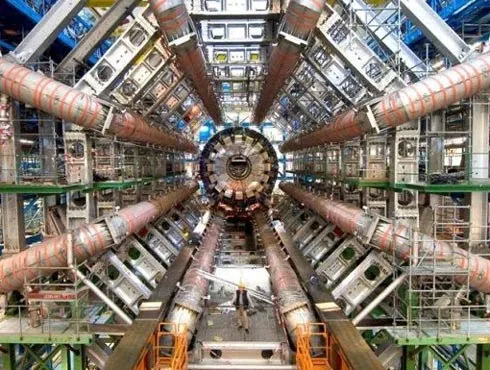
Likewise, researchers belonging to the Universities of Buenos Aires and La Plata, led by Ricardo Piegaia and María Teresa Dova, respectively, were involved in the Atlas project, which was responsible for the design and construction of one of the four particle detectors contained in the collider.
Argentine physicist Dr. Daniel de Florian did a postdoc at CERN. He obtained his degree from UBA and his doctorate in La Plata and is a member of CONICET. Perhaps in the coming days I can talk with him about this particular topic, as well as his scientific work.
“We have reached a milestone in our understanding of nature,” said CERN Director General Rolf Heuer. “The discovery of a particle consistent with the Higgs boson opens the way to more detailed studies, requiring more statistics, which will pin down the particle's properties and likely shed light on other mysteries of our Universe.”
Identifying the characteristics of the new particle will require a considerable amount of time and data. But, whatever form the Higgs particle takes, our knowledge of the fundamental structure of matter is about to take a big step forward.
Spanish participation in the LHC and outreach by CIEMAT
The participation of Spanish research groups in the LHC is supported by the Ministry of Economy and Competitiveness, through the National Program for Particle Physics, and by the National Center for Particle, Astroparticle and Nuclear Physics (CPAN), a Consolider-Ingenio 2010 project. In addition to having designed and built several subdetectors that are key in the search for new particles at the LHC, Spanish groups participate prominently in its operation and maintenance, as well as in the collection, processing and analysis of the collisions produced by the experiments, including those that could lead to the observation of the Higgs boson.
CIEMAT (Centro de Investigaciones Energéticas, Medioambientales y Tecnológicas) is a Spanish Public Organization. I especially thank them for their work and in particular María del Socorro Bermejo Parrilla for her press work.
Sources and related links
- CIEMAT: CERN experiments observe a particle compatible with the long-sought Higgs boson. See PDF.
- Sala de Prensa: Argentine scientific contribution to the discovery of the Higgs Boson
About the images
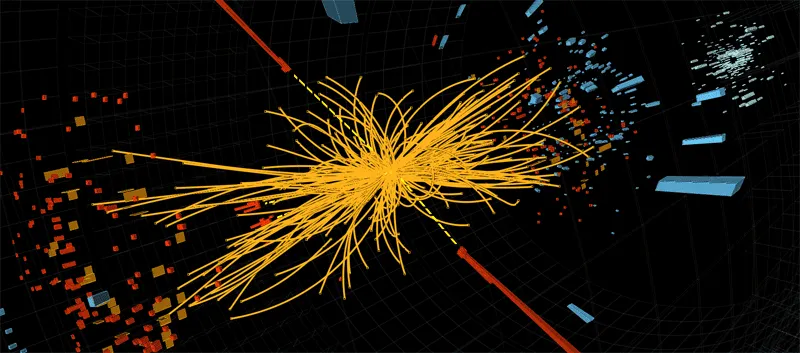
- Initial image: A proton-proton collision event in the CMS experiment that produces two high-energy photons (in red). This is what they expect to see from the decay of a Higgs boson, but it is also consistent with processes from the standard model of physics.
Credit: © CERN 2012