If you want to know about physics, ask an athlete. That could be inferred from a recent study done with skaters. Here I'll talk a bit about physics and a bit about knowledge.
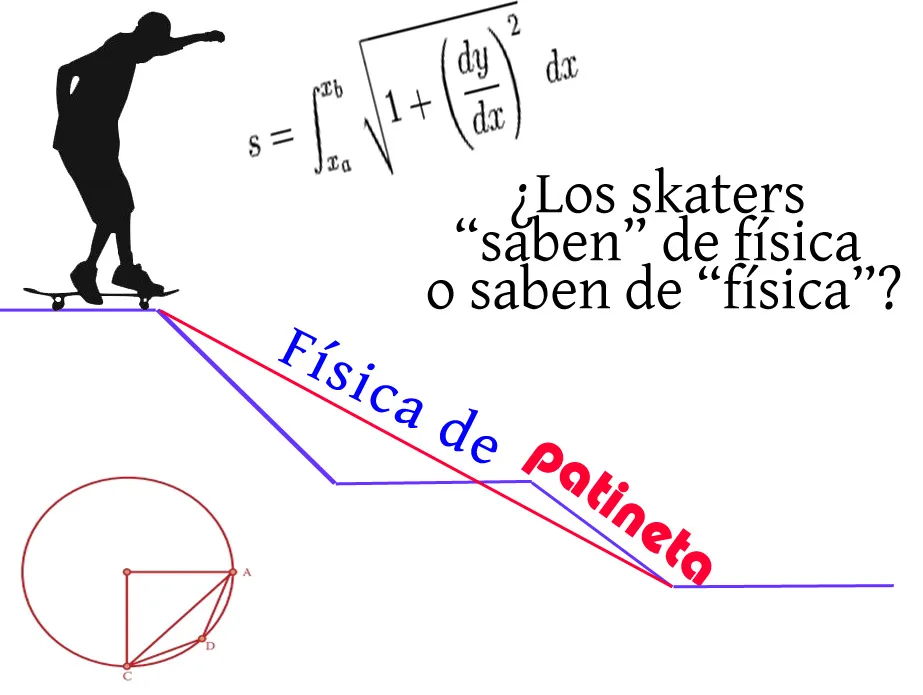
"A ball travels faster when sliding down a long inclined plane divided into two sections separated by a flat section compared to a shallower slope without divisions."
People don't seem to realize this, but skaters or skateboarders do, according to psychologist Michael McBeath of the University of Arizona. As reported by the professional on November 5, 2011 at the annual meeting of the American Psychological Society, skaters use their motor memory to determine, intuitively, that an early descent creates a speed advantage.
"This is a difficult problem, even for physics teachers we questioned, but skateboarding experience improves speed estimates on slopes," McBeath indicated according to ScienceNews (#1).
The study was conducted among 122 high school students who were shown a diagram (similar to the one at the beginning of this post, see #1 ScienceNewsDigital), with a long line with two sections separated by a flat stretch and another shorter straight inclined line. Only 27% noticed that a ball would travel faster on the longer path. But some students, who practiced skateboarding, solved the problem correctly.
McBeath's team recruited 41 volunteers who had practiced that sport for at least six months in a park that has two slopes similar to those proposed earlier in the graphics. They were asked to go down one of those slopes in the fastest way and 75% chose the "bumpy" descent.
When given the same theoretical problem as before, 61% of the skaters solved it satisfactorily. Those who did so were the ones with the most experience on wheels.
The skaters would have chosen the fastest slope in the park because they knew, from previous experiences, which inclined plane was faster, suggested Barbara Tversky to ScienceNews. Challenging skaters with unfamiliar slopes could reveal ways in which their intuition is wrong, she pointed out.
The cycloid
A cycloid is a curve generated by a point on a circumference that rolls on a straight line. In the 17th century the mathematician Johann Bernoulli posed the following problem in Acta Eruditorum:
Given two points A and B in a vertical plane, what is the curve traced by a point on which only gravity acts, that begins at A and reaches B in the shortest time? It is the brachistochrone problem.
Earlier, Galileo Galilei had studied the problem in his Discourses and Mathematical Demonstrations Relating to Two New Sciences and his result is similar to the blue curve in the previous graphic. (#2)
As the story goes, Bernoulli already knew how to solve the problem at the moment he posed it. His answer was made known, along with four others (those of Newton, Leibniz, L'Hôpital and Jacob Bernoulli) and at the end he indicated:
"Nature always tends to act in the simplest way and thus allows here a curve to serve to fulfill two different functions..." in reference to the resolution given earlier by Huygens to the tautochrone problem, whose answer was also a cycloid. (#3)
On this topic, the Argentine mathematician and science communicator Dr. Adrián Paenza, in his program Alterados por Pi showed, together with Dr. Leonard Echagüe, how two balls fall down an inclined straight path and a cycloid. And then, in the same segment, he shows skaters, indicating the same thing as the American psychologist (probably because there were already similar studies at the time).
On theoretical and practical knowledge
In the July issue of PhysicsWorld (Volume 25, number 7, 2012) dedicated to physics and sport, there is an article by Robert P. Crease, Head of the Department of Philosophy at Stony Brook University and historian at Brookhaven Laboratory, titled "Sporting knowledge". (It can be accessed through physicsworld.com if you have an account, for free).
The article refers to the one published in Science News about the skaters. The underlying idea in that Science article seems to bother him: that skaters "know" physics, with the quotation marks relativizing the meaning of the verb, putting it in doubt.
However, the philosopher indicates that performing trajectories is not ballistics, swimming is not hydrodynamics and dancing is not mechanics. One discipline - art - involves knowing the kinetic possibilities of one's own body in the physical world. That knowledge is self-instructive (aided by tutors) and impossible without personal experience. The other discipline - science - involves knowing how abstract bodies move in abstract space and time.
Thus, the professor separates the meanings of "Movement" and "Motion".
And he adds that what he doesn't like is the tendency to think that one of these skills has priority over the other.
It is the old problem between practical and theoretical knowledge that throughout history has also taken other forms or words like the debate between a posteriori or a priori knowledge, or the dilemma between experience and intellect, or Platonically the ideas between doxa and episteme, or Kantianly, the difference between being and ought to be.
Confusing the senses of "knowing," and giving priority to the theoretical sense over the practical one reflects our adherence to ancient ideas that true knowledge is theoretical, Crease opines. And he concludes that the way to express the results is not that athletes "know" the laws of physics, with the quotation marks implying that they don't really know, that there is no true knowledge there. Instead, he proposes saying that athletes know the laws of "physics."
The first thing that went through my head when I read that article (which I recommend reading in full), is that I did not agree, but that I did adhere to that ideal of theoretical knowledge. That abstract knowledge allows solving many problems and not only those in which one has personal experience. It is more general, universal, comprehensive. Indeed, as indicated at the end of the article in Science News, if skaters had to answer about curves or slopes they don't know, their intuition would surely fail.
However, he is partly right. Theoretical knowledge is general, but abstract. Read a manual on how to ride a bicycle and then take one and try it and you will see that you fall (if there was no prior practice). Separating theoretical knowledge from practical knowledge makes sense as a study model. And furthermore, they complement each other. Here, for a previous edition of the Carnival of Physics, I talked about the shot put where theoretical knowledge indicated one thing, but in practice something else happened and we tried to see why that difference existed.
Thinking that one form is superior to the other contributes nothing. It is true that theoretical knowledge usually explains the whys. What is the best way to kick a ball so that its trajectory traces a curve, so that it curves, when taking a free kick? You might indicate that the sphere must be struck with the inside of the foot. A professional soccer player might add the type of movement that must be made with the leg. But why is that the best way to kick to achieve that result?
I cannot separate myself from the idea that knowing the causes is better than not knowing them. And I don't think most soccer players can answer that question. However, knowing the reasons does not mean we can execute the shot.
Those of us who think that theory is more important than practice may have quickly descended a slope without stopping to think.
By the way, what I just did is a movement, purely intellectual...
Note written for the XXXIII Carnival of Physics, in this edition hosted by The World of Ideas. To join and read the entries visit Gravedad Cero.
Sources and related links
- (#1) ScienceNews: Skateboarders rock physics, by Bruce Bower 3-12-2011; Vol.180 #12 (p. 10). Also at ScieceNewsDigital.
- PhysicsWorld.com: Sporting knowledge, by Robert P Crease.
- (#2) Discorsi e dimostrazioni matematiche, intorno à due nuove scienze, Galileo Galilei, at e-rara (PDF 80 MB); at Wikipedia; in HTML in English at University of Virginia; Curves with history, by Antonio Pérez Sanz; The best slide... or Galileo was not right, Antonio Pérez Sanz, in Revista Suma Number 53; The cycloid: a historical journey through its properties, Domingo Hernández Abreu, in Revista Unión, December 2007, Number 12 pages 115-134
- (#3) The brachistochrone problem, J J O'Connor and E F Robertson.
About the images
- The initial image includes a drawing by cmtp on Stock.xchng.