A collection of links to music, images, and videos that relate art and science. Today: Images of Footprints on another world; RCW38; Noctilucent clouds; Messier 17. Music: Apollo 11. Video: A small step.

Images of the decade
Footprints on another world
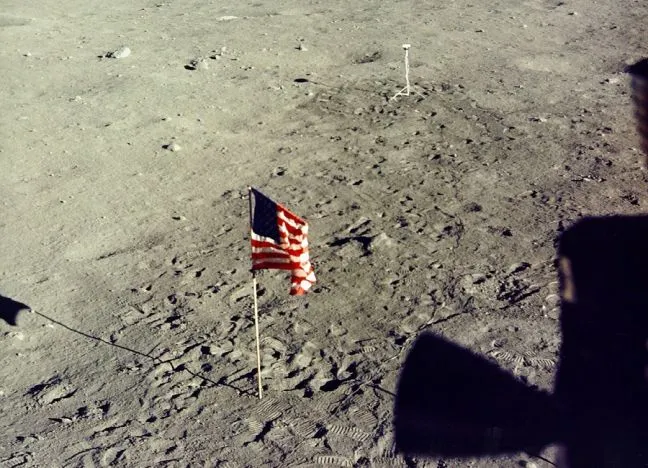
On July 20, 1969, human beings set foot on the Moon for the first time.
Taken from the window of the Apollo 11 lunar module, the Eagle, this image shows the footprints in the lunar dust made by Neil Armstrong and Buzz Aldrin.
The Apollo missions to the moon have been described as the result of a great technological and human mobilization in history.
By the way: the flag does not "wave", it only appears to. We will see the flag almost always the same in all the photographs (See photos: AS11-40-5874 and AS11-40-5875 or AS11-40-5885) at Apollo 11 Multimedia. Note the perpendicular bar on the mast that holds the flag.


I recommend reading La conspiración lunar ¡vaya timo! by Eugenio F. Aguilar, Laetoli publishing.
Credits: Apollo 11, NASA
It was NASA's Astronomy Picture of the Day (APOD) on July 20, 2002. And at Observatorio.
Star-forming region RCW38 from 2MASS
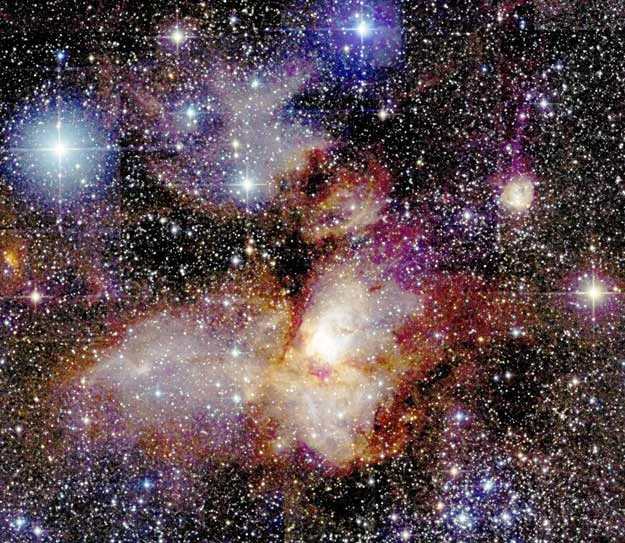
The star cluster in RCW38 was hidden.
Looking at the star-forming region RCW38 does not reveal most of the stars in this cluster.
The reason is that the open cluster is so young that it is wrapped in a thick layer of dust that absorbs visible light.
Viewed in infrared light, in fact, many stars in RCW38 can be observed, because dust is less effective at absorbing infrared light.
The top color image is a mosaic of RCW38 taken by the 2MASS survey in infrared light and shows not only many bright blue stars of the cluster but also bright emission gas clouds and spectacular fields of dark dust.
RCW38 spans about 10 light-years and is located 5500 light-years away in the constellation Vela.
Credits: R. Hurt,2MASS Project, UMass, IPAC/Caltech, NSF, NASA
It was NASA's Astronomy Picture of the Day (APOD) on July 17, 2002. Also at Observatorio.
Images of the week
Polar mesospheric clouds in Frischborn, Germany
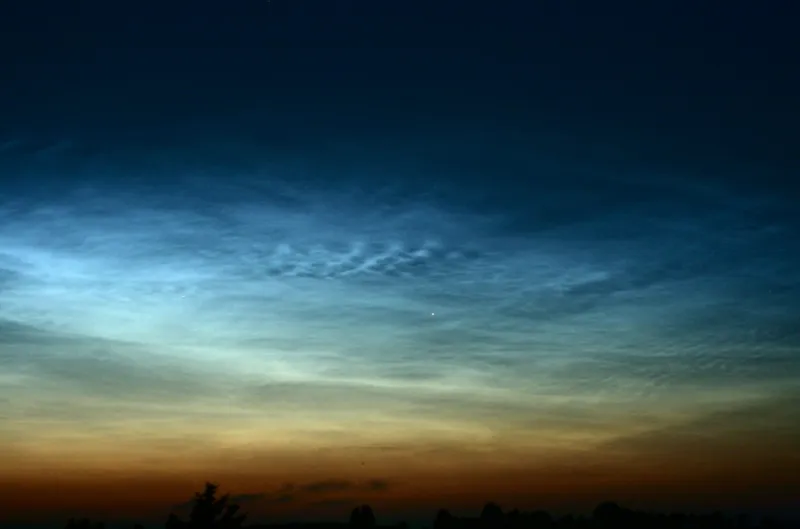
The record is from June 26 of this year. Karsten Möller saw these formations overhead and quickly ran after his Canon 400 Da to capture them.
They are called noctilucent clouds or NLC.
Credit: Karsten Möller.
It was the Amateur Astronomy Picture of the Day (AAPOD) on July 16, 2012.
An audience of stellar flashes
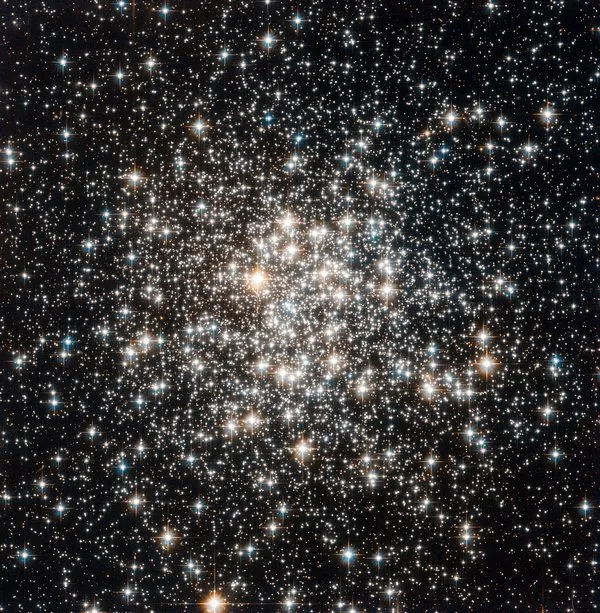
The image could be interpreted as thousands of attendees at a concert, in a dark stadium, just as the band makes its appearance and the audience illuminates the scene with the flashes of their cameras.
But it is Messier 107, one of the more than 150 globular clusters found around the galactic disk. This spheroidal collection of stars contains hundreds of thousands of ancient stars. But there are much denser groupings, like Messier 53 or M54. The object is in Ophiuchus, about 22,000 light-years away.
It was the Space Telescope Image of the Week.
Space Music
Today: Apollo 11
Here I leave a selection of eleven tracks about the first of the six successful missions that landed on the moon.
Animated Science
A small step
One small step is the title of a short film by Damien Slevin. Both on the author's site and in the video on Youtube, the synopsis indicates that on July 24, 1969 man reached the peak in the effort to reach the Moon, only to affirm that it is just a lifeless desert...
In this regard, it should be noted that the Apollo 11 mission landed on the lunar surface on July 20 (20:17 UTC). Neil Armstrong stepped on the moon a few hours later. And the mission returned to Earth on July 24. And yes, it is a "desert" or, as Buzz Aldrin noted, a "magnificent desolation".
The animator was Nathan Jones and the music is by Simon Gruer (Avrigus).
In addition to being able to watch the video on YouTube, it is also on Vimeo and on Slevin's site you can also see a presentation with the storyboard, as well as a "comic" version.
To access previous editions of this section, consult the Multimedia Selection Series. The series attempts to show that the immensity of the universe can be perceived in different ways. I choose some images from a decade ago -so they don't fall into oblivion- and from the current week that ends, as well as sounds/music and videos that are artistic forms of expression with content related to astronomy and related sciences.