A collection of links to music, images and videos relating art and science. Today: Images of NGC 1569; Our busy space neighborhood; NGC 4700; The Gyulbudaghian nebula. Music: The Solar System. Video: Unearthed.

Images of the decade
NGC 1569
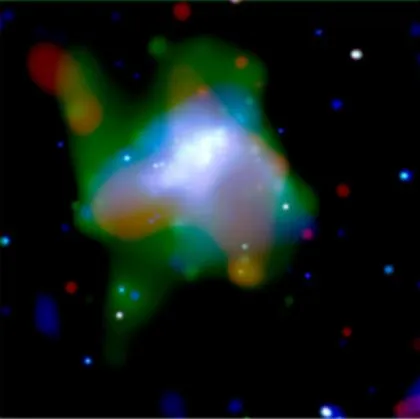
This image corresponds to a dwarf galaxy 7 million light-years away from Earth. It was captured with the Chandra X-ray Observatory and the image shows two large bubbles or lobes above and below a disk of gas at the galaxy's equator. The 27 hours of observation allowed astronomers (led by Crystal Martin of the University of California) to measure for the first time the concentration of oxygen, neon, magnesium and silicon in those bubbles and the disk. They found that the bubbles contain as much oxygen as in 3 million suns.
In the last 10 million to 20 million years, NGC 1569 has had great star formation and supernova activity, perhaps generated by a collision with a large gas cloud. Supernovae expel oxygen and other heavy elements at high speed, heating the gas in the galaxy and forming bubbles.
Dwarf galaxies are much smaller than ordinary ones, like the Milky Way. Due to their size, they have relatively less matter and gravity so gas can escape more easily. This property, combined with the fact that dwarfs are the most common galaxies in the universe, makes them key objects for understanding how the universe was seeded with the various elements of the periodic table.
Credit: NASA/CXC/UCSB/C.Martin et al.
The image was published on the Chandra site on July 23, 2002. It also appeared on NASA APOD and on Observatorio.
The crowded Solar System
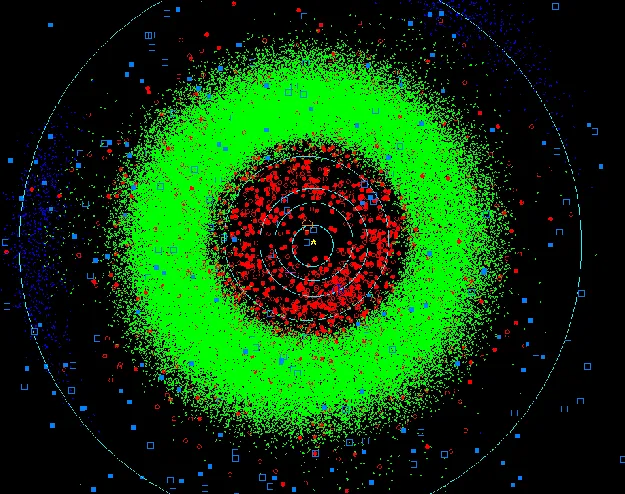
What is the solar system composed of? We can point out the inner planets. Before we listed nine, now eight, plus the dwarf planets. We add their corresponding moons, asteroids, comets. The graphic shows the known objects in the solar system as of July 20, 2002. The light blue lines mark the orbits of the planets. The red dots are asteroids less than 1.3 Astronomical Units from the Sun. The dark blue squares are comets and the dots of the same color are Trojans, asteroids in Jupiter's belt.
Credit and Copyright: MPC, CBAT, Harvard CfA, IAU.
It was NASA's Astronomy Picture of the Day (APOD) on July 24, 2002. And on observatorio.
For a current graphic, see on MPC.
Images of the week
NGC 4700
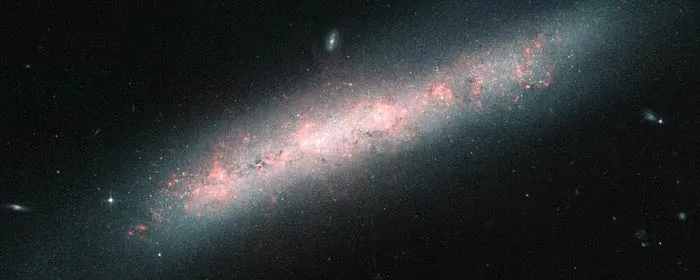
The galaxy NGC 4700 is forming many new stars. The pink clouds are H II regions, where the intense ultraviolet light from young stars causes the surrounding gas to glow. In 1610 the French astronomer Nicolas-Claude Fabri de Peiresc found the first recorded HII region: The Orion Nebula. NGC 4700 is a barred spiral galaxy, in Virgo, about 50 million light-years away.
It was the Hubble Space Telescope Image of the Week.
Credit: ESA/NASA Hubble.
The Gyulbudaghian nebula
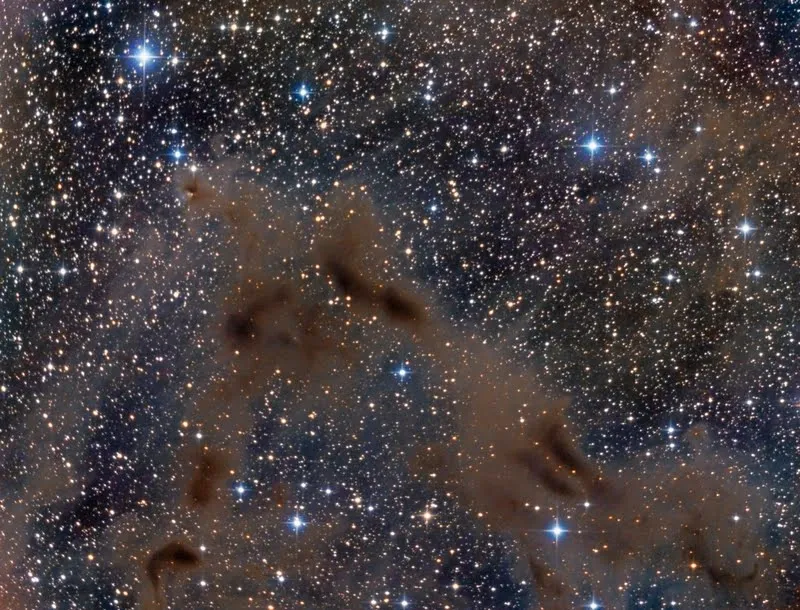
This is a Herbig-Haro object (HH 215). It is a bipolar and variable nebula generated by shock waves from a contracting protostar, PV Cephei, in Cepheus. The name of the nebula honors the Armenian astronomer who discovered the object in 1977. It appears in the Beverly Lynds catalog, known as Lynds Bright Catalogue of Bright Nebulae or LBN with the number 468 and also as GM 1-29 (for the Armenian astronomer and his Russian colleague Magakyan).
Given the variability of the object, it is sometimes possible to undertake the task of observing and recording the nebula with telescopes within reach of amateurs.
In this case, the image was acquired on June 24, 2012 from Spain with a Newton 200 F4 and Atik 383L+ by Toni Mancera.
It was the Amateur Astronomy Picture of the Day (AAPOD) on July 23, 2012.
Space Music
The solar system
From SoundCloud, Mushrooms Season offers us this set of tracks about our cosmic neighborhood.
Animated Science
Unearthed
In the near future the world is a chaos where humans have consumed almost all natural resources. In search of a solution the mining ship Ezekiel finds an unknown planet that could have exploitable resources. Two astronauts explore that desolate rocky world. There, they will unearth the unexpected...
The short film was made by Lindsay Harris and Stuart Leach and produced by Dalang Films. With music by Wilfredo Acosta.
The dialogues are in English, but you don't need to know that language to understand the plot, similar to Planet of the Apes.
To access previous editions of this section, consult the Multimedia Selection Series. The series attempts to show that the immensity of the universe can be perceived in different ways. I choose some images from a decade ago -so they don't fall into oblivion- and from the current week that ends, as well as sounds/music and videos that are artistic forms of expression with content related to astronomy and related sciences.