A collection of links to music, images and videos relating art and science. Today: Images of M1; Proxima Centauri; the Cat's Paw Nebula; the Alnitak region. Music: Proxima Centauri by KLINK. Video: Encounter on Planet X.

Images of the decade
The Crab Nebula from the VLT
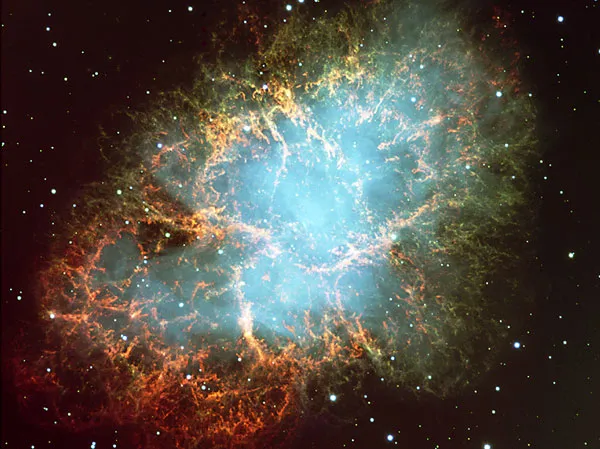
The first object in the Messier catalog (M1), full of mysterious filaments, is the result of a star that was seen to explode in the year 1054.
This spectacular supernova was recorded by Chinese astronomers and very probably by the Anasazi Indians.
The filaments are a mystery because they seem to have less mass than what was expelled by the original supernova and more speed than could be expected from a spontaneous explosion.
In the photo above, taken recently by a Very Large Telescope, the color indicates what is happening to the electrons in different zones of the Crab Nebula.
Red indicates that the electrons are recombining with protons to form neutral hydrogen, while blue indicates that the electrons are spinning around the magnetic field of the inner nebula.
Right at the center of the nebula lies a pulsar (PSR0531+121): a rotating neutron star, in this case, 30 times per second.
The object lies in Taurus at about 6,300 light-years away.
The record was one of the first achieved with the FORS2 instrument. The acronym comes from FOcal Reducer and Spectrograph. The first of them was installed in 1998 on the VLT, at the Cassegrain focus of the first unit (called ANTU). The twin instrument (similar, but not identical), FORS2, was installed the following year on the Kueyen unit (on Antu since 2004). On November 17, 1999 ESO published a series of photos that demonstrated the capabilities of these instruments. Among the images presented was a time sequence of the Crab Pulsar. That observation had a total exposure of 2.5 seconds. During that short interval the image of the rotating neutron star was recorded 2048 times on the CCD chip. Each individual exposure lasted then 0.0012s. That resolution was limited by the transfer rate capability of that chip, which was later changed for a faster one.
This image of Messier 1 corresponds, then, to the first light of FORS2 on October 29, 1999, published in a press release (eso9948) in November of that year and in The Messenger No. 98 (December 1999). In issue 94 of that publication appears the first light of the first instrument and photos of it.
Credits: FORS Team (the scientist in charge is Ivo Saviane), 8.2-meter VLT, ESO
It was NASA's Astronomy Picture of the Day (APOD) on July 14, 2002. And on Observatorio.
Proxima Centauri: The Closest Star
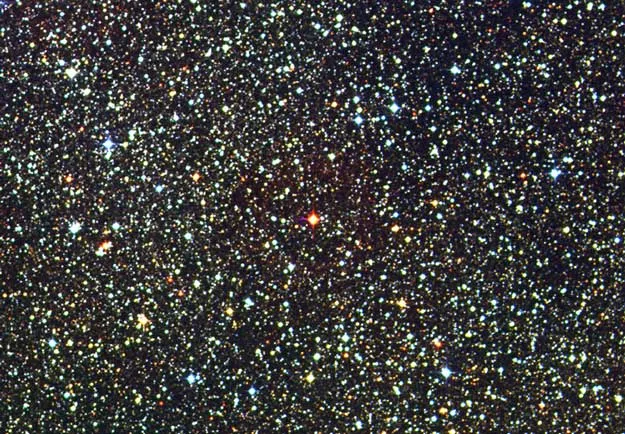
Proxima Centauri is the closest member of the triple star system Alpha Centauri.
Light takes only 4.22 light-years to reach us from there.
The small red star, captured in the center of the image above, is so faint that it could only be discovered in 1915 by British astronomer Robert Innes, through a telescope.
In the background, stars of all kinds from our Milky Way Galaxy can be seen.
The brightest star in Alpha Centauri is similar to our Sun, and has been known throughout history as the fourth brightest star in the night sky.
The Alpha Centauri system can be seen mainly from Earth's Southern Hemisphere.
Credit & Copyright: David Malin, UK Schmidt Telescope, DSS, AAO
It was NASA's Image of the Day (APOD) on July 15, 2002. In Spanish on Observatorio.
Images of the week
The Cat's Paw Nebula, re-edited
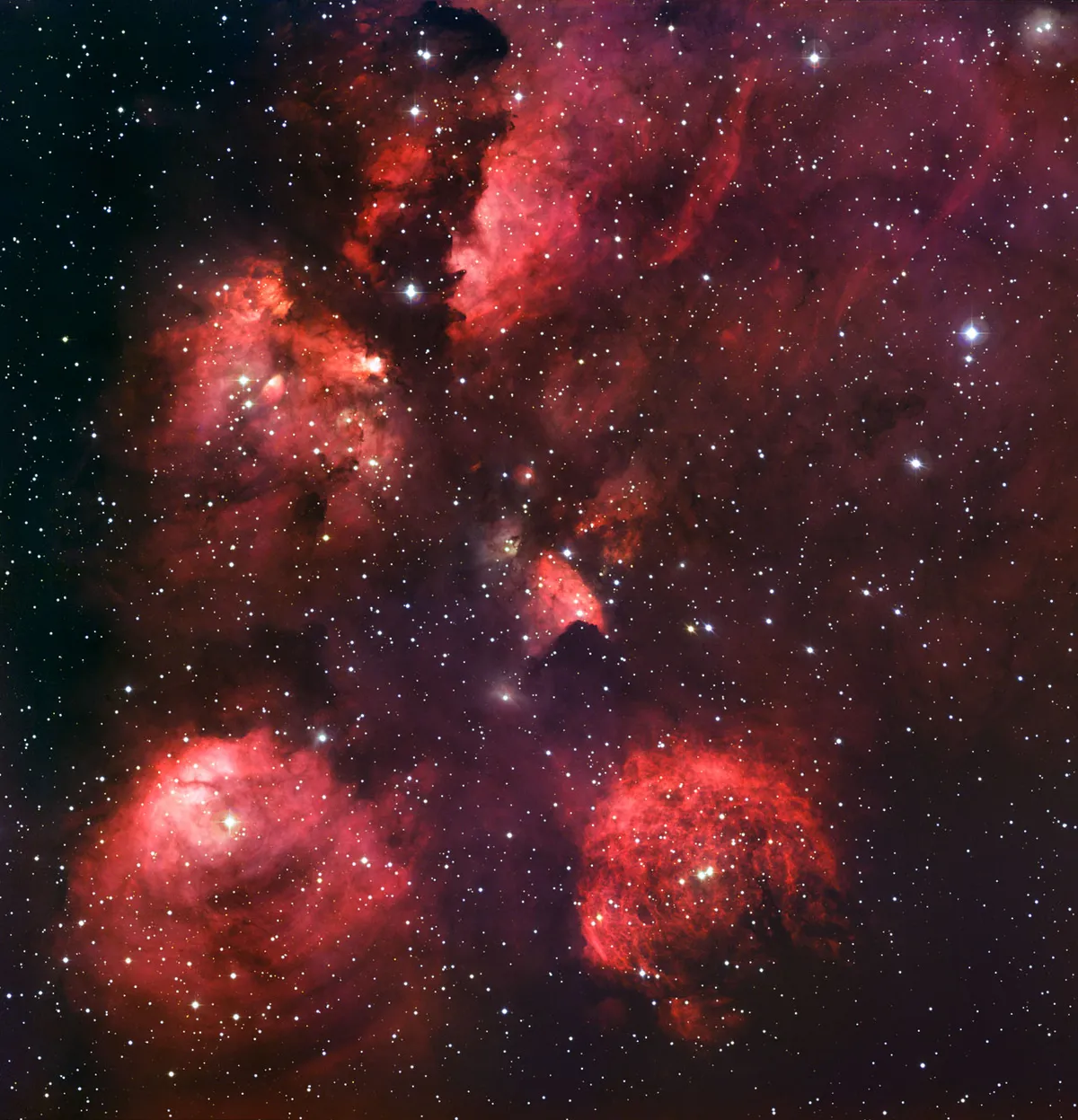
The well-known emission nebula in Scorpius (NGC 6334) was re-edited with a combination of exposures from ESO's MPG telescope and shots taken by amateur astrophotographers Robert Gendler and Ryan Hannahoe. The ESO images of that vast star-forming region, 5,500 light-years away, were taken with the WFI instrument at La Silla and published in January 2010. The resolution of these images was combined with the colorful information provided by dedicated amateurs who performed 60 hours of exposure on a 0.4m telescope.
More information on Robert Gendler's site.
Credits: ESO/Gendler&Hannahoe
It was the ESO Picture of the Week.
The Alnitak region in Orion
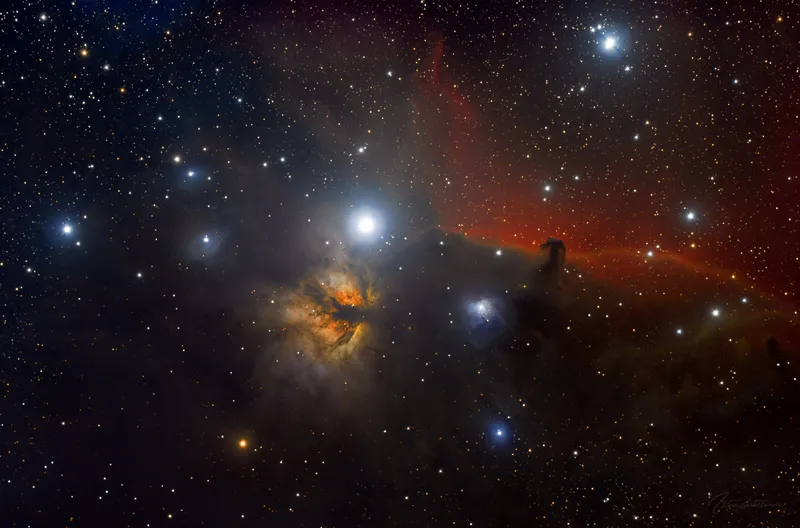
In this nebular landscape we can observe the region near Alnitak (Zeta Orionis, one of the "three Marys") in the constellation Orion. In that area lies the Flame Nebula cataloged as NGC 2024 and the Horsehead Nebula (Barnard 33) visible by contrast with the emission nebula IC 434. The objects are located, approximately, about 1,000 light-years away.
The record was made with a William Optics Triplet FLT-98 + a Canon EOS 1000D by Jaime Soria from Omeñaca on November 26, 2011.
It was the Amateur Astronomy Picture of the Day (AAPOD) on July 14, 2012.
Space Music
Proxima Centauri, by The Ruu
Kamil Linkiewicz, The Ruu on Soundcloud or K.LINK on Bandcamp, is a Polish artist who is composing his first work, Fist Assault, whose second track refers to our stellar neighbor.
Animated Science
Encounter on Planet X
An animated short by Tom Bland. The work was a finalist at the SHORTSNONSTOP festival in April of this year.
The closest star system, as we said before, is Alpha Centauri. There, as far as is known, there are no planets. But there are in other parts of the universe. Hopefully, if other beings exist, they do not behave as we do here on Earth.
To access previous editions of this section, consult the Multimedia Selection Series. The series attempts to show that the immensity of the universe can be perceived in different ways. I choose some images from a decade ago -so they do not fall into oblivion- and from the current week that ends, as well as sounds/music and videos that are artistic forms of expression with content related to astronomy and related sciences.