How is astronomical work communicated in a virtualized present?
The discursive preponderance of objects transforms them into acting subjects, relegating human work. Today, the stars are the photographs and the telescopes. A point of view on astronomical communication.
Don't you perceive a parallel between the destinies of men and of images?
by Adolfo Bioy Casares in La invención de Morel (Colihue)
This man worked, who will write his history by Adrián Abonizio, in El Témpano.
In the first part of this note, I pointed out that today we live in a virtualized world. We can access our workplaces remotely through different devices. We have the possibility to connect with the world through the internet. Many computing tasks allow for process automation. Astronomy is not outside these new forms of production. The astronomer has acquired other types of roles: they are no longer in a cage of a huge telescope all night so that starlight impregnates a plate with photosensitive emulsion. Researchers can access observatories remotely and their result is no longer tangible elements, but binary data stored in relational databases.
It's not that the researcher is now less important than before, but that they perform other tasks or the same ones but in a different way.
How does communication influence this context?
On one hand, I showed, very succinctly in the first part, that many press releases from the world's major observatories, invisibilize the astronomy professional, giving preponderance to instruments and binary data. It is the telescopes that observe. It is thanks to them that results are achieved, the communications tell us.
But I also pointed out that, on the other hand, those analyses should not remain in the catchy headlines. And that there are some differences between press releases and the publication of images.
In the former, although importance is given to the instruments, astronomers are present in the discourse. It is they who, using the telescopes and analyzing the data, reach conclusions. However, an emphasis on how wonderful the instruments are is perceived in the discourse. The other issue is linked to binary data, transformed into images.
2. The issue of images
On SpaceTelescope, as well as on ESO and other observatory websites, they have sections for scientific communications as research (press releases) and another for Images of the Week.
Let's look at some examples.
2.1 SpaceTelescope
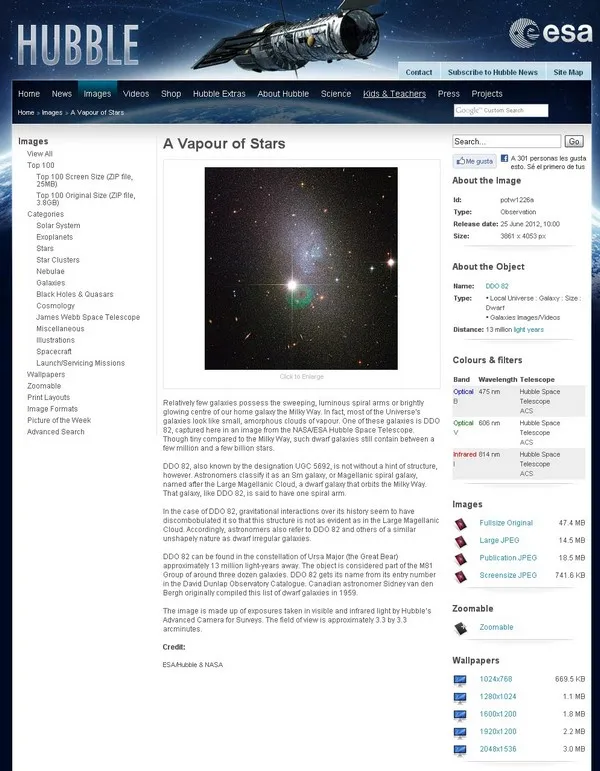
"A Vapour of Stars" is the title of the photo of the week on SpaceTelescope on June 25, 2012. (http://www.spacetelescope.org/images/potw1226a/)
In the text, an object (DDO 82) is identified, minimally characterized, and its approximate distance to Earth is indicated.
The credit indicates: ESA/Hubble & NASA.
On the right side, object data, image type, size, publication date are indicated. Then color and filter data are noted (used in Hubble's instruments) and downloading the image in different sizes is allowed.
Why was this "photo" taken? Who is responsible for this image? What was the goal of achieving this impression?
None of that. No people are mentioned, except Sidney van den Bergh, compiler of the DDO catalog. The noun "Astronomers" is used, to explain that "they classify (that object) as an Sm galaxy".
Is there no person associated with this image?
Well, yes there is. Of course, the technicians who operate the instruments. But also, these telescopes are directed to previously established areas through a process in which researchers present proposals that are evaluated by other peers. There is a scientific objective. The same in the case of the Mercury photo. Then it is possible that a special editing of the data is done so that the photo comes out "pretty" and a popularization text is added, but the scientific objective is always present. In this blog, I commented on that image in Multimedia Selection 2012-26 and indicated there some scientific references to the image.
2.2. ESO
The European Southern Observatory (ESO) is one of the Northern Hemisphere organizations that has gained a foothold in the Southern Hemisphere. Its press work is formidable, as I have pointed out here other times.
On its site we find press releases like the one titled "The VLT telescope brings us closer to NGC 6357", from 20-06-2012. Note the same as before: The acting subject is "The VLT telescope" and what it does is "bring us closer".
In the text, in this case, the mention of researchers is omitted, although John Herschel, who observed the object (NGC 6357) in 1837, is included.
If we go to see the images individually, we will also have data about them: type, date, size, object type, distance, colors and filters, various sizes for download.
The second image is a drawing. The third, another photo, includes as credit a person: Davide De Martin. Coordinates and orientation are also indicated in this photo.
But in many other cases, of press releases, the astronomer does have a place, as in "New way to study exoplanet atmospheres" from June 27. There clearly appears "The principal investigator of this work, Matteo Brogi (Leiden Observatory, The Netherlands)".
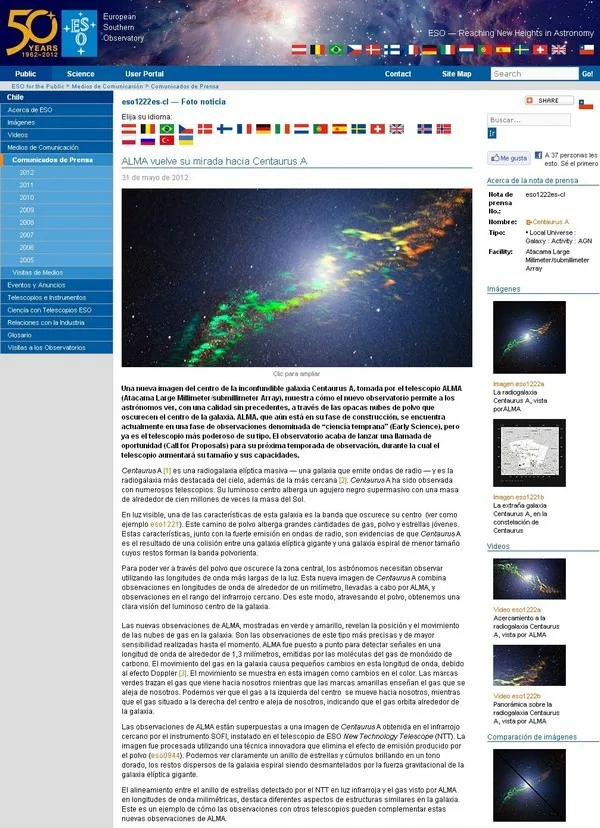
But this form of elision of the astronomer is quite common especially in image publication. Let's see other cases:
"ALMA turns its gaze towards Centaurus A", from May 31, 2012. The subheading includes the following statement: "A new image of the center of the unmistakable galaxy Centaurus A, taken by the ALMA telescope (Atacama Large Millimeter/submillimeter Array), shows how the new observatory allows astronomers to see, with unprecedented quality, through the opaque dust clouds that obscure the center of the galaxy."
The image was taken BY the telescope. Note: What shows is the image that was taken by a telescope. What it shows is how the new observatory allows astronomers to see.
2.3 Chandra
Let's see another example, this time on the Chandra Observatory site:
"V1647 Ori: X-raying the beating heart of a newborn star" is the title of an image published on that site on July 3, 2012. As in other cases, besides the image (whose page has a variety of data) there is also a link to a press release on the matter. As on the other sites, the press release does tell us about an author, a scientist who conducted research.
But on the Chandra site, furthermore, the image pages have information about people.
On those pages we will see an initial image that for some time now includes basic questions and answers: what it is, how far away the object is, how big it is, where it is located, what the colors mean.
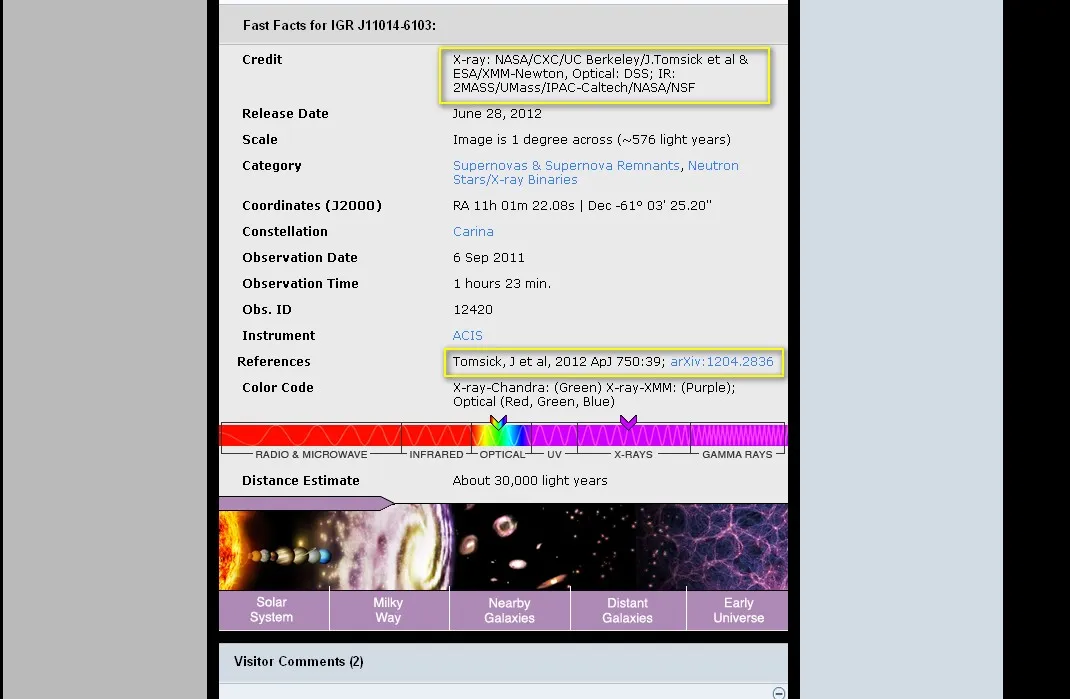
In the cited case, instead of that data, a video is included. Note how the credit includes people (K.Hamaguchi, et al). In the text, "astronomers" is mentioned (2 times) and team. Although these are general forms, below the credits, coordinates, observation dates, instrument, references (which implies scientific publications) are indicated.
It's not a coincidence: it's a custom of the site. Let's see another case:
"IGR J11014-6103: Has the Speediest Pulsar Been Found?" was published on Chandra on June 28, 2012. It talks about "researchers" and "astronomers", also as general forms. But at the same time, within the text it is noted that the results were published in a journal with the list of authors and below the references are indicated.
Images and metadata
Another issue with images is that in many cases the file does not have specific information about the object. It is common to use images as desktop backgrounds, but in that use, astronomical objects are nothing more than beautiful landscapes without references. The file names also do not allude to an object. See what data about the objects the images for download as "wallpapers" on HubbleSite have.
On Chandra, on the other hand, many of the photographs are labeled with overlaid text.
At ESO, several images have metadata, so there is no need to "intrude" on the image itself through overlaid text. It's another topic, which I have commented on here before (The DNA of astronomical images).
Conclusion
Publications on sites like ESO, HubbleSite, SpaceTelescope, and Chandra provide us with information about scientific research in astrophysics.
Their details allow us to learn about news and also learn concepts and methodologies. But these discourses also create meaning, reality.
George Berkeley thought that only "things" that are perceived exist. To be is to perceive or to be perceived, Esse est percipi. I do not adhere to that position from an ontological point of view. But it is clear that "for us" that which we have knowledge of exists. Ergo, we will not think about those we are ignorant of.
It is logical, on the other hand, that observatory websites emphasize the instruments. Men and women pass, observatories remain. Furthermore, these facilities require money, funding, maintenance. Showing how wonderful they are, in part, must have that objective.
If press releases account for the professionals, with first and last names, it is also true that they omit people by using general forms like "astronomers" or "researchers".
Independently of press releases, there are image publications in which not only is the presence of astronomers omitted discursively, but they are directly invisibilized. What prevails are the data and the acquisition mechanisms, to such an extent that the subjects are the objects.
These communications reach the general public. In CAP Journal issue 12 there is an article by Oli Usher, Oana Sandu and Lars Lindberg Christensen titled "How Do We Know What Works?". There they point out that communications on SpaceTelescope or ESO are efficient, meaning they reach a large number of people, as emerges from an analysis conducted with tools like Google Analytics. (#4)
The sites of large observatories like ESO, Chandra, NASA, SpaceTelescope, HubbleSite do formidable press work. It is a necessary task in a globalized and hyperconnected world where more and more people have access, both to inform themselves and to produce discourses.
But I also detect these ways of omitting professionals. Images exist for concrete reasons. There is no doubt about the importance of the instruments, but we cannot fail to say that there, always, are people. It is the men and women who turn this wheel. The Chandra Observatory site shows that it is possible to make indications about the authorship of the images, even if they are not press releases.
The astronomical communications of the large observatories deserve, at least for these reasons, a deeper analysis. Those who run the websites and create those discourses are capable people who, perhaps, will heed this call for reflection on these points. If those communications constantly talk to us about observations, perhaps we also need to observe our discourses. And this last line is, clearly, self-criticism.
Sources and related links
- #4: How Do We Know What Works?, Oli Usher, Oana Sandu, Lars Lindberg Christensen, in CAP Journal 12 (May 2012), pp. 9-12.
About the images
- Fig. 1-3: Screenshots of the SpaceTelescope, ESO, and Chandra sites, respectively.